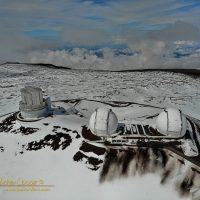
Governor Ige signed the new public access rules, drones would be illegal on the summit in ten more days.
Keck and Subaru in the snow atop the summit of Mauna Kea
With a deadline looming much sooner than I had contemplated there was a narrow window of opportunity. While I had wanted to fly the summit for a long time, I now had a few short days in which to do so. On January 23, 2020 the new rules would take effect.
The Office of Mauna Kea Management has attempted to restrict drone use on the summit by posting signs that drones are not allowed. Problem, they did this with no legal authority to do so. In conversations with OMKM staff I had pointed this out and received a quiet admission that it was true.
The new public access rules would change this… Flying a drone would be specifically prohibited on the science reserve, a civil offence with steep fines involved. With the governor’s signature those rules would be in force.
Today is February 29th, that odd date that only occurs every four years.
The reason for a leap day inserted into the calendar, the existence of February 29th, is ultimately astronomical. Perhaps a little explanation is in order…
We originally defined days as the time it takes the Earth to rotate. While we define years as the time it takes the Earth to orbit once around the Sun. The problem is that these values do not divide evenly into one another.
Sunrise seen from the summit of Mauna Kea
The Earth takes about 365.24219 days to obit the Sun, when measured by the Sun’s position in the sky, what is called a tropical year. There are different ways to measure a year, but if one is concerned with keeping the seasons in sync with your calendar, then you are interested in tropical years.
It is that bunch of decimals, the 0.24219 etc., that is the problem, every four years the count drifts out of sync by roughly one day. The insertion of an extra day every four years helps bring the calendar back into synchronization with the orbit of the Earth and with the seasons.
Even leap years do not quite fix the problem as 0.24219 is close, but not quite 0.25 or one quarter of a day. Thus additional corrections are needed… Enter leap centuries.
Our current calendar was instituted by Pope Gregory XIII in 1582, setting up a standard set of corrections for the fractional difference between the length of a year and the length of a day. Scholars knew that errors had been accumulating in the calendar for centuries, resulting in a drift of several days.
Religious authorities were concerned that this drift had displaced important celebrations in the church calendar, in particular the celebration of Easter. After much argument it was decided to reform the calendar. The current solution was devised by a number of astronomers, including Aloysius Lilius, the primary author of the new system.
The Gregorian Calendar uses an extra day in February every four years, unless the year is divisible by 100, then there is no leap leap day that year. However, if the year is divisible by 400, then it is a leap year. While this may sound odd, it does create a correction much closer to the ideal value of 365.24219 days per year.
I am a geek, so let us put that into code…
1
2
3
4
5
6
7
8
9
10
if(year modulo4=0)then
if(year modulo100=0)then
if(year modulo400=0)then
leap=True
else
leap=False
else
leap=True
else
leap=False
Even this is not perfectly precise. The correction is close but will drift given enough time. The length of a tropical year also changes slowly over time. We will eventually have to add another correction to keep the calendar and the seasons in sync. But not for a few millennia, good enough, for now.
As 2020 is divisible by four and not divisible by 100, there will be a leap day added to the end of this February… Today.
Along with the sway bar links there was an EGR valve in that box of parts that arrived a couple weeks ago. This weekend that valve was replaced.
Replacing an EGR valve on the 2006 Explorer
Again I hit the YouTube auto manual before doing the job in order to size up exactly what would be needed. Ouch! That does not look fun. Indeed the videos made it look like a real knuckle buster to get out.
In one video the mechanic has to pound away with a mallet and breaks a 10mm socket in the process of removing the valve body bolts.
Unfortunately I have had to destroy my banana patch.
The back yard banana patch has been leveled
The patch of plants in my backyard was a venerable Keck lineage, starts passed down from one employee to another over the decades. They were the treasured apple bananas so popular in the islands.
I long ago lost count of how many bunches this patch produced, so many small bananas eaten or shared. The little tart tasting apple bananas are an island delicacy. From fresh to dried, or in smoothies we enjoyed this tropical treat from our own yard.
Given the rather high cost of auto service in the islands I tend to do the basic and easy stuff myself. Oil changes, brake pads, even the occasional wheel bearing.
The vehicle up on axle stands while replacing the sway bar links
When I did that bearing I noted the brakes were just fine and the new brake pads ordered at the same time had remained sitting on the shelf.
There the pads have sat for over two years. So a week ago I inspect the brakes again and find out the brakes are fine.
It was a busy night at Kaʻohe, with well in excess of the ten people we are allowed without a permit. I am quite glad I did stop in our local DOFAW office and get the needed permit.
A one day old crescent Moon set over Hualālai
After several weeks of storms the last week has been beautiful weather. A Saturday came I worried the spell of weather would not hold… It did.
As we see so often there was an overcast sky on the side of the mauna when we arrived, a layer of clouds that dissipated shortly after sunset leaving a perfect sky for the remainder of the night.
As we waited for the clouds to clear we set up gear, chatted, introduced folks that had not met, and watched a one day old crescent Moon set over Hualālai.
We had a bunch of Keck folks there, Josh and Harriet, John and Stephanie, Sky, Cliff, Andrew, Philip, and the whole crew Dave Kriege brought along
I brought out my 18″ Deep Violet for the night, best to enjoy a very dark sky and to hunt faint fuzzies in Monocerus and Orion.
My observing list for the night was a collection of objects between 6 and 7 hours right ascension and +10 to -10 declination. I printed out a list of objects I had never observed in the area using my ObsList tool. The area is in the winter Milky Way so this list is mostly open clusters and nebulae.
And observe we did… A great night. Clear and calm, a night for wandering amongst the galaxies.
NGC 2149 A small reflection nebula centered on a 12.7 magnitude star, about 2′ across, faint, fading evenly away from the star
Sh2-282 An extraordinary field, very rich galactic starfield with a couple obvious faint and very rich clusters (NGC2262 and Collinder 110) the area is rich in faint nebulae seen as dark and bright areas in the field
NGC 2143 Large 10′, coarse, fully resolved, a clump of brighter 9-11 magnitude stars in a right starfield, centered on a half dozen brighter members
Andrew Cooper, 26 Jan 2023
Just one of the idyllic nights Kaʻohe can supply for an amateur astronomer. I really need to get up here more often.