
Postcard from the Universe – Scutum & M11
When you want to see the stars, find someplace dark

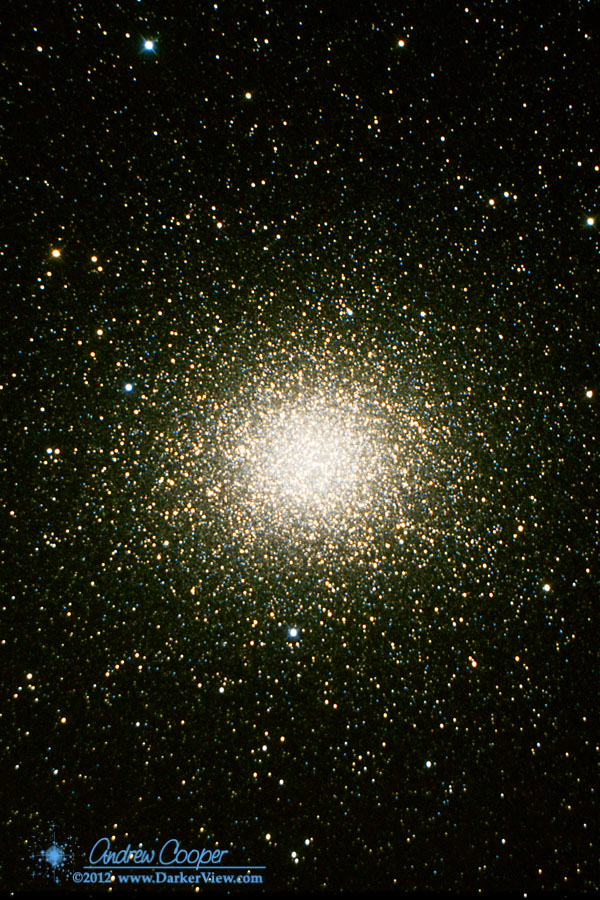
A better image of comet C/2001 L4 PanSTARRS. The comet is moving slowly near the north celestial pole, still a nice object for observation through much of the night for any northern hemisphere observer.

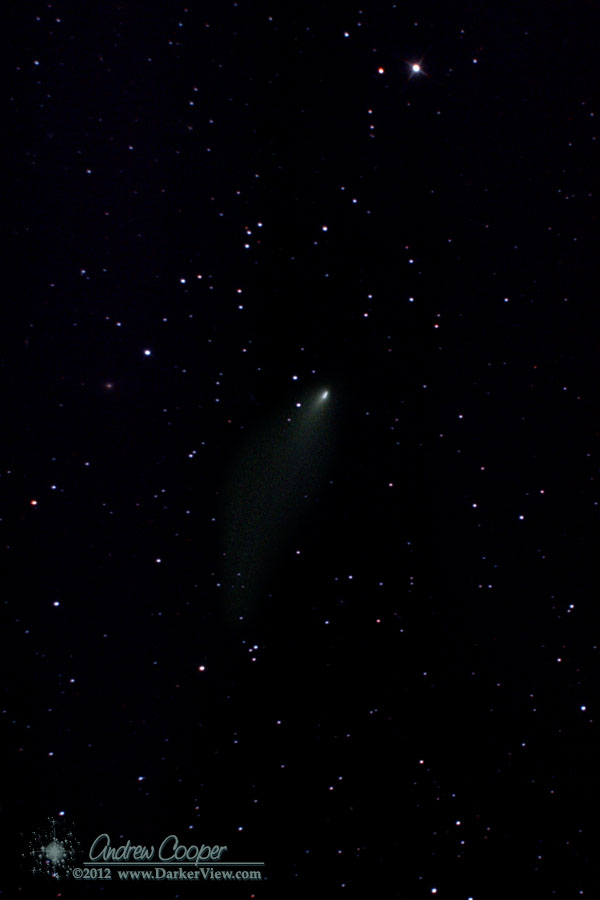
Now for a truly awful comet image.

It had been wonderfully clear all afternoon. It was just as the sky darkened that trouble appeared, a band of high clouds sweeping in from the west. Noooo!
The comet appeared in the STi guide camera right on schedule, my coordinates less than half a degree off! Not bad with a manual telescope mount offsetting from the Sun. The clouds swept over the comet a few minutes later, just as the tail was beginning to appear in the darkening sky.
I did grab a few images from the guide camera and snap a few frames with the DSLR. The monochrome CCD on the guider managed slightly better shots despite a fairly bright sky. I managed a few more frames as an opening appeared a few minutes after that. It is still an awful image. The only reason I could tell it was the comet is that it remained centered as the clouds swept through the image. Take my word for it, the barely there spot at the center of the photo is the comet.
At least my vehicle is fixed, a new alternator in place. Try again tomorrow?
Another product of imaging earlier this week. Comet C/2012 K5 (LINEAR) is fading, but still bright enough to image. Right beside Orion it was well placed to target from my driveway. Just refreshing my comet hunting skills, getting ready for the show over the next few months as C/2011 L4 (PanSTARRS) comes into view.
In the few days I had the camera I was determined to acquire some astrophotography test shots with the EOS-M camera. Even if it meant getting up at 3am to have some dark sky after moonset. It would have been easier a few days before, but a Pacific storm system had provided several days of overcast with occasional rain. This particular morning was just about perfect, clear skies, decent seeing and no wind to bounce the telescope around.

The result is an f/7 optical system with 1080mm focal length. This gives a field of view of about 72×48 arc-minutes (1.2 x 0.8 degrees) on the sky when using a camera with an APS-C sensor.
Mauna Kea is simply a great place to shoot astrophotos from. Dark, clear skies with typically good seeing. Unlike some mainland locations there is a distinct lack of aircraft overhead. I am not sure how many shots I have had ruined by the bright anti-collision strobes crossing through the frame when shooting from locations in Arizona.
There are hazards to shooting photos here that do not commonly exist elsewhere. I was unpleasantly surprised when reviewing the take the next morning to find brilliant yellow lines through a hour and a half of exposures taken of the Cygnus region. The material is otherwise great, the makings of a nice shot, except for this one little issue. There are ways of suppressing artifacts like this when processing, but the beam is so bright I am not certain they will work all that well.
Worse, I checked the schedule, the offending laser is coming from Keck 2 AO, a system I work on.
The observatories have a system in place to deal with this issue. There are four operational lasers on the mountain, Keck 1 and Keck 2, Subaru and Gemini. Each optical observatory using a laser maintains a server that posts their laser location, status, and calculates the position of each beam in the sky. This can be queried by the other observatories to check if the beam crosses the field of view. A set of rules has been negotiated to determine who has right of way, usually who is on target first.
Obviously this computer system does not take into account my little telescope shooting photos from Hale Pohaku. If I had known I could have called Heather and asked her to shutter her laser, I was on target first. Being the kind soul she is, she would probably laugh with me.

The last time out I fitted a camera ball mount to the counterweight shaft of the Losmandy mount. This allowed me to shoot an additional camera at the same time, along with the camera attached to the telescope. The second camera can be aimed at a different target completely. With a relatively wide angle lens, tracking errors become insignificant.
With the center of the Milky Way high overhead it made an obvious first target to test this wide-field setup. The results are quite nice, a series of one minute exposures reveal the star clouds in fine detail. The camera for this run was the Canon 60D, as the 20Da was shooting the Lagoon at the time. I need to swap places and try the shot again with the 20Da to see what the Hα sensitivity reveals, capturing more of the nebulae that is mingled with the stars.
The lens was an older Nikon 50mm f/1.8 stopped down to f/2.8, nice round star images right into the corners of the frame. Yes, a Nikon lens mounted to a Canon camera, you can do that. A very nice lens, I will be using it again for this work.

Another new Moon weekend, another observing outing to Mauna Kea. With some shiny new astro equipment to play with I decided to load for photography instead of visual. Disassembling the photographic mount I realized it had not been taken apart in over two years, setup in the garage and used in the driveway. I did not expect to be alone, a few other local observers had indicated plans to get out this night.
As expected the Mauna Kea Visitor Information Station was a zoo. A dozen summit tour buses added to a heavy Saturday night crowd. The parking lot was full with even more cars parked along the road. Not a real problem, the tour buses use reserved spaces right in front of the building. They pull out about an hour before sunset, headed for the summit with their customers. We swoop in on the vacated parking spaces and set up our gear.

In addition to the VIS telescopes, there were quite a few local amateurs taking advantage of a moonless Saturday night. Cliff and Tony brought Cliff’s 24″ Dob, a two person job to move that ‘scope. Wayne brought photography gear. Mike was likewise set up for photography, planets instead of deep sky, using a Flea 3 and an ancient 10″ Celestron. Olivier brought his 19″ Pricilla, providing plenty of glass for visual astronomy while the cameras exposed for hours.
It was Malalo o Ka Po Lani, cultural night at the VIS, with a special lecture. This meant a large crowd, most of whom stayed to enjoy the perfect skies the mountain provided this night. They wandered around the telescopes asking lots of questions. While the photographic ‘scopes did not offer views through the eyepiece, there was still a lot of interest in the process. I chatted with many folks as I worked, fiddling with the complex equipment necessary to take photos of the sky.
It was quite the gathering of Losmandy G-11’s! Wayne brought two, Mike brought one to carry the old 10″ Celestron, I had mine setup for photography with the AT6RC. Add the three that the Mauna Kea VIS uses! A testament to these well-built mounts, some of which are two decades old.
The astrophoto gear was working nicely. There were a few issues to deal with at the beginning of the night, the usual new gear stuff. A few things I need to fix before next time… need to remount the guider so I can co-align it with the imaging ‘scope. I need to mount a real finder, and make it easier to hunt down the targets. But overall I was pleased, the new setup worked as I hoped it would.
Another pleasant surprise was the ease of focusing with the AT6RC with a Bahtinov mask. I have been wondering about the stock focuser on the new ‘scope, how well does it handle the heavy DSLR camera. One lesson is that it locks the focus quite well, I noticed no drift each time I checked focus. Indeed, at one point I pulled out the 60D, swapped the focal reducer and adapter onto the 20Da and checked focus again, it was still perfect.
While my camera took exposure after exposure, I took in the views that big glass can produce. Bouncing back and forth between Cliff 24″ and Olivier’s 19″. No surprise for a spring session, galaxies were in rich supply. We viewed a lot of the showpiece objects, from Ursa Major to Virgo and Corvus.
This night was the type of night we hope for when planning an observing outing… Not too cold, no strong wind, and no clouds. Just a dark sky to delight the imagination all night long.

Most of my astrophotos are taken with my venerable Canon 20Da, a special version of the EOS 20D that was produced for astrophotography. Normal DSLR cameras work quite well for astrophotography, with one major drawback… The filter placed in front of the sensor blocks much of the Hα light emitted by many nebulae.

Specifically for astrophotography, Canon produced a special version of the 20D with a re-designed filter that allowed Hα light to reach the sensor, the Canon 20Da. The camera also featured on-screen focusing, a feature now found on most DLSR cameras, but unusual back in 2005.
The 20Da was discontinued in 2006. Astrophotographers wanting a DSLR camera with a filter that admits Hα light must buy a standard camera and remove the filter, or have it modified by specialist that offers a conversion service.