Three bills introduced in the 2019 Hawaii legislature session directly address state land leases. The first of these we will discuss here on DarkerView is SB905 which attempts to assess reasonable compensation for such a lease.
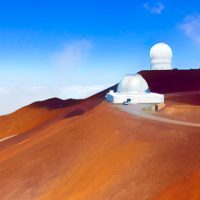
The red cinder of Mauna Kea contrasts with white clouds and white telescopes
When considering the issues of land leases in Hawaii there are a few important things to consider. The vast majority of land in the state is owned by either the state itself, or by a handful of large landowners. These entities do not typically sell land, rather much of the land is in long term lease to the current users.
A significant number of commercial developments, some military bases, and large resorts sit upon leased land. Malls, apartment complexes, and a surprising number of private homes are on leased land. This leads to a wide range of potential issues when the leases run out or are open to renegotiation. Sometimes it gets ugly, with families evicted from homes that have been in the family for generations.
As one would expect, the leasing of state land can quickly become a hot political issue. A great deal of land use law, and an even larger body of case law revolves around these leases.
The most direct of Senator Kahele’s attacks on Mauna Kea astronomy is contained in SB916. Indeed this one bill is the most revealing in understanding the motivation behind the remainder of the Mauna Kea bills we have been discussing.
The United Kingdom Infrared Telescope surrounded by the sunset crowd
The provisions of SB916 are particularly troubling. While clearly motivated as an attack on astronomy facilities on the summit of Mauna Kea, provisions of the bill go far beyond the mauna, certainly impacting any use of state land on all islands.
In reading the bill one particular provision stands out, a prohibition of any impact on surrounding resources. This should be a glaring issue to anyone considering supporting this measure. This could in effect prohibit any use of public land…
The bill is simply a wish list for opponents of any development, language that can be used as grounds to sue and obstruct development over a wide range of real or perceived issues.
Next up in our examination of the current legislature’s crop of Mauna Kea bills is SB936.
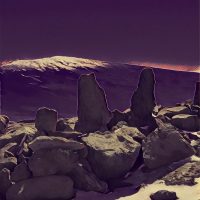
An ancient ahu atop Mauna Kea
This bill removes two thirds of the revenue currently going to the University of Hawaii managed Mauna Kea lands management special fund, redirecting the revenue towards two additional funds. One third would go to a new Mauna Kea special fund administered by the Department of Hawaiian Homelands. The other third would go to a DLNR administered Mauna Kea natural area reserve special fund.
The deadline for the introduction of new bills in the Hawaii legislature’s 2019 session has passed and we can see that at least six bills directly address Mauna Kea.
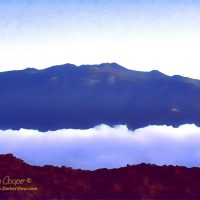
Mauna Kea seen at dawn from Mauna Loa
We have previously discussed HB1067, the development moratorium bill addressing Mauna Kea lands above 6,000ft. The remainder are less direct, but are no less aimed squarely at the controversies surrounding new astronomy facilities on Mauna Kea.
HB1067 Prohibits any development on conservation lands of the Mauna Kea summit at 6,000 feet above sea level and higher.
SB905 Requires the lessor of a master lease for public land to receive reasonable compensation.
SB916 Requires that the board of land and natural resources make certain determinations before approving public land dispositions. Restricts the board of land and natural resources from approving the disposition of public lands under certain circumstances
SB918 Limits the term of certain public land leases, including any extensions, to no more that thirty-five years.
SB933 Requires that the board of land and natural resources conduct a rent review of all leases and subleases of public land once every ten years.
SB936 Removes 2/3 of the funds from the university managed Mauna Kea special fund. 1/3 to a new Hawaiian Homelands managed special fund. An additional 1/3 to a new Department of Land and Natural Resources special fund.
Many of these bills do not address the mauna by name, but even a quick reading and familiarity with the issue reveals that there is no other reason for these bills to have been advanced.
What do all of these bills have in common? With the exception of House Bill 1067 all of the senate bills were introduced, and likely authored in large part by state Senator Kaialiʻi Kahele.
It appears that Senator Kahele has made it his mission to destroy astronomy on Mauna Kea. When last year’s blatant attempts in the legislature failed, he has become more circumspect, attempting to add layers of bureaucratic barriers to changing anything on the mauna.
SB916 is the clearest example of this. Not only would it likely make any use permit of Mauna Kea legally impossible, it would have the same effect on all state lands.
It is worth going through the bills individually, considering the possible implications of the language. Over the next few days DarkerView will do just that, examining each of these bills.
Taken individually some of these bills seem reasonable enough, when considered as a group it becomes clear there is a distinct goal. This is not about improving management or oversight of the mauna, there are better ways to accomplish improvement. This is about ending astronomy on Mauna Kea.
With the Hawaii state legislature now in session we now have a clear view of those bills targeting the controversy on Mauna Kea. While of the bills concerning the mauna are indirect, one is quite direct. HB1067 is a complete ban on any development above 6,000ft on Mauna Kea. Blunt and simple.
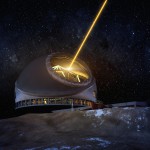
An artist concept of TMT at night, with the laser guide star system illuminated.
Introduced by representative Amy A. Perruso representing central Oahu district 46, Launani Valley and Wahiawa . The bill has a long introduction, but a very simple change to the state statutes…
§304A- Mauna Kea conservation district lands; development; prohibition. Notwithstanding any law to the contrary, no new construction or development on conservation lands on the Mauna Kea summit located at six thousand feet above sea level and higher shall take place after December 31, 2019.
Not the first time I have attempted to take this photo, rather the fourth, or is it fifth?
I think I got it right this time…
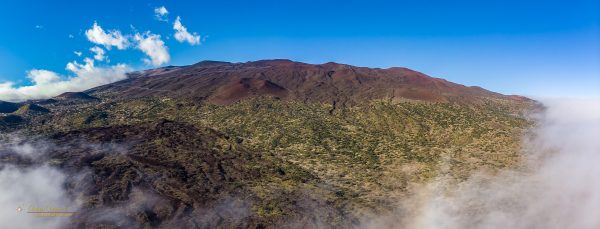
Looking up at Mauna Kea from below Hale Pohaku
The image is a two frame mosaic taken with the Mavic Air and stitched in Lightroom. The trick is catching the clouds at just the right place, and racing to launch the drone from close enough to take advantage of the clouds. Conditions change with remarkable speed and fluidity as the clouds move across the flank of the mauna, surging up the slope or dissipating quickly.
A partially eclipsed Moon rises just above the shadow of Mauna Kea on January 20th, 2019.
I needed a quiet day to work on some code in the Keck 2 dome control PLC. One problem, every time I load code the dome lights go out. Guys working in the dome tend to object to the lights going out randomly.
Answer? Go up on a weekend when there as only a couple guys on duty and not a lot of work going on. I can have the whole telescope and dome to myself most of the day.