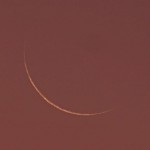
A very young moon over WaikoloaNew Moon will occur today at 08:30HST.
A total solar eclipse will sweep across the mainland United States today. For viewers here in the islands this eclipse will be visible as a minor partial eclipse with between 15-20% of the Sun’s disk covered by the Moon. The eclipse will occur right at sunrise.
Given the path and the probability of good weather this eclipse is likely to be heavily watched. Expect thousands of photos available on social media shortly!
Ahead of our aircraft a crescent Moon is rising. Outside the window it is completely dark, a blackness broken only by the strobing anticollision lights across the wing and the rising Moon. Seattle is still hours away as we cross the Pacific, there are no city lights below to break the darkness.
Boarding Alaska flight 850 in KonaThe waning crescent phase is another reminder that the total solar eclipse I have been anticipating is very near, only a few days now. Not that I really need a reminder, the entire reason I am on this flight is to meet the Moon once more, to catch the moment when it blots out the Sun.
Somewhere below me in the cargo hold is the telescope mount, assembled from restored and hand made parts. In the luggage bin overhead is the telescope, the little refractor that is a prized posession. Through it I have watched and photographed eagles and whales, volcanic eruptions, and distant galaxies. At my feet is a pack with a few cameras in it, only five.
For over a decade I have awaited the coming of this event. A day that once seemed so remote draws swiftly near as a rising crescent Moon portends.
Among the petroglyphs at Horsethief Lake is one that has always caused me to wonder. Of course the site is home to the famous Tsagaglalal or She-Who-Watches image. This is not the one I refer to, rather a somewhat smaller and usually overlooked image.
Eclipse Petroglyph at Horsethief LakeTo me this petroglyph is obviously a total solar eclipse.
To my eye the image is clearly that of the solar corona surrounding the black shadow of the Moon against the Sun. The image is all the more striking to me personally… In 1979 I witnessed a total solar eclipse, my first, just a short distance from here, from the bluffs above Maryhill.
A tricky shot, taking very precise timing and navigation. I can not claim credit, Sean Goebel did the planning. I just supplied scouting information and came along for the ride.
The Moon rising directly behind the telescopes on the summit as seen from near WaikoloaSean has been after this photo opportunity for some time. For months he has messaged me to check on the weather over the Waikoloa area each time a full Moon is available. As he has to drive across island to reach the correct locations, a look ahead at the weather can save a great deal of wasted time.
Given that this only involved a fifteen minute drive from the house for me… Why not? Give it a try. Besides, I already had a suitable telescope loaded in the vehicle.
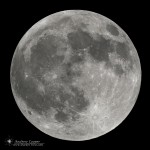
Full Moon taken 27Aug2007, 90mm f/12 APO and Canon 20DaFull Moon will occur today at 08:11HST.
Occurring with this full Moon is a partial lunar eclipse. This eclipse is fairly modest, only about 25% of the Moon will be immersed in the earth’s inner shadow. For the islands the event will be even more unremarkable as the penumbral stage will have just begun prior to moonset and none of the partial eclipse will be visible. The timing of this eclipse favors Australia and Asia.
As I gazed up at a nearly full Moon this evening I realized that the countdown is quite short now. When that Moon is new again it will pass in front of the Sun to create a total solar eclipse.
The Moon one day short of full.This will be my first total solar eclipse in nearly four decades. Not since 1979 have I witnessed a total eclipse. Over those decades I have seen many partial eclipses, quite a few lunar eclipses, a few transits of Mercury, and one transit of Venus.
I have been anticipating and planning this trip for many years. It was after the transit of Venus in 2012 that I really turned my attention to the next major astro-event. Laying out plans to camp somewhere in Eastern Oregon where the viewing is likely to be excellent.
On August 21 this year a total solar eclipse will sweep cross the mainland United States, something that has not happened since 1979.
The 1999 Total Solar Eclipse, image credit Luc ViatorI have witnessed only one total solar eclipse in my lifetime, the February 1979 eclipse that crossed Oregon and Washington. Our family viewed the eclipse from near Maryhill, Washington, atop one of the high bluffs overlooking the Columbia river. We had a perfect view, a vivid memory that remains with me nearly four decades later. The 2017 event will be similar in some respects, sweeping into North America near the Washington-Oregon border.
Our plan for this eclipse? A little preliminary yet, but starting to shape up. Eastern Oregon should provide a good chance for a clear view in August. Stay in the LaGrande area with family, heading south on eclipse day to a good vantage point near the center-line. Most likely somewhere south of Baker, Oregon. There are a lot of high elevation meadows and mountain roads that should provide a memorable place from which to view this eclipse.
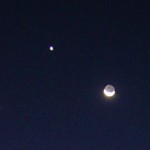
Tomorrow morning, July 20th, a pretty crescent Moon will be located close to a brilliant Venus. The Moon will be a slim 11% crescent a little over 4° from Venus shining at -4.0 magnitude. The pair will rise about three hours before sunrise a bit before 2am, look for the two above the brightening glow of dawn.
The Moon, Venus and Aldebaran join up for an evening conjunction