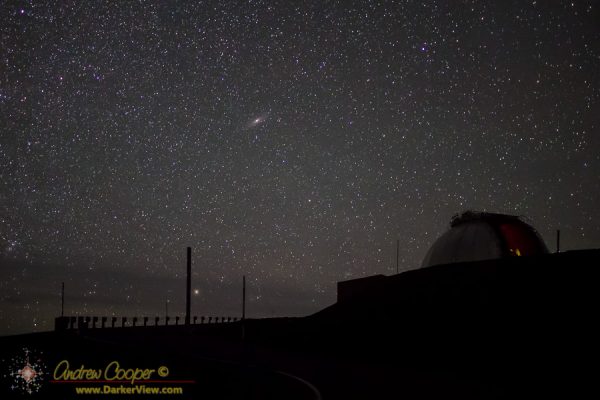
A very young moon over WaikoloaNew Moon will occur today at 08:30HST.
A total solar eclipse will sweep across the mainland United States today. For viewers here in the islands this eclipse will be visible as a minor partial eclipse with between 15-20% of the Sun’s disk covered by the Moon. The eclipse will occur right at sunrise.
Given the path and the probability of good weather this eclipse is likely to be heavily watched. Expect thousands of photos available on social media shortly!
A few years back I posted the design of a Sun finder. With the eclipse looming it is time to highlight that post again. Aiming your telescope or camera at the Sun can be a nuisance. A problem with a really simple solution.
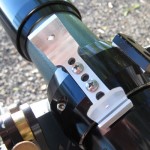
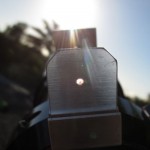
A Sun finder mounted to a TeleVue 76mm ‘scopeThe idea is simple… A pinhole that casts a small dot of light on a target. Line up the dot on the target and the Sun should be neatly in your field of view. Having used these devices many times, it really is that easy, Sun in view in seconds.
A sun finder in use with the projected dot visibleMy version is a custom machined part made from aluminum and plexiglass. In a crush a similar item can be made from cardboard and tape with a pair of scissors, and probably function just as well.
I would suggest light cardboard, the type used in a cereal box, and some masking tape that will peel clean off your telescope or camera. Just line up the telescope once and mark the dot of light’s position with a pen… Done.
Yes, DarkerView has been a solar eclipse blog over the last couple weeks. No worries, it will soon be over and regular programming will resume… After the obligatory photos from the eclipse expedition!
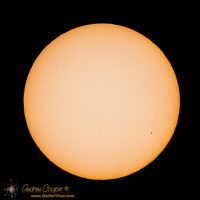
The Sun as it appeared August 10, 2017 with sunspot AR2670A few articles? Yes, just a few…
Ahead of our aircraft a crescent Moon is rising. Outside the window it is completely dark, a blackness broken only by the strobing anticollision lights across the wing and the rising Moon. Seattle is still hours away as we cross the Pacific, there are no city lights below to break the darkness.
Boarding Alaska flight 850 in KonaThe waning crescent phase is another reminder that the total solar eclipse I have been anticipating is very near, only a few days now. Not that I really need a reminder, the entire reason I am on this flight is to meet the Moon once more, to catch the moment when it blots out the Sun.
Somewhere below me in the cargo hold is the telescope mount, assembled from restored and hand made parts. In the luggage bin overhead is the telescope, the little refractor that is a prized posession. Through it I have watched and photographed eagles and whales, volcanic eruptions, and distant galaxies. At my feet is a pack with a few cameras in it, only five.
For over a decade I have awaited the coming of this event. A day that once seemed so remote draws swiftly near as a rising crescent Moon portends.
With a little short of two minutes of totality I need to go into this with a plan. I do want a few photos, but I also want to experience the eclipse. How do I balance that?
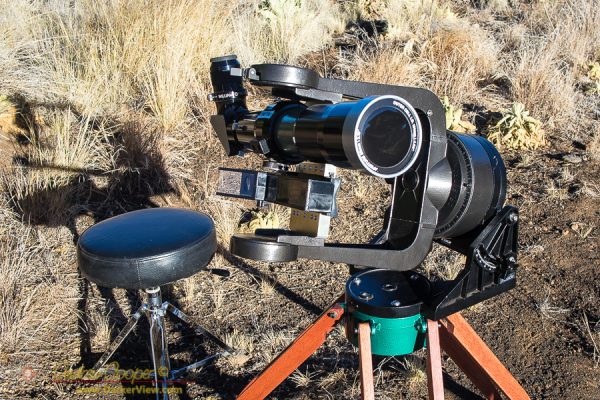
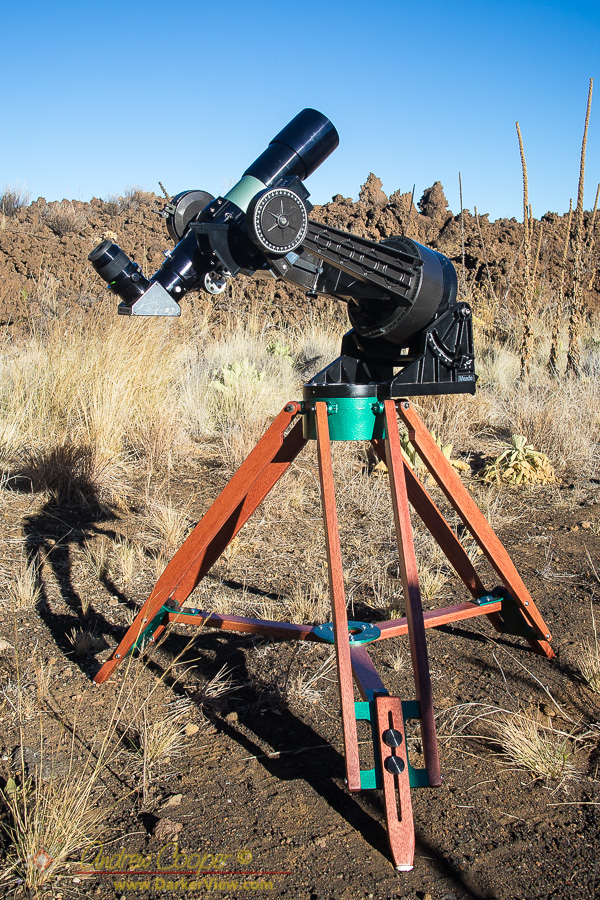
Hodgepodge setup on the side of Mauna Kea with the TV-76mm and Telrad on the plateThe important bit here is that I am going to give myself time to simply enjoy the eclipse and not spend the whole time futzing with the camera gear. When totality begins I will simply sit back and watch. To that end I have thought through a shot plan that may just accomplish this balance.
The plan calls for three cameras… A single camera on a solar telescope, this will be primarily run on automatic with an intervalometer. I just need to check focus and centering of the solar image periodically during the long partial phases. I will use part of totality to attend to this camera and take a deep corona photo.
In the end it is a Celestron C8 telescope drive and forks containing custom electronics, a Meade heavy duty wedge from an LX-90, a hand-made tripod, holding a Televue 76mm APO telescope, using a Vixen style dovetail base, with a Baader film solar filter.
It is tempting to call it Frankenscope after the similarities with the classic monster.
Hodgepodge setup on the side of Mauna Kea with the TV-76mm and Telrad on the plate
To further add the the Mary Shelley plot similarities, much of this was revived from the junk pile. I very nearly decided to toss the drive and fork, they were that bad, peeling paint and rusty bolts. A great deal of work was necessary to re-animate these components.
The wedge came from a telescope that was killed in an unfortunate incident with an aquarium heater. The heater was used to de-humidify the OTA and prevent fungus on the optics. Note: Aquarium heaters are not made to operate out of water.
The Hodgepodge mount assembled for the first time
Several new aluminum parts were machined from scraps, some of which were scavenged when the observatory shop was being cleaned out and a lot of metal stock was tossed.
Many of the electronic components used to build the drive corrector were also scavenged parts from dead electronics, this includes the 1.8432MHz crystal that forms it’s beating heart. This heartbeat keeps the mount turning at exactly sidereal rate.
Yeah, you could call it Frankenscope.
But I will call it Hodgepodge.
The Hodgepodge mount assembled for the first time
The legs and other parts of the field tripod with a fresh coat of polyurethane
Parts for the Hodgepodge field tripod drying in intense tropical sunlight
The extendable foot section for the Hodgepodge field tripod
The Meade wedge bolts to a Celestron field tripod head without modification
Hodgepodge setup on the side of Mauna Kea with the TV-76mm and Telrad on the plate
A few days ago I looked at the solar imagery from the spacecraft and ground observatories and feared that our Sun would be completely spotless for next week’s solar eclipse. The one sunspot visible had just rotated out of view, not to return until well after the eclipse. There were no other sunspots apparent.
SOHO sunspots on Aug 15, 2017 showing the newly formed AR2671Our Sun has served up a very nice surprise. A complex and energetic sunspot group has formed. Better yet it will be just about mid-disk when the Moon arrives.
Sunspot group AR2671 formed on the eastern limb of the Sun over the last couple days. It has even produced a few c-class solar flares to show it has some vigor.
Better yet… This sunspot group will be a boon to eclipse photographers across the US. The pattern of dark spots will make the difficult task of focusing a telescope on the Sun far easier. These spots will provide a focus target to untold telescopes.
The only question now is will the group last for five more days? Will is grow or shrink.
Among the petroglyphs at Horsethief Lake is one that has always caused me to wonder. Of course the site is home to the famous Tsagaglalal or She-Who-Watches image. This is not the one I refer to, rather a somewhat smaller and usually overlooked image.
Eclipse Petroglyph at Horsethief LakeTo me this petroglyph is obviously a total solar eclipse.
To my eye the image is clearly that of the solar corona surrounding the black shadow of the Moon against the Sun. The image is all the more striking to me personally… In 1979 I witnessed a total solar eclipse, my first, just a short distance from here, from the bluffs above Maryhill.
Take a photo with a thin film solar filter and you get a blue-white image of the Sun. Correcting this to a yellow gold image is fairly simple in most any photo processing package.
The Sun as photographed through a Baader film solar filterCorrecting is probably the wrong word here. The Sun is actually closer to white as we define color. After all, the Sun is our normal source of light, what our eyes evolved to use.
Color is a fluid subject, simply our interpretation of frequency across a very small slice of the electromagnetic spectrum. As such there is no absolute right and wrong, just a set of conventions we normally use.
The issue is that people expect the Sun to be yellow-gold. Present an image of the Sun in any other hue and it is rejected as fake, or false color. We are accustomed to certain visual cues to identify and interpret our world, color is a major part of that. Unless you want to argue with a million people or two, you are better off making your Sun photos yellow-gold.