A tricky shot, taking very precise timing and navigation. I can not claim credit, Sean Goebel did the planning. I just supplied scouting information and came along for the ride.
The Moon rising directly behind the telescopes on the summit as seen from near WaikoloaSean has been after this photo opportunity for some time. For months he has messaged me to check on the weather over the Waikoloa area each time a full Moon is available. As he has to drive across island to reach the correct locations, a look ahead at the weather can save a great deal of wasted time.
Given that this only involved a fifteen minute drive from the house for me… Why not? Give it a try. Besides, I already had a suitable telescope loaded in the vehicle.
While the total phase of this month’s total solar eclipse can be viewed directly without protection, as soon as the Sun peeks out from behind the Moon you will need a safe way to view the Sun. That means a proper, and safe viewing method.
A partial solar eclipse from Kawaihae, 9 May 2013I have previously posted on safe viewing of the Sun, discussing both filters and projection methods. It is time to re-post that information!
Personally? I will have a small telescope with a filter available for viewing and photography, along with proper solar sunglasses available to monitor the partial phases as the eclipse begins.
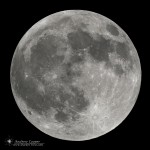
Full Moon taken 27Aug2007, 90mm f/12 APO and Canon 20DaFull Moon will occur today at 08:11HST.
Occurring with this full Moon is a partial lunar eclipse. This eclipse is fairly modest, only about 25% of the Moon will be immersed in the earth’s inner shadow. For the islands the event will be even more unremarkable as the penumbral stage will have just begun prior to moonset and none of the partial eclipse will be visible. The timing of this eclipse favors Australia and Asia.
As I gazed up at a nearly full Moon this evening I realized that the countdown is quite short now. When that Moon is new again it will pass in front of the Sun to create a total solar eclipse.
The Moon one day short of full.This will be my first total solar eclipse in nearly four decades. Not since 1979 have I witnessed a total eclipse. Over those decades I have seen many partial eclipses, quite a few lunar eclipses, a few transits of Mercury, and one transit of Venus.
I have been anticipating and planning this trip for many years. It was after the transit of Venus in 2012 that I really turned my attention to the next major astro-event. Laying out plans to camp somewhere in Eastern Oregon where the viewing is likely to be excellent.
In this ever complex world in which we live the rules are always changing, and usually getting more complex. A modern, information society has many rules that govern who owns what. Copy a photograph from the web and you are probably breaking the laws concerning copyrights. There is a complex and sometimes contradictory set of laws that governs all manner of ownership in this technological age.
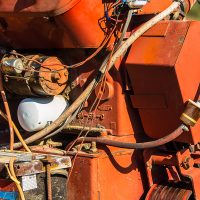
The engine on a hay baler offers a view of mechanical paraphernaliaDo you know the rules?
Buy a CD with your favorite tunes… Can you copy the tracks onto your phone? Can you create a video with the music and post it to YouTube? What about that expensive photo software package? Can you put it on your laptop and desktop? The rules are often complex, and often the answer is not clear cut.
Increasingly we do not actually own what we buy. At least that is what many corporations will tell us.
You would think that the answer is easier if the thing we are talking about is a physical object. If you buy a car, can you re-paint it, install a new stereo, or ignition system. Of course you can do that. Can you? Sometimes the answer is no.
Increasingly corporations attempt to maintain control of a product after the sale. They use many tools to do this. One is intellectual property, copyrights and copy protection on the software that is now embedded into many of the things we buy.