Author: Andrew
Cropping the Photo
You never frame a photo properly when taken. This is a lesson I learned long ago… In the sometimes frantic process of shooting the photo, you rarely have a chance to frame the subject correctly. That moment when the whale surfaces, or the bear looks right at you, there is little time to adjust the photo for best impact, you just shoot.

Rotation is also an issue, many photos are taken handheld, often hastily in the moment. These will have small errors in rotation. Do not even mention shots taken from a pitching boat! A modest crop of the photo will also allow correction on the image rotation.
The choice of crop is critical, it is the first step in my processing of the photo. Either the crop works, or move on to the next photo in the folder. Almost all photos can be improved by cropping in a little, to cut away the extraneous areas and to concentrate the viewer’s attention on the primary subject. Much of the time I will throw away 10-25% of the photo, not cropping a lot, just tightening up the composition.
Adobe LightRoom acknowledges this fact of photography, the crop and rotate tool is on top, first on the left of the processing tools. Crop it in, perhaps straighten the rotation, then you know if the photo is worth any further effort.
The art is in choosing the crop… How much to crop. How to position the major elements. This decision is an aesthetic choice of the photographer, and as with many such choices, there is no single best answer. There are some rules that can help. These are rules that can help, but are not ironclad, they can be broken if the composition calls for it.
Reaction to Governor Ige
To no one’s surprise those most opposed to astronomy on Mauna Kea have reacted negatively to yesterday’s statement by Governor Ige. Released statements by the Mauna Kea Hui, Kū Kia’i Mauna and other groups offer no compromise in response to the governor’s proposals.

Today’s protest is interesting compared to earlier protests, it seems less energetic, with far fewer passing vehicles honking in support. The previous protest at this location was almost constant honking. Has the community sentiment shifted away from those protesting? Are many accepting the spirit of compromise that was exemplified by the governor yesterday? The real test will be when construction resumes, and we all expect it to resume soon.
It was in walking over to check on the protest that I had a more interesting conversation. A Hawaiian gentleman was selling fresh ahi and pickled mangoes from a roadside stand. He ask why they were protesting the telescopes. It made no sense to him that anyone would oppose the TMT.
This is in line with many quiet conversations I have had. Many in the local community do support the TMT, but the support has been muted by the most strident voices of opposition. Conflict is not comfortable to many in this community, traditional Hawaiian and to a large extent traditional Asian attitudes that so many follow here have steered many away from the controversy. As we chatted he offered me a piece of ahi free, he had a big catch yesterday. I deferred and thanked him, I still have plenty of halibut to use up in the freezer.
Telescope Controls
Governor Ige Steps In
After weeks of being pretty much silent on the controversy, Governor Ige has issued a statement on the ongoing issue of TMT construction. It was big news around this place, pretty much the entire staff of Keck Observatory piled into our big conference room to watch the governor’s address live.

Creating a Clock in a Microchip PIC18F
Engineering is full of these little exercises. A set of numbers that must be arranged to achieve the desired result. In this case I need to keep time in a microcontroller, as there are events that I wish to occur every few seconds.
If you are using a crystal oscillator with the microcontroller, the frequency is reasonably accurate, about 50ppm at 25°C. As long as your application does not require high precision time, the result is a decent clock. Some form of clock or timekeeping is a very typical function in many microcontroller projects.
To do this I have a standard set of subroutines that I simply import into each microcontroller project. Well tested and used for years, requiring little effort to set up each time. The routines count seconds, minutes, hours, and even days and months if needed. This time is different… I am using a PIC18F25K80 in place of the PIC16’s I have used for decades. A newer processor, little differences in the hardware and instruction set… I need to rewrite the code.

Timer 2 on the PIC18F25K80 is typical of timers found in both the PIC16 and PIC18 family. There are always a handful of timers in any microcontroller, usually with different arrangements for different tasks. At least one will be set up much like this one, with a comparator to provide a repeating fixed and timed interval.
Two Lasers on the Galactic Center
The Bright Spots on Ceres
As the Dawn spacecraft settles into lower orbits around Ceres the photos of this small world are of ever better resolution. The mysterious bright spots have slowly resolved into an interesting arrangement of multiple spots. Despite many wild claims on YouTube and UFO websites of alien cities or crashed spacecraft, the spots are looking more and more like a set of ice outcroppings. They are still fascinating, if just a bit more ordinary than some would hope.
My bet? Some sort of cryovolcano.
NASA’s Dawn mission captured a sequence of images, taken for navigation purposes, of dwarf planet Ceres on May 16, 2015. The image showcases the group of the brightest spots on Ceres, which continue to mystify scientists. It was taken from a distance of 4,500 miles (7,200 kilometers) and has a resolution of 2,250 feet (700 meters) per pixel.
“Dawn scientists can now conclude that the intense brightness of these spots is due to the reflection of sunlight by highly reflective material on the surface, possibly ice,” Christopher Russell, principal investigator for the Dawn mission from the University of California, Los Angeles, said recently.
Dawn arrived at Ceres on March 6, marking the first time a spacecraft has orbited a dwarf planet. Previously, the spacecraft explored giant asteroid Vesta for 14 months from 2011 to 2012. Dawn has the distinction of being the only spacecraft to orbit two extraterrestrial targets.
The spacecraft has been using its ion propulsion system to maneuver to its second mapping orbit at Ceres, which it will reach on June 6. The spacecraft will remain at a distance of 2,700 miles (4,400 kilometers) from the dwarf planet until June 30. Afterward, it will make its way to lower orbits.

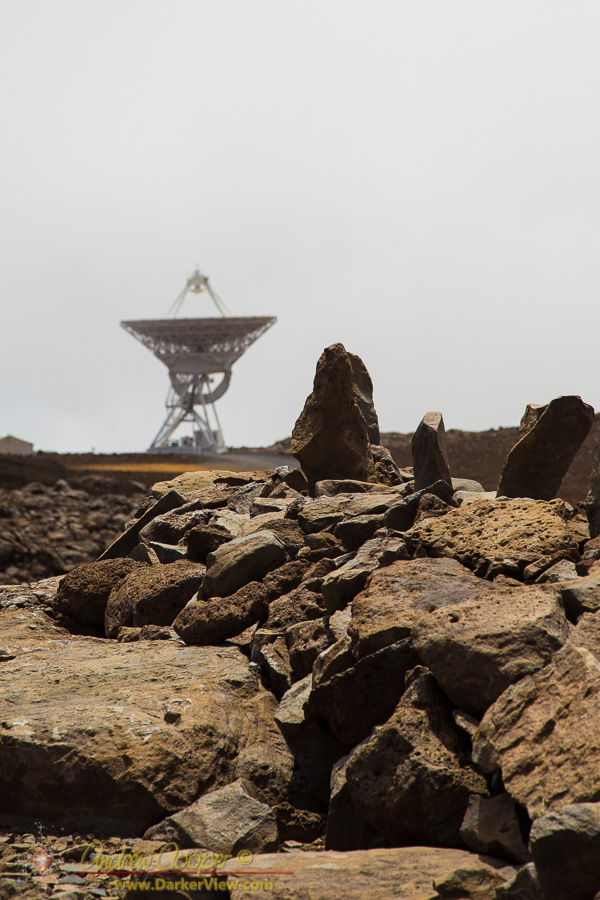
Caltech Submillimeter Telescope
A Night on the Summit
A photographer needs a guide around Keck for the night? Setup time-lapse cameras throughout the facility? Sounds like fun… Sign me up.

Two lasers, both aimed at the galactic center were on the schedule for the second half of the night. Andrea Ghez and her team having time on both telescopes. The weather looked a bit problematic, thick cirrus covered the sky, but the forecast called for clearing after midnight.
Jason came with a carefully drafted plan, where to set and aim each camera, timer settings, lens choice, all carefully considered. A pretty good plan too, only a few details needed changing as we placed each camera. Four cameras in Keck 1, another two in Keck 2. One camera placement was my idea… Clamped to the Keck 1 dome where it would track with the telescope. I had spent a few minutes in the machine shop putting together a solid camera clamp.
Unfortunately the clouds did not clear as predicted, thin cirrus hanging on through the night. It was clear just to the west, but stubbornly would not give us the clear skies we needed overhead. Several times it looked to clear, but the clouds would thicken again. We did have both lasers on sky for a few minutes, just enough for a few photos and not long enough to do any science.
With high hopes for some dual laser time-lapse I was ready to set up my own camera, but ended up with only a few still photos. Jason got a few nice shots during that short time, having eight cameras helped make the most of those few minutes. I did get a nice video clip of the telescope shot by rotating the dome with a camera.
Jason is working on a personal project and will be out shooting more images in the dark. I will certainly feature the results of his effort here on DarkerView when he finishes. For myself? I will have to schedule another opportunity to go up and shoot some laser time-lapse. There is an intriguing night at the beginning of July on the schedule with both Keck lasers. I also need to mail Jason a camera remote, an accomplishment that only one bit of camera gear got left behind.