Engine trouble. Bad enough that the boat has spent a couple months on shore, one engine replaced and the other rebuilt. Thus it has been a while since I have been out diving, since late October! Had the weather been better shore diving may have been a higher priority. The winter weather has been rough, with high surf warnings a common item in the morning news.
One of the many entries to the cave at PentagonSince the gear had sat for several months the first order of business was a good checkout of everything. The tanks only had a few hundred pounds of pressure in them, but enough to check the regulators and computer. The valves and buoyancy bladder in the BCD held pressure. I did need a new mask strap, solved with a trip down the hill to the Blue Wilderness shop. Purchasing two, one for the mask, one for the spares kit. Both of the tanks are due visual inspection, need to get that taken care of.
Arriving in the Makalawena area we found a dozen boats milling about. Only one thing would attract that may boats… Dolphins. The shallow water here is a good place to find dolphins and whales. Sure enough, there were dozens of dolphins about and pods of humans snorkeling between the boats in an attempt to see the dolphins in the water. The dolphins seemed intrigued by the boats and swimmers. A group came over to check us out and surf in our wake.
The original plan had been to hike Puʻu Kole, a dramatically red cinder cone visible from the summit access road. The red coloration leads to the name, Kole, which translates as red.
What actually happened is that I climbed the wrong puʻu.
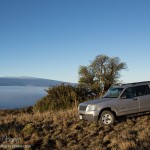
The vehicle parked on the side of Mauna Kea with a snow covered Mauna Loa in the backgroundPuʻu is Hawaiian for hill and is generally used to refer to the many cinder cones that dot the landscape of this volcanic island. As prominent landmarks these hills are used to describe the land, and can be found as references in the old land surveys. Every prominent puʻu has a name. The summit of Puʻu Kole is used to define the modern Hamakua and Hilo district boundaries.
As I traversed the R1 4WD road the side of Mauna Kea was enveloped in heavy fog, thick enough that you could not see a hundred yards, sometimes less. I was pretty sure I was in the vicinity of the target, and sure enough the shadow of a large puʻu was visible in the mist. So I parked the vehicle and climbed it.
It was when I reached the top and looked downhill that I noted there was another puʻu hiding in the fog. It was then I realized that I might just be on the wrong hill. Checking the maps I realized that I had climbed Puʻu Palaolelo.
Wrong? Perhaps this is the wrong word, there was no particular reason I needed to be on the right puʻu other than my desire to explore a place I had seen so often while ascending or descending the summit road. The error was fortuitous in that my original target hill was enveloped in thick fog all morning, while Puʻu Palaolelo, a little higher on the mountain, was alternately in the fog and in the sunlight.
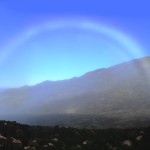
A beautiful fogbow, a glory and the spectre of the brocken on Puʻu PalaoleloIt was this play of fog and sunlight that led to the most dramatic experience of the day. When I neared the summit a beautiful fogbow appeared. Even better, when the angle of the sunlight and the steep slope of the puʻu allowed a glory and even a spectre of the broken appeared in the fog.
Standing atop the puʻu I could not miss the beauty of the morning. Still early the low sunlight was rich in color. Across the saddle you could see Mauna Loa, capped in vivid white, quite a contrast to her black lava flows. A chill wind swept fog over the summit, at times I was spattered with droplets. As the fog and light played across the landscape my camera memory card quickly filled. It was a satisfying hike, resulting in some pretty photos. My original goal of climbing Puʻu Kole lies unfulfilled, an excuse for another walk on the mountain.
Early on the morning of April 4th a total lunar eclipse will be visible across the Pacific. Sky watchers in Hawaiʻi will be able to observe this event from beginning to end.
The total lunar eclipse on Apr 14, 2014, Canon 6D on 90mm f/12 APOThis eclipse is just barely total with an umbral magnitude of 1.0008. The northern edge of the Moon will be barely inside the umbra and probably much brighter than the south hemisphere. The eclipse is also quite short, with a total phase lasting only four minutes. Compare this to the next total eclipse of 2015 where totality lasts over an hour.
Maximum totality will occur at 12:02UT or about 02:02HST. First contact will occur at 11:01HST on the evening of the 3rd, with umbral first contact a little after midnight at 00:15HST. It is this umbral contact that will be the first obvious effect of the eclipse to a visual observer, a notable notch out of the Moon.
Observing a total lunar eclipse requires no special equipment, simply the desire to look up. The most useful piece of equipment will be a reclining chair or some other method of staying comfortable while watching the sky. A pair of binoculars or small telescope can provide beautiful views of the Moon during an eclipse. Photography is somewhat more challenging, but not that difficult. Focal lengths of around 1000mm will fill the field of most DSLR cameras allowing photos like that shown here.
Penumbral Eclipse Begins
11:01 HST
09:01 UT
Partial Eclipse Begins
00:15 HST
10:15 UT
Total Eclipse Begins
01:57 HST
11:57 UT
Greatest Eclipse
02:01 HST
12:01 UT
Total Eclipse Ends
02:02 HST
12:02 UT
Partial Eclipse Ends
03:44 HST
13:44 UT
Penumbral Eclipse Ends
04:58 HST
14:58 UT
Timing for the 4Apr2015 total lunar eclipse
The entire eclipse will be visible during the night, quite convenient for amateur and casual sky-watchers.
An evening conjunction of Mercury, Venus and Jupiter on 30 May, 2013A very nice evening conjunction between a crescent Moon and Venus will occur this evening, March 22. The pair will be just under 5° apart and will grace the sunset until well after dark, setting after 9pm. Venus is currently shining brightly at -4.0 magnitude, a nice match for a 10% illuminated waxing Moon.
When doing a dawn hike on Mauna Kea it is important to choose your altitude with care. You really want to be right at the top of the cloud layer. There, where the fog drifts over in alternating shifts with the sunlight, there is where the magic happens. Mamane in the fog, puʻu appearing and disappearing, and fogbows. Add fog and you have all the ingredients for some good photography.
The plan had been to spend the morning on the summit doing some testing. When that got cancelled I quickly dropped into plan B… Go hiking. I got the altitude right.
The spectre of the brocken was a nice treat. At the center of the fogbow you can see a glory, and in the center of the glory is my shadow looming large in the mist. That is the spectre.
A beautiful fogbow, a glory and the spectre of the brocken on Puʻu Palaolelo
A team led by astronomers from the Jagiellonian University in Krakow, Poland, recently used the W. M. Keck Observatory in Hawaii to observe and measure a rare class of “active asteroids” that spontaneously emit dust and have been confounding scientists for years. The team was able to measure the rotational speed of one of these objects, suggesting the asteroid spun so fast it burst, ejecting dust and newly discovered fragments in a trail behind it. The findings are being published in Astrophysical Journal Letters on March 20, 2015.
Active asteroid P/2012 F5 captured by Keck II/DEIMOS in mid-2014. Credit: M. Drahaus, W. Waniak (OAUJ) / W. M. Keck ObservatoryUnlike the hundreds of thousands of asteroids in the main belt of our solar system, which move cleanly along their orbits, active asteroids were discovered several years ago mimicking comets with their tails formed by calm, long lasting ice sublimation.
Then in 2010 a new type of active asteroid was discovered, which ejected dust like a shot without an obvious reason. Scientist gravitated around two possible hypotheses. One states the explosion is a result of a hypervelocity collision with another minor object. The second popular explanation describes it as a consequence of “rotational disruption”, a process of launching dust and fragments by spinning so fast, the large centrifugal forces produced exceed the object’s own gravity, causing it to break apart. Rotational disruption is the expected final state of what is called the YORP effect – a slow evolution of the rotation rate due to asymmetric emission of heat.
The vernal or spring equinox occurs today at 12:45HST. Today there will be little difference between the length of the night when counted against the number of daylight hours. This is the first day of spring as marked by many cultures in the northern hemisphere.
As the new year is well underway I find myself in the midst of my major project for this year. For the next few months I will be replacing the control system for the Keck 2 dome. The project is well underway, but the real work remains ahead of me.
The Allen-Bradley PLC/2 that controls the Keck 2 dome and shuttersIt is a project that is long overdue. The current controller for the dome and shutters is an Allen Bradley PLC/2, a thirty year old piece of equipment that is sadly obsolete. Yes, a PLC, programmable logic controller, one of those machines I thought were a completely horrible way to do anything. I was appalled when I first encountered this technology, now I have to master it.
Parts for the PLC/2 are still available, but the programming software is a real issue. The software runs on a DOS (as in pre-windows) operating system, and does not run under the emulation modes of later Microsoft systems. You need a real DOS computer, something that is a bit rare these days. If the controller running the Keck 2 dome were to fail, I am not certain we could repair it.
I have the computer that is used to do the programming in my office, an ancient Compaq Portable III. Portable is an odd word to use with this computer, it weighs over 20lbs and is huge by modern laptop standards. This museum piece still works! Last month I booted it up and wandered through the file system. At power up I was greeted by a monochrome amber screen and a DOS prompt. I still remember a few basic DOS commands, enough to check things out. It appears that all of the software and files are still present on the hard drive. Sometime I need to see if I can indeed program the old PLC/2. If something goes wrong in the update I need to be able to revert to the original control system.
A reminder that the Keck public lecture is tomorrow night…
Astronomy Talk: America’s Space Program – NASA’s Roadmap to Tomorrow’s Missions
This portrait looking down on Saturn and its rings was created from images obtained by NASA’s Cassini spacecraft on Oct. 10, 2013. Credit: NASA/JPL-Caltech/Space Science Institute/G. UgarkovicNASA Administrator Charles Bolden will discuss America’s space program and the challenges the agency faces for the missions of tomorrow. Using a stepping stone approach that builds on the capabilities of our unique orbiting laboratory – the International Space Station – the growing abilities of commercial providers to reach space, and a new rocket and crew vehicle to travel to deep space, NASA is extending human reach into the solar system even as its amazing science missions are rewriting textbooks about our universe and inspiring the next generation of explorers.
The agency currently has spacecraft speeding toward Jupiter and Pluto and roving on Mars, and is searching for planets that could potentially harbor life beyond our solar system. An unprecedented mission to capture and redirect an asteroid to an orbit near to Earth is in the planning stages, and the Space Launch System and Orion Crew vehicle are reaching new milestones in development to take astronauts to an asteroid and on to Mars.
NASA has been a 1/6 partner in the W. M. Keck Observatory since 1996 and it is an honor to offer this program to the community.