Fall equinox occurs today at 16:30HST. Today there will be little difference between the length of the night compared to number of daylight hours. This is the first day of fall as marked by many cultures in the northern hemisphere.
This year many calendars will mark September 23rd as the beginning of fall, and so it is for much of the world. Here in Hawai’i the equinox actually occurs on the 22nd when considering the time zone differences.
Today Mercury reaches maximum elongation, the furthest point it will reach from the Sun in our sky and the highest it will be above the sunset for this evening apparition. The planet is easily visible as a bright, starlike object about 26° above the setting Sun as twilight begins. Over the next couple weeks Mercury will slide back into the sunset, heading for inferior conjunction on October 16th.
Tomorrow morning the Moon and Jupiter will be close. The Moon will rise first, followed by Jupiter at 03:06 to be almost 40° above the eastern horizon at sunrise. The Moon will be about 18% illuminated and about 8° above a bright Jupiter. The next day the Moon will have moved to the other side of Jupiter but will be even closer, about 7° separation.
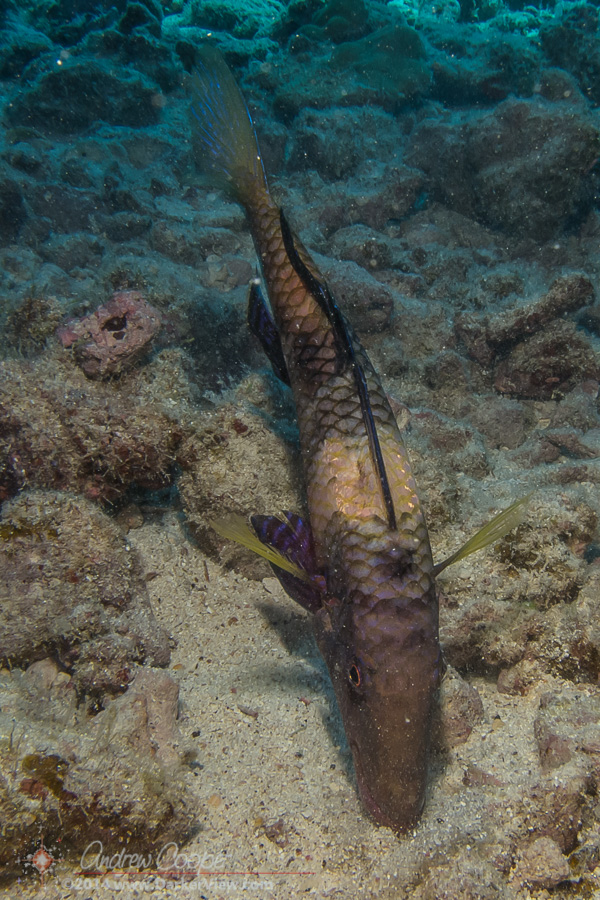
The fish did not seem too concerned at my presence, or perhaps it was taking advantage of my being there. It was rooting about in the cave rubble, using its sensitive barbels to detect prey under the debris and sand. As I watched it would slowly sweep over the rubble, then suddenly and vigorously rummage about in a cloud of sand. I could not see if the fish was having any success, but it was interesting to watch.
So often fish and other marine creatures will modify their behavior when a diver is present. It is always interesting when you run across something continues on despite being watched. It is worth a few minutes of air to sit and observe, sit and learn.
A manybar goatfish (Parupeneus multifasciatus) feeding in cave rubble at Golden Arches.
When most folks work late at the office it is a boring evening at a desk staring at a computer. I may have stared at a computer a bit, but it was hardly a boring evening.
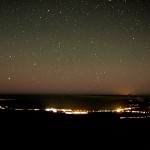
A focusing test shot from the Keck CloudCamThe task that had me staying late was to focus the new cloud camera. To accomplish this task I needed a dark sky and stars. The plan is the same as I have used before, work the day and then stay into the evening.
Waiting for darkness had it’s advantages, an opportunity to do a little photography. In addition to the usual tool bag and lunch I took my camera gear with me.
With Sniffen on the roof while I watched the frames on the computer, I called the corrections up to him on the radio. It is tricky work to focus a fast lens, made worse by the need to do it remotely. We had to wait for each 30 second exposure, painfully slow. I hesitated to ask Sniffen to sit much longer out in the cold, but he was game and ready to assist. His tiny adjustments were deftly made, I watched as the lens moved through focus.
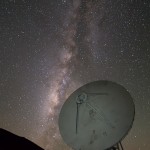
The summer Milky Way soars over the VLBA antenna atop Mauna KeaThe focus is not as good as I would like to see, I suspect that the Sigma 18mm f/1.8 lens leaves a little to be desired when used wide open. Perhaps one of the Rokinon lenses would work better. Or maybe I just need to step the lens down a stop or two.
After leaving Keck I took my time wandering down the mountain. I stopped at IRTF for a set of panorama shots. One of the first things I noted was the lack of airglow. Last time I shot from the summit the airglow was intense. Despite using the same camera and lens, with the same settings, the bright red glow was missing. Only a pale green near the horizon to be seen in the shots.
On a whim, I drove out to the VLBA antenna for a set of shots. This radio telescope was something different than the usual telescope shots I take. I walked around the dish until I could position the summer Milky Way beside the antenna. As the VLBA is a radio telescope there was no issue in using a little light from my flashlight to paint the dish and illuminate it for the photo.
I arrived home just before midnight, tired from a full day on the summit. The photos will wait for another day for processing.
After spending much of the year in dawn skies, this week will see Venus disappear into the dawn. Superior conjunction will occur October 24th, with the planet appearing in the evening sky at the end of November.
Last week I visited Gemini to see their TBAD installation. While we were on the dome floor I used Google Photo Sphere to shoot a few full panoramas of the telescope…