Solid Rock is Not Forever

Living with active volcanoes, one gets to see new landforms appear regularly. The landscape can get rearranged with little notice, with places I once visited buried under new rock. In my time living on Hawai’i, I have seen roads, bays and tide pools, and entire neighborhoods disappear under new lava. Watching new land created by these flows of liquid rock is mesmerising.

61G lava flow ocean entry
The 61G lava flow ocean entry at Kamokuna under the light of a full Moon

The opposite is also true around here, sometimes prominent landforms are erased by the actions of flowing water, or the incredible power of wind and wave.

Thus we bid farewell to the Hōlei Sea Arch, cast into the sea by the heavy surf generated by Hurricane Nolo.

The arch was one of the features of Hawaiʻi Volcanoes National Park found along Chain of Craters Road. Featured on park maps and served by a viewpoint and interpretive signs, thousands of tourists have stood atop the cliff to admire what waves had sculpted from the jagged black sea cliffs.

Those same waves have erased what they carved. Sometime around September 27th, the arch fell into the sea. Apparently, no one witnessed its fall, there are no Facebook posts or YouTube videos of falling rock. All we have are before and after photographs. This is understandable as the park was closed during the hurricane.

I last visited the arch over a year ago, travelling the park with my parents. It had been noticeably eroded by the waves, appearing much thinner around the base than on previous visits. It was only a matter of time.
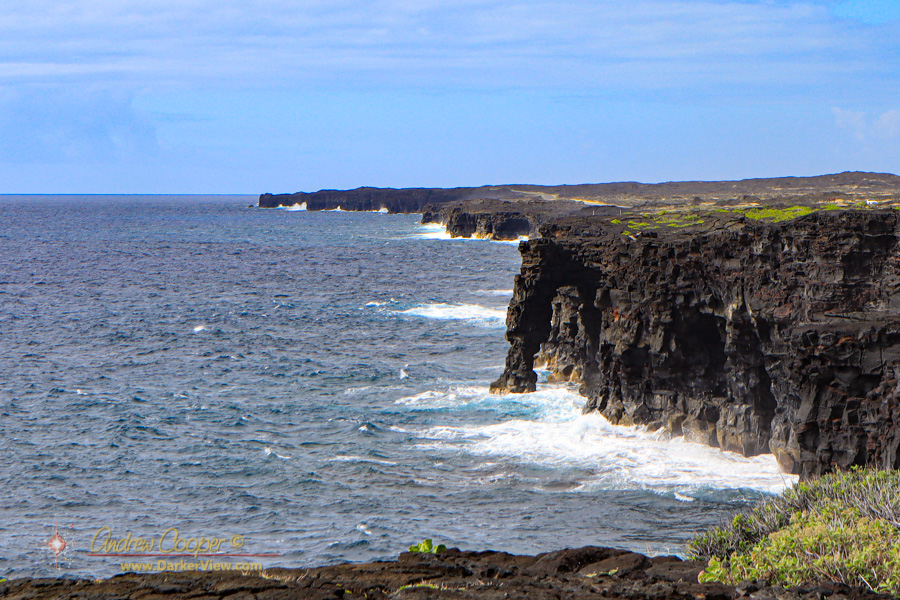
Hōlei Sea Arch and the sea cliffs along the southeastern coast of Hawai'i
Hōlei Sea Arch and the sea cliffs along the southeastern coast of Hawai’i in 2025

Landscaping

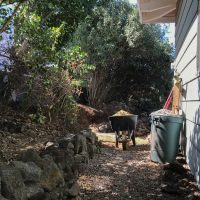
Being home for a while has let me finish up the ongoing landscaping project in the back yard. The last earth moving is in process with the area taking on the final configuration, just stacking rocks and some more planting to do.

Also need to get more mulch from the county green waste facility, at least three trailer loads.

New landscaping in the back yard begins to look complete...
New landscaping in the back yard begins to look complete…

Stacking Stone

The wall building project is now well along, with sections of completed wall and the outline what it will look like when I am done now apparent.

Tools ready to hand as work continues in the backyard

At this point there is 18 ft of completed wall, another 52 lineal feet of various height walls in various stages of completion from first course laid to nearly topped out. Another 11 feet will be started shortly to complete the first phase of wall building.

To create this much wall over five tons of rock has been loaded, driven 19 miles, unloaded, and hauled to the back yard. Twelve wheelbarrow loads per ton. About 70% of that rock has been stacked into the walls, the remainder in piles awaiting use.

Continue reading “Stacking Stone”

Building More Walls

With the big wall completed along the driveway, and a bit of a break over a hot muggy summer, I am again building walls.

Back Yard Wall Excavation
Excavating for a series of terrace walls in the back yard.

This is not the sort of wall between people, I detest those, but rather a real rock wall, terracing the backyard to make the space available for landscaping and other projects. This puts into action a plan that has been brewing for years.

Part of the impetus is that I have a source of rock secured, a very large pile of very nice rock found in a Waimea backyard. One of my co-workers casually mentioned he needed to rid himself of a pile of rock, to which I quickly asked… How much rock?

Continue reading “Building More Walls”

The Last Load

For weeks now I have been digging. Pickaxe, shovel, wheelbarrow, hard manual labor, and it just gets harder.

One last load of dirt and rock to remove from the work zone.

I am digging away at the slope behind the garage, solving longstanding drainage issues, creating a nice level walkway, building a small retaining wall.

The first stage was digging out all along my garage, reworking the slope, pulling the soil away from the foundation, giving the water somewhere to go other than right along the wall. This involved a couple dozen wheelbarrow loads of soil and rock removed and about thirty feet of two foot retaining wall… Done!

Continue reading “The Last Load”

Ripple Rock

Seymour Narrows is a bit of water one approaches with caution. This narrow passage north of Campbell River provides the shortest route between Vancouver Island and the mainland for transiting vessels. This passage is also subject to dramatic tidal currents of up to fifteen knots.

The strong currents create large areas where the water seems to boil, dotted with whirlpools and debris swept along by the rushing water. The result is what explorer Captain George Vancouver described in his logs as “one of the vilest stretches of water in the world.”

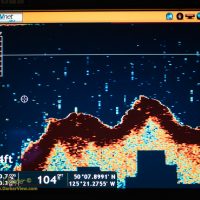
The remains of Ripple Rock well beneath the surface in Seymour Narrows
As usual we had anchored and waited a couple hours for the tide to change, waiting for the worst of the currents to slack. While small, fast boats can pass by during high current, most vessels wait for the tide here. We were not alone, when we pulled anchor and nosed into the narrows we joined a parade of boats that had waited.

The passage was once much worse, a large rock named Ripple Rock lurked just under the surface at low tide. This mid channel rock created huge standing waves and vicious eddies as the current ran over it.

Continue reading “Ripple Rock”