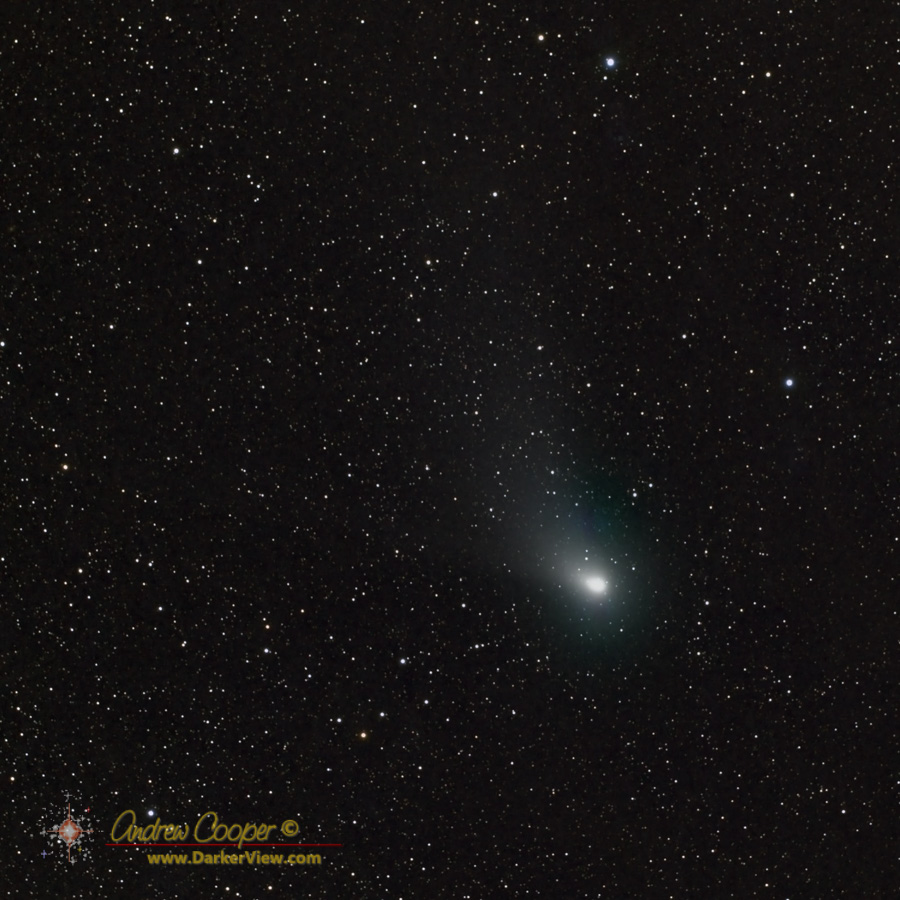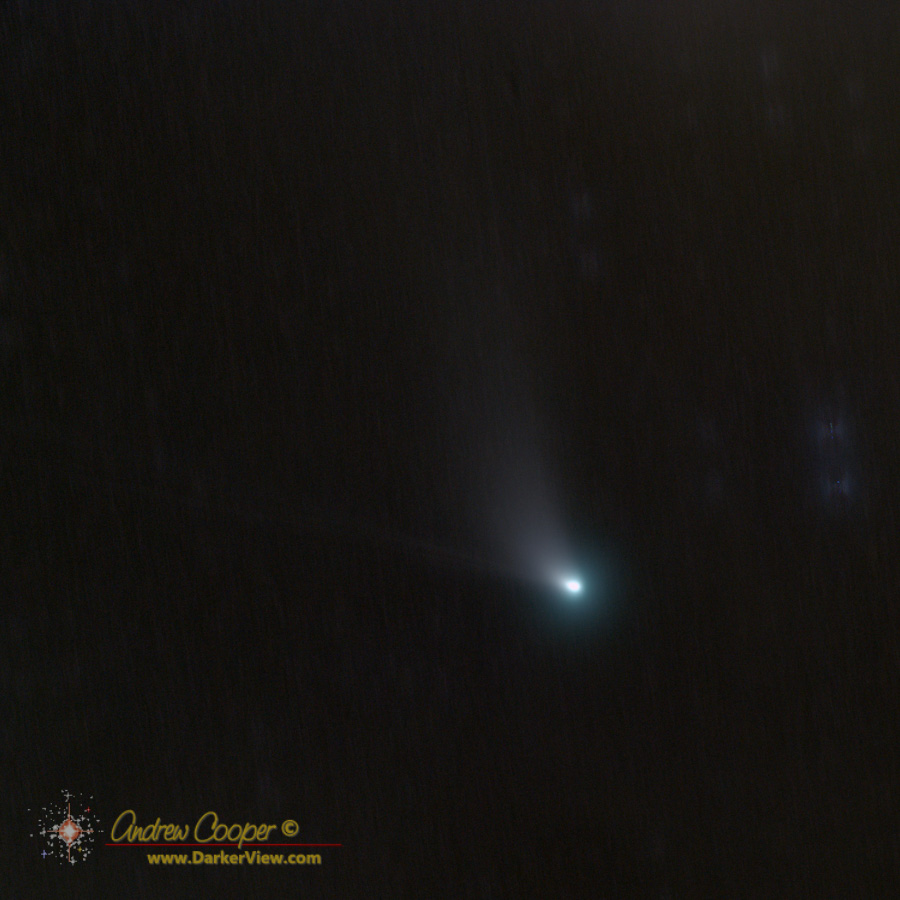
A spate of bad weather followed by the bright moon kept me from imaging the comet until this week. A little late to the game and a fading comet. Still, I did get an image.
The comet is currently high in the evening sky, an easy target. An now that the bright Moon has left the evening sky this week and next represent a last chance to see the comet before it truly begins to fade.
Comet ZTF has faded below 6th magnitude according to recent estimates, too faint for the unaided eye, but still spottable in binoculars and fairly easy to catch in a small telescope. The comet remain well placed to spot for some time to come but will slowly fade, dropping to about 8th magnitude by the end of the month.
Comet C/2022 E3 ZTF
Canon 6D with a TeleVue 76mm scope riding on an ZWO AM5 mount. 30 x 180s images processed in DSS. A version processed to remove stars does show a trace of the ion tail.
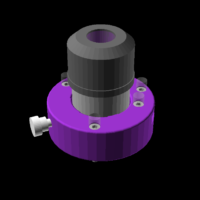
This has been a bit of a design challence for me… Just how small, how simple, can I make a focuser and yet still provide excellent usability. My latest Helix 1-14 design is my best yet.
A simple helical crayford focuser
As my 3D printer design skills improve I applied lessons learned and the unique capabilities of an FDM printer to the problem of a focuser. After a bit of a journey I have arrived at a design I can consider finished. Is it the final design? I may tinker some more, but I am satified for the moment.
The design is based on a few ideas from here and there, products I have seen or used, internet postings from others faced with the same challenge. I am not one for just printing someone else’s design, I rarely do that, I want to do my own, and maybe make it better.
For the last couple years I have been exploring 3D printed telescope designs. The latest result of this oddessy is Kinipōpō, a 4.5″ f/4 Newtonian using a entirely 3D printed ball mount design.
Kinipōpō ball telescope 3D model
The Hawaiian word kinipōpō translates as ball or sphere.
A ball telescope offers a number of advantages, the first of which is ease of use. It is simplicity itself to aim at a target, no odd controls, no weird angles, just freely push the ‘scope to the target. As the tube can be freely spun the eyepiece can always be positioned for easy viewing.
The design is an RFT, or Rich Field Telescope. This type of ‘scope is designed to be a low power, wide field ‘scope ideal for enjoying sweeping the sky and providing views rich with innumerable stars. It is not a good ‘scope for planets, the magnification is far too low. It’s prey is large, bright targets, star clusters, bright nebulae, or even the dark nebulae silhouetted against the rich starfields of the Milky Way.
Another ideal target is bright comets. My prototype providing pleasing views of comet C/2022 E3 ZTF a month before preihelion and maximum brightness.
The short focal length does create coma issues around the edge of the field, stars near the edges of the field smear a bit and will not focus. The problem does not seem too objectionable, but it is there.
The design is inspired in part by the classic Edmunds Optics Astroscan telescope, in being both small, portable, and simplicity to use. On the other hand the design offers a number of improvments over the Astroscan. Primarily the ‘scope offers an increased aperture of 114mm compared to the Astroscan’s 105mm, while being very close to the same overall size.
The scope costs about $200 to assemble, the largest chunk of that being the primary mirror. While the needed plastic filament for the 3D printer is cheap, it does take quite a bit of time to print. The largest part, the spherical shell requires over 60 hours on the printer, with many of the other parts being overnight prints. Assembly is not difficult, mostly cleaning up the plastic prints, heat setting a number of brass threaded inserts, and a bit of epoxy here and there.
Three of these little telescopes have been built, and three have been given away. I get photos of them every now and then, fun little telescopes under a dark sky.
As usual we rang in the new year staying quietly at home. Quietly? We may have been quiet, the neighborhood was not. I have always considered the amount of fireworks the neighborhood launches to be a rough economic indicator. Apparently this last year ws not too bad, the quantity of explosives launched over Waikoloa was impressive.
While Waikoloa was impressive, Honolulu was insane…
Our celebration? Testing a little telescope and enjoying a cup of cocoa at midnight.
With celebrations complete we shall have to see what this new year brings. There is some optimism and no complete disasters looming, which after the last few years is all I am going to ask for.