
Postcard from the Reef – Crown Toby
When you want to see the stars, find someplace dark

Getting to and from the vehicles was done as quickly as possible, running from door to door. Not only were the temperatures as low as anyone could remember, the wind was adding to the issue, blowing at a steady 35mph. The temperatures reached -8°C (17°F) at night and never rose above freezing during the day. The ice is slowly sublimating in the dry air, but there is still too much on the domes for safe observing.
Now if the wind would obey the posted speed limit…

More than three-quarters of the planet candidates discovered by NASA’s Kepler spacecraft have sizes ranging from that of Earth to that of Neptune, which is nearly four times as big as Earth. Such planets dominate the galactic census but are not represented in our own solar system. Astronomers don’t know how they form or if they are made of rock, water or gas.

Included in the findings are five new rocky planets ranging in size from 10 to 80 percent larger than Earth. Two of the new rocky worlds, dubbed Kepler-99b and Kepler-406b, are both 40 percent larger in size than Earth and have a density similar to lead. The planets orbit their host stars in less than five and three days respectively, making these worlds too hot for life as we know it.
A major component of these follow-up observations was Doppler measurements of the planets’ host stars. The team measured the reflex wobble of the host star, caused by the gravitational tug on the star exerted by the orbiting planet. That measured wobble reveals the mass of the planet: the higher the mass of the planet, the greater the gravitational tug on the star and hence the greater the wobble.
Continue reading “Kepler and Keck Provide Insights on Enigmatic Planets”
Occasionally the large local hawk moths find their way into my garage. What to do with them?
Take their portrait…

After identifying the juvenile bigeye emperor, I thought I recognized the adult photos in the book. Sure enough, when I looked back through the photos of the same dive there they were…

Jupiter will pass through opposition at 09:49HST today.

Look for a bright object rising in the eastern sky after sunset. It is difficult to mistake for anything else, shining at it’s brightest during opposition, a brilliant -2.7 magnitude. For the remainder of the winter and much of the spring, the planet will be quite prominent in the evening sky.
Sometimes you see a fish that is not familiar, asking yourself “What is that?” After so many dives I probably have seen one before, but have not paid any attention to that particular fish in the swirl of color and fish on the reef.
Then comes the challenge of identifying the photo. A first run through the book provided no answers. A second run, checking any families with similar body plans… Nothing. Great, it is probably juvenile that looks nothing like the adult… The adult photo is in the book. More browsing, this time on the Stender’s website. The website often has multiple photos of the same species, including the color variations that come with differing sex and age.
Yup, a juvenile bigeye emperor, it looks absolutely nothing like the adult…

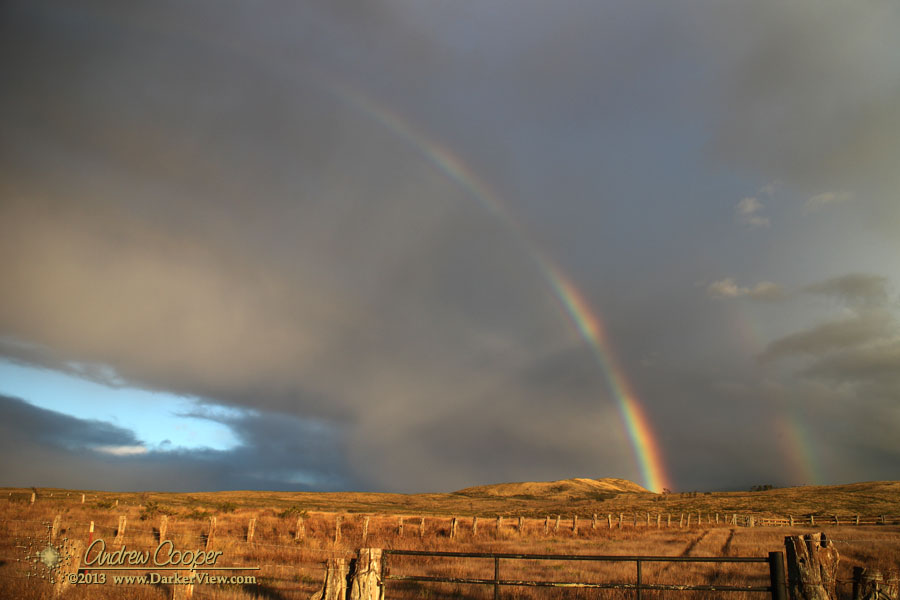
As I have mentioned previously, Waimea has rainbows. Not just a few rainbows either, but multiple rainbows through the day. Add a few cloud bows, and moon-bows into the schedule and you get the idea of how common rainbows are in this town. The last couple weeks have been above average, with rainbows even us jaded rainbow viewers have stopped and taken notice of.
I stopped for this rainbow as is looked like a good photo op, I was just on my way home from work and had plenty of time to play with a camera. To my surprise I noted that some cloud shadows were cutting the south end of the bow, creating a wheel, something I had never seen before.
Today the Earth is closest to the Sun, a point called perihelion. We will be about 147,099,000km (91,403,000miles) from the Sun. Compare this to the 152,096,000km (94,508,000miles) we will be at aphelion on July 3rd, a difference of about 4,996,000km (3,104,000miles) occurs throughout one orbit.
It may seem odd that we are actually at the closest for the middle of northern winter, you just have to remember that proximity to the Sun is not the cause of the seasons. The seasons are caused by the axial tilt of the Earth, creating short and long days throughout the year, with a resulting change in the angle and intensity of the sunlight.
| 2014 Solstices and Equinoxes | ||||
|---|---|---|---|---|
| UT | HST | |||
| Perihelion | Jan 4 | 05:59UT | Jan 3 | 19:59HST |
| Vernal Equinox | Mar 20 | 16:57UT | Mar 20 | 06:57HST |
| Summer Solstice | Jun 21 | 10:52UT | Jun 21 | 00:52HST |
| Apehelion | Jul 3 | 22:59UT | Jul 3 | 12:59HST |
| Autumnal Equinox | Sep 23 | 02:30UT | Sep 22 | 16:30HST |
| Winter Solstice | Dec 21 | 23:03UT | Dec 21 | 13:03HST |
| Source: NASA Sky Calendar | ||||
A reminder that the peak of the annual Quadrantid meteor shower occurs tomorrow morning, during the predawn hours of January 3rd. There should be no moonlight to interfere, no excuse not to get out and watch the sky.