I have only had three telescopes given to me this year. Telescopes in various states of disrepair. I usually fix them up, clean them up, and find a new home for them.
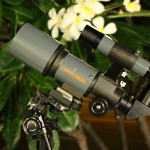
It was Julia who gave me this little bit of fun… A Celestron 62mm f/4.8 Cometron. A small refractor intended for low power viewing. Prefect for viewing comets or other wide field objects.
A Celestron Cometron 62mm f/4.8 telescope.These little refracting telescopes were sold in the 1980’s to capitalize on the comet Halley mania. Sold bearing the Celestron name, they were actually built by Vixen. They continued in production for many years as they proved relatively popular. The Cometron name has been used for a number of small telescopes over the years, but, as far as I know, this is the original.
The ‘scope I was given was in pretty good shape. Nothing broken or badly damaged. The optics dirty but free of coating damage or uncleanable grime. All that was require was disassembly and a good cleaning to remove dirt, spider webs, and a few cockroach egg cases.
Today the planet Mercury passes through inferior conjunction, passing between the Sun and the Earth. In a week or so the planet will again be visible in the dawn sky, climbing higher each day. Maximum elongation will occur November 17th.
A team of astronomers has found the first Earth-sized planet outside the solar system that has a rocky composition like that of Earth. This exoplanet, known as Kepler-78b, orbits its star very closely every 8.5 hours, making it much too hot to support life. The results are being published in the journal Nature.
Artist impression of the planet Kepler-78b and its host star. Credit: Karen Teramura (UH/IfA)This Earth-sized planet was discovered using data from NASA’s Kepler Space Telescope, and confirmed and characterized with the W. M. Keck Observatory.
Every 8.5 hours the planet passes in front of its host star, blocking a small fraction of the starlight. These telltale dimmings were picked up by researchers analyzing the Kepler data.
The team led by Dr. Andrew Howard (Institute for Astronomy, University of Hawaii at Manoa) then measured the mass of the planet with the Keck Observatory on Mauna Kea, in Hawaii. Using the ten-meter Keck I telescope fitted with the HIRES instrument, the team employed the radial velocity method to measure how much an orbiting planet causes its star to wobble, to determine the planet’s mass. This is another excellent example of the synergy between the Kepler survey, which has identified more than 3,000 potential exoplanet candidates, and Keck Observatory, which plays a leading role in conducting precise Doppler measurements of the exoplanet candidates.
One of the less common morays. How common? I had to dive Hawaiian reefs for seven years to get a good picture of this fellow. Consider I get a decent shot of a whitemouth moray about every other dive.
A zebra moray (Gymnomuraena zebra) in the coral at Hoover’s Towers
We put it together in very short notice. Fortunately a webcast is pretty easy to put together.
Keck is hosting a sizable team of folks who are here to observe comet ISON. Astronomers from several institutions are participating in the NASA Comet ISON Observing Campaign. They have a total of 6½ nights, but only the last few hours of each night as the comet rises in the dawn. Comet C/2012 S1 ISON is starting to encounter significant publicity, we may as well take advantage of this.
It was a lot of fun. I particularly like the spot (41:00) where I made the mistake of saying spectra were not very pretty to look at in a room full of spectroscopists. These folks love spectra and quickly corrected me, leading to a nice discussion on why spectra are so valuable to astronomy, often more valuable than photos.
The video is embedded below. A lot of good information about comet ISON, indeed about comets in general. Nothing like having a room full of comet experts…
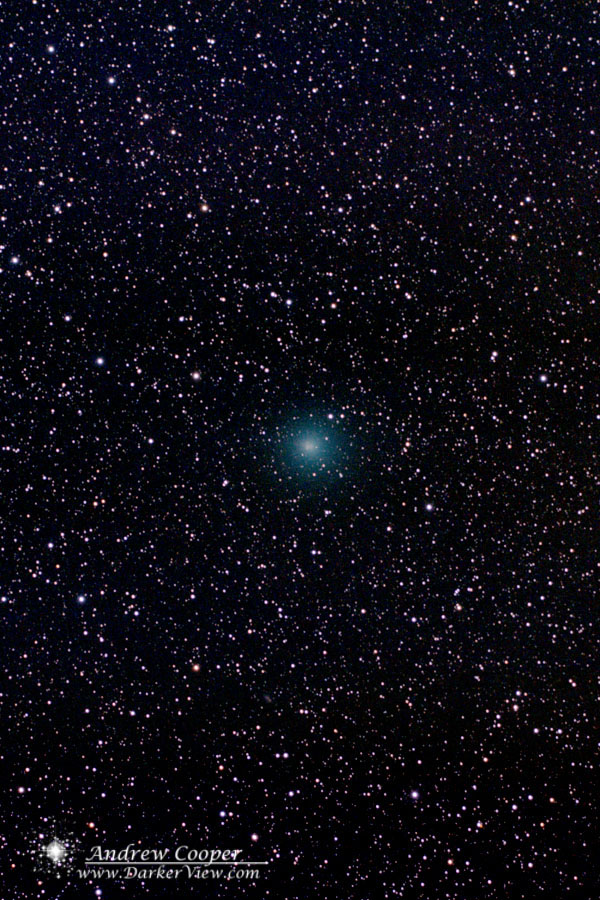
I will probably make my first attempt to photograph C/2012 S1 ISON this coming weekend. A couple reasons for waiting… The bright Moon will have moved out of the morning sky by then. The comet, currently around magnitude ten, is brightening rapidly.
On the other hand the comet is plunging towards the Sun, rising later each day. Wait much longer and the photographic opportunity will slip away, at least until after Thanksgiving, when the comet will again appear after perihelion.
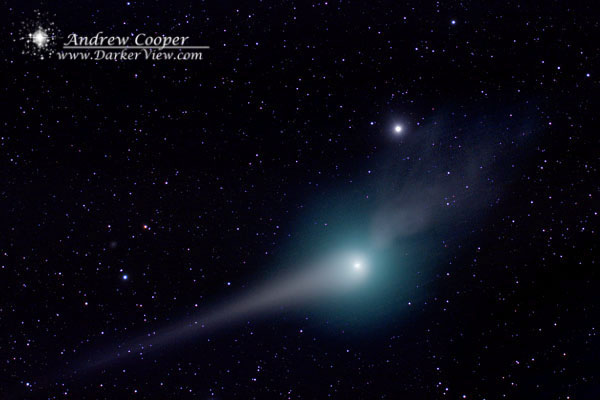
In the meantime, one of my favorite comet photos from years past…
Comet C/2007 N3 Lulin on the morning of 22 Feb 2009
Supposedly twins, each of our two telescopes has its own peculiar personality. Anyone who works on the crew can tell the telescopes apart at a glance. I do not need the caption to know this is Keck 1. Each telescope has a unique configuration, a unique set of instruments, plus many little differences that take time to appreciate and come to love…
The Keck 1 Telescope awaiting lights out and release for the night