
Ocean Entry
When you want to see the stars, find someplace dark

Our May meeting will take place Tuesday, May 14th, 7:00pm at Keck Observatory HQ in Waimea. This month we have local photographer Ethan Tweedie in to talk.
Six years I have been diving the reefs of the Big Island. Despite this I have never seen a frogfish. They are rare, but not that rare!
A flashing light catches my attention from across the open coral. Pete is signaling, he does not do that often, when he does it is usually worthwhile. Pete had been working one wall while I worked the other side of a small channel in the reef. So far I had found nothing unusual.
There it was, a bright yellow frogfish just at the edge of a small plate of coral. Not only a nice find, but a nicely posed one as well, conveniently placed for photography. By the time Pete and I had finished photographing this fish it probably had sunburn.
I owe Pete a beer.

It was fun. It is always fun!

Prince Kuhio Plaza is the largest mall on the island. Perhaps small by large city standards it is still the focal point of shopping in Hilo. The observatories and a few other organizations use tables all through the branches of the mall. In the center of it all is a stage with live music, giveaways and other activities for the crowd. The whole thing is a great family day and a great outreach opportunity.
Take two old scanners, two VCR’s, a stereo amplifier and tape deck. Place on a table with an ample supply of screwdrivers, wire cutters and other tools. Mix in a dozen middle school kids and observe the results!
As you might expect a little chaos appears. Chaos is good… Embrace the chaos! Use the result to have a little fun while learning.

I was not going to simply talk, I have always believed learning is best done by hand. Some of the gear was from my own garage, some off the electronics disposal pallet at work. A lineup of old electronics greeted the kids, then I opened the tool-bag!
Tomorrow is AstroDay at the Prince Kuhio Plaza in Hilo. I will be there! Will you?


For viewers here in the Hawaiian islands this will be a deep partial solar eclipse, with well over 40% of the Sun obscured by the Moon. This is enough to produce a noticeable drop in the Sun’s brightness at mid-day.
Please exercise caution when viewing the Sun! Use appropriate eye protection or indirect observing techniques to project an image of the Sun. The link at the start of this paragraph leads to a great discussion on viewing the Sun safely. As always the single best source on the web (or anywhere) for eclipse and transit information is Fred Espenak’s eclipse website at NASA. Stop by whenever you have a question on upcoming events as well as viewing and photography tips.
| Location | Begins | Maximum | Ends | Altitude | Azimuth | Magnitude |
| Honolulu | 14:23 | 15:48 | 17:01 | 43 | 275 | 44 |
| Hilo | 14:31 | 15:56 | 17:05 | 61 | 270 | 47 |

The early hours of dawn on May 5th will see the peak of the ηAquariid meteor shower. This is a reliable shower that produces anywhere from 30-80 meteors each hour near peak. Resulting from debris left behind by Comet 1P/Halley this shower approaches the Earth from the direction of the constellation Aquarius. As this constellation is quite low in the sky during the shower the meteors are entering the atmosphere at a low angle, this often results in meteors with long trains crossing much of the sky. A good shower that produces great fireballs.
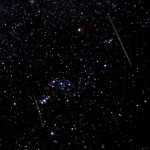
IMO analyses in recent years, based on data collected between 1984–2001, have shown that ZHRs are generally above 30 between about May 3–10, and that the peak rates appear to be variable on a roughly 12-year timescale. Assuming this Jupiter-influenced cycle is borne-out, the next trough is due around 2014–2016, so ZHRs should be relatively modest in 2013, according to this idea – IMO website
The ηAquariid shower has a broad peak with several weeks of activity either side of the peak. The entire meteor shower lasts from around April 19 to May 28. Any morning from May 3rd to May 10th can be worth watching with rates to around 30 meteors per hour. The peak itself is predicted for 01:00UT on May 6th (15:00HST May 5th), but this shower often produces subpeaks as the Earth passes through clouds of debris left on successive orbits of Halley’s Comet.
The radiant for the ηAquariid shower does not rise until the last few hours of dark, about 2:30am, making this an early morning observing exercise. 2013 does offer decent viewing conditions, with only a slim waning Moon on the day of peak activity and new Moon occurring a few days later on the 10th. Remember, meteor watching can be enjoyed without any special equipment, just a dark sky and a safe place to watch from. Perhaps a good reason to get out under a dark sky? But then, should you ever need a reason to go observing, just go.