Dr. Ben Zuckerman
University of California at Los Angeles Violent Events in Rocky Planetary Systems: Implications for the fate of technological civilizations
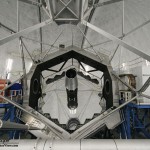
Looking into the optics of the Keck 2 telescopeThursday, October 25, 2012
7:00 PM
Gates Performing Arts Center Auditorium
Hawaii Preparatory Academy
65-1692 Kohala Mtn. Rd., Waimea
This evening, Dr. Ben Zuckerman of UCLA, will take us on a journey describing Earth’s formation 4.6 billion years ago to its possible demise 4-5 billion years from now. Along the way, we will consider a few tumultuous eras suffered by Earth’s biosphere, including the present. Such eras, from origins to final resting places, can be explored by understanding astronomical studies of other planetary systems. These systems also provide clues for the long-term fate of our technological civilization and the likelihood, or lack thereof, of civilizations beyond our own.
Seating is limited to first come, first served.
Doors Open at 6:30 PM
Free and Open to the Public
The W.M. Keck Observatory seeks a Project Manager/Engineer to work under the general supervision of the Deputy Director and in close collaboration with the Principal Engineer to manage activities for a major optics renewal program. Be part of a challenging, fast-paced, technical environment where ability, leadership, teamwork, communication and interpersonal skills are highly prized. This is a regular position with future assignments to other exciting optics development programs.
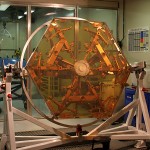
A Keck mirror segment after stripping and cleaning, ready to place in the chamber to receive a new reflective coatingThe Observatory operates two of the largest, most scientifically productive optical/infrared telescopes in the world. The twin 10-meter telescopes are located at one of the premier sites for astronomy, set amidst several other world class observatories at the 14,000 foot summit of Mauna Kea, on the spectacular Big Island of Hawaii. The successful candidate will have the opportunity to join a highly skilled, innovative and deeply committed team of professionals who excel at enabling the most exciting and important astronomical discoveries in the world.
The successful candidate will need to exhibit leadership ability, very strong communication and inter-personal skills and a strong personal commitment to the success of the program.
The principal activities of this position will be:
Project planning, tracking, reporting and proactive management of schedule, budget, risk and contingency
Responsibility for requests for proposal, vendor selection, contract negotiation and contract management
Obtaining staff resources for project
Managing the overall logistics to ensure smooth and effective workflow
Development of quality assurance plans
During the production phase: management and technical responsibility for the renewal program
Subsequent assignments may involve significant technical leadership along with project management activities.
Minimum qualifications for this position include:
Bachelor’s degree in Optics Engineering, or other engineering or physical sciences degree with experience of optics, materials science, physics, or mechanical engineering, and at least 5 years of optical systems design and implementation experience
At least 5 years of significant project management experience in managing projects of $5M or greater. Experience must include devising budgets, schedules and contingency, critical path analysis, risk identification and mitigation, and project tracking and reporting
5 years of experience in managing contracts, including generating and managing requests for proposal and statements of work, vendor selection, contract negotiation and contract management
Staff supervisory experience
Highly desirable qualifications include
An advanced degree: a master’s or doctorate in a relevant discipline
Experience dealing with optical component vendors
Experience in devising and running quality assurance programs
Familiarity with general mechanical engineering analysis techniques, ideally including experience in finite element analysis and fracture mechanics
Experience with Zemax
Experience in handling large optics (~2m diameter)
Experience in specifying, measuring and aligning optics
Experience in devising efficient information management systems for bulk technical data
This position requires you to submit your resume on-line at: http://keckobservatory.iapplicants.com with your cover letter that states why you are uniquely qualified for the position.
Additional information about WMKO and this position may be found on our website at www.keckobservatory.org EEO Employer
Low in the evening sky a thin crescent Moon will be just 6° below Mars tonight. The Moon, only 10% illuminated, will be below and to the north of the planet. Tomorrow the pair will still be close, but the Moon will be above the planet.
Star parties at Hale Pohaku are very informal affairs. You never really know who is and who is not going to show up. We just don’t plan that much.
It had just been too long, I had not had a good night out with the telescope for months. This dark moon Saturday was not going to be missed, I packed up Deep Violet and headed for The Mountain. I knew a few folks would be there, certainly Cliff and Tony. The rest of the folks were a surprise to me. As the evening progressed more and more ‘scopes showed up, a few more familiar voices in the darkness.
Almost all of the big dobsonian telescopes to be found on Hawai’i show up at the VIS for the night.We had picked a decent night. The transparency was fairly good, and the seeing was great. We enjoyed views of Jupiter better than I had seen in quite a while, Probably years. There was the red spot, moon shadows, even the moon Io could be clearly seen transiting the disk.
The only real issue was the wind, it was annoying. A couple of us moved our telescopes into the patio area of the MKVIS, where the building offered some shelter at the expense of blocking some of the sky.
There will be a very close conjunction of the Moon and Mercury this evening. A very thin moon, only 4% illuminated will pass the planet at a mere 42 arc-minutes separation. Taking into account the 30 arc-minute diameter of the Moon will leave Mercury less than 30 arc-minutes from the limb of the Moon. Mercury will be shining brightly at -0.2 magnitude, a nice match for the very young Moon. The pair will be about 15° above the horizon at sunset, allowing an excellent view of the conjunction.
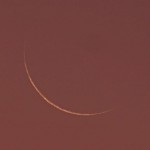
A very young moon over Waikoloa, this is only 26 hours after new, visible to the unaided eye as a sliver in the fading glow of sunsetNew Moon will occur today at 02:02HST.
My mother made jam all the time when I was growing up. She still does, I am just not home to enjoy the product very often. I remember a basement with shelves and shelves of preserves. We enjoyed the bounty of summer all through the grey days of winter.
When I was home recently I was somewhat chastised by seeing jars of homemade strawberry jam. It was delightful on the morning toast. Sitting at the kitchen table, helping my mother to destroy the newspaper crossword.
Faced with a bucketful of guava from my own tree there really was no choice. I set about slicing them up for the pot. I mostly remember how to do this, my mother made sure her sons were educated in the basic household skills, to her mind this included canning. I even have the needed tools and a stash of jars and lids.
The trick with guava is seed removal, this requires a few moments in the blender then straining through a screen colander. I have never done guava before, thus the results are a bit uncertain. I referenced a half dozen recipes across the web and noted the basic proportions they had in common. All the recipes I found require no pectin, thus I added none.
All of the jars sealed successfully, so maybe I do know what I am doing. We shall see…
There is a battery of webcams atop Mauna Kea, a few of which feature good sensitivity and are useful after dark. The telescope operators depend on these cameras to evaluate conditions around the telescopes during observation. From the warm control rooms, they can see clouds overhead, or even fog blowing over the summit.
The imagery from the Mauna Kea cameras is publicly available, a very useful feature to those of us who live and work around the mountain. But there are others use this video, looking for things that those who install and operate the cameras did not intend.
A video showed up recently, purported to show a UFO maneuvering over Mauna Kea. The camera is again the CFHT Cloudcam, a very nice camera installed to give CFHT operators a good look at approaching weather. The high quality images of this camera have occasionally shown odd events in the sky. Back in June the camera recorded a strange expanding halo of light that was eventually linked to the launch of a Minuteman Missile from Vandenburg AFB.
Purported UFO video from the CFHT CloudcamI have embedded the latest video to the right…
OK, just a dot of light that appears then fades, not very impressive. Particularly interesting is that the dot of light does not move with respect to the camera. To me this suggests some nearby fixed source of light that entered the camera from another angle. Another reasonable possibility is a geostationary satellite glinting in the sun. Making this out to be a UFO is a stretch by any measure.
As our Sun continues through the current solar maximum we should have plenty of opportunities to view one of the most sublime of all natural spectacles, the Aurora Borealis.
A strong auroral display over St. Johns Harbor, Alaska on the evening of September 4, 2012While traveling in Alaska and other northern regions there is always a possibility of a good showing. To make the most of the opportunity a little information cane be useful…
Solar Activity
Solar activity waxes and wanes in an eleven year cycle. When active there are increased numbers of sunspots and solar flares. It is this activity that can have such a dramatic effect here on Earth. A strong solar flare can be accompanied by a release of enormous quantities of material from the Sun. Called a coronal mass ejection (CME) this material streams outwards from the Sun. If the Earth happens to be in the path this material will strike the Earth’s magnetic field, causing the field to distort and reverberate with the impact. Charged particles are channeled into the atmosphere along the magnetic field to create a glowing spectacle.
Our current solar maximum should run through 2013 and into 2014 providing excellent auroral viewing conditions for the next year or two.