The instrument may date to the 1800’s but at that time it was powered by water and muscle as there was no electricity on the mountain. It was not until much later, in the middle of the twentieth century that the telescope was refitted with electrical controls and motors.
The control console for the 36″ Refractor at Lick Observatory
The seeing was pretty bad, leading to bloated stars in the image, unusual conditions for Hale Pohaku. Still a nice subject for the AT6RC and 60D camera. I expect I should shoot this target again.
M22 or NGC6656 in Sagittarius, a classic globular cluster, AT6RC and Canon 60D 20x4min @ ISO2000
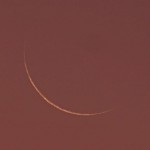
A very young moon over Waikoloa, this is only 26 hours after new, visible to the unaided eye as a sliver in the fading glow of sunsetNew Moon will occur today at 05:55HST.
Today Mercury reaches maximum elongation, the furthest point it will reach from the Sun in the sky and the highest it will be above the sunrise for this morning apparition. The planet is easily visible as a bright, starlike object about 15° above the rising Sun as the twilight begins. Over the next couple weeks Mercury will slide back into the sunrise, heading for superior conjunction on September 10th.
The visitor directions on the website had specifically cautioned that the summit road was curvy, something I found to be a drastic understatement. From the very bottom it is curve after curve all the way up, with almost no straight sections. S-curves followed sharp bends leading to hairpins. Nearer the observatory the curve intensity only increases as the road narrows. Local history indicates that the horse-drawn wagons that transported heavy equipment up this road could not negotiate steep grades, the only solution was to follow the contour of the mountain, resulting in an incredibly curvy road.
On a sunny Saturday afternoon there were other users, the road is apparently popular with local cyclists. With the density of the sharp curves there was often little choice but to follow at bicycle speeds at times. I would much rather drive up Mauna Kea than this road again. Next time up Saddle to the summit I will recall Mt. Hamilton road and consider myself lucky.
The reason I was climbing this winding road was simply to be a tourist. Unlike the previous seven days, this day was to be fun. For much of the previous week there had been full day sessions of lectures and labs covering the intricacies of adaptive optics systems. Spending a full week in Santa Cruz might be considered a vacation, aside from the fact there had been very little open time to explore the surrounding area. There was only one open day in my travel plans, and I had specific plans for that day, a visit to an observatory.
The 36″ refractor at Lick ObservatoryI arrived well ahead of my late afternoon tour appointment, no problem, just play tourist for a while. At the gift shop / information desk I met Lotus Baker, a longtime Mt. Hamilton resident. She was full of stories and information. We chatted for a while, until her turn to lead a tour of the classic 36″ Lick refractor. Lotus proved to be an excellent tour guide, providing an enjoyable tour of this beautiful telescope.
Tomorrow morning a thin Moon will join Mercury in the dawn. The 4.6% illuminated Moon will be a bit under 6° from the planet, with the planet closer to the sunrise. The pair will be over 15° above the horizon at sunrise.
Mars will pass between Saturn and Spica this evening. Currently moving in retrograde, the red planet will be directly between the ringed planet and the star. All three will be close to 1st magnitude. Saturn and Spica are currently about 4.5° apart. Mars will be just under 2° from the star.
The trio will be close for a couple weeks. On the 21st a thin crescent Moon, 24% illuminated, will join to create a very nice quartet.
Tomorrow morning, August 13th, the Moon and Venus will meetup for a nice conjunction. Separated by only 1°17′ the pair will be a nice match. The Moon will show about 16% illumination compared with Venus at -4.3 magnitude. A telescopic view of the planet will show that Venus is also at a partial phase, about 50% illuminated.
Viewers further north will be able to witness an occultation, Venus will slide behind the Moon during the middle of the day when high in the sky.
Jupiter will be about 22° west, higher in the sky. While Mercury is still visible just ahead of the rising Sun.
The massive set of cables going into the telescope must twist as the telescope rotates. Besides cables there are also hoses to carry high pressure oil, glycol coolant and compressed air. To accommodate the rotation, these cables and hoses go through a large assembly called the Azimuth Wrap. Looking a bit like an oversize bicycle chain with cable laced through the links, the wrap insures the cable does not kink, tangle or stretch as the telescope sweeps back and forth.
Lacing new cable through the wrap is an intricate task of threading through the metal comb that supports the cables in each link. See the little pink one in the middle, just did that…
The many cables needed to operate the Keck 2 telescope thread through the azimuth wrap.