
A very thin Moon will rendezvous with Mercury this evening. The pair will separated by about 8° and at the same elevation, over 20° at sunset. The Moon will be a very thin crescent, only 7% illuminated. A little over 5° north of Mercury will be Pollux, with Castor a bit further north, both stars about a magnitude dimmer than the planet which is currently about zero magnitude.
Author: Andrew
An electrical engineer, amateur astronomer, and diver, living and working on the island of Hawaiʻi.
Discovery of the Most Distant Galaxy in the Cosmic Dawn
W. M. Keck Observatory press release…
A team of astronomers has used the Subaru Telescope and the W. M. Keck Observatory to discover the most distant galaxy yet, at 12.91 billion light-years from the Earth. This new galaxy, dubbed SXDF-NB1006-2, is slightly farther away than the previous record holder, galaxy GN-108036, which was found last year.
To identify SXDF-NB1006-2, the team used the Subaru Telescope to observe a total of 37 hours in seven nights in two wide fields of the sky. The team, led by Takatoshi Shibuya (The Graduate University for Advanced Studies, Japan), Dr. Nobunari Kashikawa (National Astronomical Observatory of Japan), Dr. Kazuaki Ota (Kyoto University), and Dr. Masanori Iye (National Astronomical Observatory of Japan), carefully processed the images they had obtained. Shibuya measured the color of 58,733 objects in the images and identified four galaxy candidates at a redshift of 7.3, which translates into about 12.9 billion light-years. A careful investigation of the brightness variation of the objects allowed the team to narrow down the number of candidates to two.
 Color composite image of the Subaru XMM-Newton Deep Survey Field of galaxy SXDF-NB1006-2, credit NAOJ
Finally, the team needed to make spectroscopic observations to confirm the nature of these candidates. They observed the two galaxy candidates with two spectrographs, the Faint Object Camera and Spectrograph (FOCAS) on the Subaru Telescope and the Deep Imaging Multi-Object Spectrograph (DEIMOS) on the Keck II Telescope, and identified one candidate for which a characteristic emission line of distant galaxies could be detected. The results are slated to be published in the June 20, 2012, edition of Astrophysical Journal.
In addition to locating the galaxy, the team’s research verified that the proportion of neutral hydrogen gas in the 750-million-year-old early Universe was higher than it is today. These findings help to decipher the early Universe during the “cosmic dawn,” when the light of ancient celestial objects and structures first appeared. They concluded that about 80 percent of the hydrogen gas in the ancient Universe, 12.91 billion years ago at a redshift of 7.2, was neutral.
Continue reading “Discovery of the Most Distant Galaxy in the Cosmic Dawn”
Summer Solstice
Summer solstice occurs today at 13:09HST. Today the Sun will occupy the most northerly position in the sky of the year. The term solstice comes from the latin terms Sol (the Sun) and sistere (to stand still). On this day the Sun seems to stand still as it stops moving northwards each day and begins move to the south. This is the first day of summer as marked by many cultures in the northern hemisphere.
| 2012 Solstices and Equinoxes | ||||
|---|---|---|---|---|
| UT | HST | |||
| Perihelion | Jan 5 | 03:59UT | Jan 4 | 17:59HST |
| Spring Equinox | Mar 20 | 05:14UT | Mar 19 | 19:14HST |
| Summer Solstice | Jun 20 | 23:09UT | Jun 20 | 13:09HST |
| Apehelion | Jul 4 | 23:59UT | Jul 4 | 13:59HST |
| Fall Equinox | Sep 22 | 14:49UT | Sep 22 | 04:49HST |
| Winter Solstice | Dec 21 | 11:12UT | Dec 21 | 01:12HST |
| Source: USNO Data Services Website and the NASA Sky Calendar | ||||
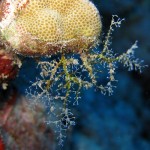
Blue Octocoral

New Moon
Three Dives on a Holiday Weekend
We managed three dives last weekend. It was a holiday weekend, Kamehameha Day, that helped. But still, we average a couple dives a month, three dives in a weekend was a bit unusual. We dove with some friends at Pukao on Saturday. Then two more on the following Monday. This was conservative, a few of the guys dove on Sunday too!
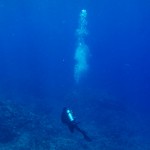
Thus, Monday morning saw us packing up the dive gear, a cooler with drinks and sandwich makings for everyone, and heading for Honokohau. There Deb and I joined Dennis and Mark for a very nice day diving.
We have been diving a lot in the NELHA area lately, I expect we will be diving some more there. It is some spectacular diving in the area. A rich reef sloping out to a steep drop-off that descends far beyond scuba depths. You look into the deep blue and know that somewhere down there is the abyssal plain, 8,000 feet below.
As usual I had my face in the coral, in and out of every crevice or small cave I came across. This is a great way to find the little stuff I love to photograph, but you can miss the big stuff… A series a sharp clangs gets my attention, the sound of Mark’s tank banger. I pull myself out of an alcove and swim over the large coral outcropping just in time to see a ten foot manta sweep by! The manta was just beyond the reef drop-off, against the deep blue of open water.
The find of the day was a Spanish Dancer, the largest nudibranch found in the islands. I do mean large, while most nudi’s I locate are an inch or two long, this fellow was the size of a dinner plate. Dancers have another feature… They Dance! Actually a form of swimming through undulating the body. I flushed him out of a crevice in the cave and the nudi proceeded to dance for us, everyone got a good look. After a few photos, actually quite a few photos, I carefully shepherded the pretty fellow back into the crevice I found him in.
No dives this weekend, I was on call. But we are already planning another outing next weekend. Summer diving season is here, bringing calm and clear water to the Kona side. The crew is ready to go, discussing where we will dive next.
Venus and the Hyades
As Venus approaches maximum elongation it will pass through the Hyades star cluster. Because Venus reaches it maximum western excursion on July 1st the planet will sweep out an arc that runs just inside the V-shape of the cluster. Thus the planet will remain within the main body of the cluster for the next 20 days.
Today the planet is only 26′ from εTau at one corner of the V-shaped cluster. On July 8th the planet will pass about 1° from Aldebaran as it exits the cluster at the other corner of the V.
Postcard from the Universe – Galactic Center
The last time out I fitted a camera ball mount to the counterweight shaft of the Losmandy mount. This allowed me to shoot an additional camera at the same time, along with the camera attached to the telescope. The second camera can be aimed at a different target completely. With a relatively wide angle lens, tracking errors become insignificant.
With the center of the Milky Way high overhead it made an obvious first target to test this wide-field setup. The results are quite nice, a series of one minute exposures reveal the star clouds in fine detail. The camera for this run was the Canon 60D, as the 20Da was shooting the Lagoon at the time. I need to swap places and try the shot again with the 20Da to see what the Hα sensitivity reveals, capturing more of the nebulae that is mingled with the stars.
The lens was an older Nikon 50mm f/1.8 stopped down to f/2.8, nice round star images right into the corners of the frame. Yes, a Nikon lens mounted to a Canon camera, you can do that. A very nice lens, I will be using it again for this work.

Postcard from the Reef – Hydroid Stings
This is not a case of “I wish you were here”, but rather another lesson in the many hazards of diving.
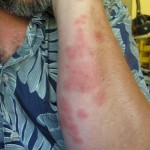
I know when I got hit, a series of pricks down my left forearm. I didn’t even react, I was concentrating on the photo. I continued to brace myself against the surge by using the rocks of the cave floor. Those rocks were home to some little critters that had an issue with the disturbance I was creating… Hydroids.
Through the rest of the dive my arm continued to sting, discomfort that persisted but was not really all that bad. I took no action other than noting that I had gotten hit. It wasn’t until the next day that I realized that the stings were not going to go away quickly. I had a series of red welts across my forearm, and they itched. Time to break out the hydrocortisone cream. A week later the welts have faded and shrunk to pinpoints, no longer itch, but are still there.
Friday evening we stopped into the shop of Kohala Divers for a bit. There were a few folks we know in the shop as they were having an open house. As I chatted with Lina Preskitt, a local marine biologist, I mentioned the stings, showing her my forearm. She raised her forearm to display a very similar set of red welts on her left arm! We laughed as we looked at a mirror of almost identical stings.
This is the second time I have been seriously stung by hydroids. Will it stop me from diving? Not at all. Perhaps be a bit more careful when mucking about on a cave floor.
The Moon, Venus and Jupiter
A nice trio will grace the dawn tomorrow, the morning of June 17th. Three bright objects will be visible just before sunrise. A brilliant Venus will be 14° above the horizon at sunrise. Above Venus will be a very thin crescent Moon, only 4% illuminated, will be 4° above Venus. About 8° above Venus will be Jupiter, shining brightly at -2.0 magnitude. Thus Jupiter will be the first to rise, at 04:02HST. Sunrise will occur about 05:43, leaving plenty of time to enjoy this bright conjunction.