Solid Rock is Not Forever

Living with active volcanoes, one gets to see new landforms appear regularly. The landscape can get rearranged with little notice, with places I once visited buried under new rock. In my time living on Hawai’i, I have seen roads, bays and tide pools, and entire neighborhoods disappear under new lava. Watching new land created by these flows of liquid rock is mesmerising.

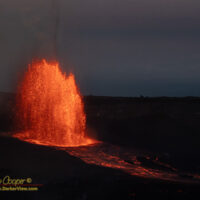
61G lava flow ocean entry
The 61G lava flow ocean entry at Kamokuna under the light of a full Moon

The opposite is also true around here, sometimes prominent landforms are erased by the actions of flowing water, or the incredible power of wind and wave.

Thus we bid farewell to the Hōlei Sea Arch, cast into the sea by the heavy surf generated by Hurricane Nolo.

The arch was one of the features of Hawaiʻi Volcanoes National Park found along Chain of Craters Road. Featured on park maps and served by a viewpoint and interpretive signs, thousands of tourists have stood atop the cliff to admire what waves had sculpted from the jagged black sea cliffs.

Those same waves have erased what they carved. Sometime around September 27th, the arch fell into the sea. Apparently, no one witnessed its fall, there are no Facebook posts or YouTube videos of falling rock. All we have are before and after photographs. This is understandable as the park was closed during the hurricane.

I last visited the arch over a year ago, travelling the park with my parents. It had been noticeably eroded by the waves, appearing much thinner around the base than on previous visits. It was only a matter of time.
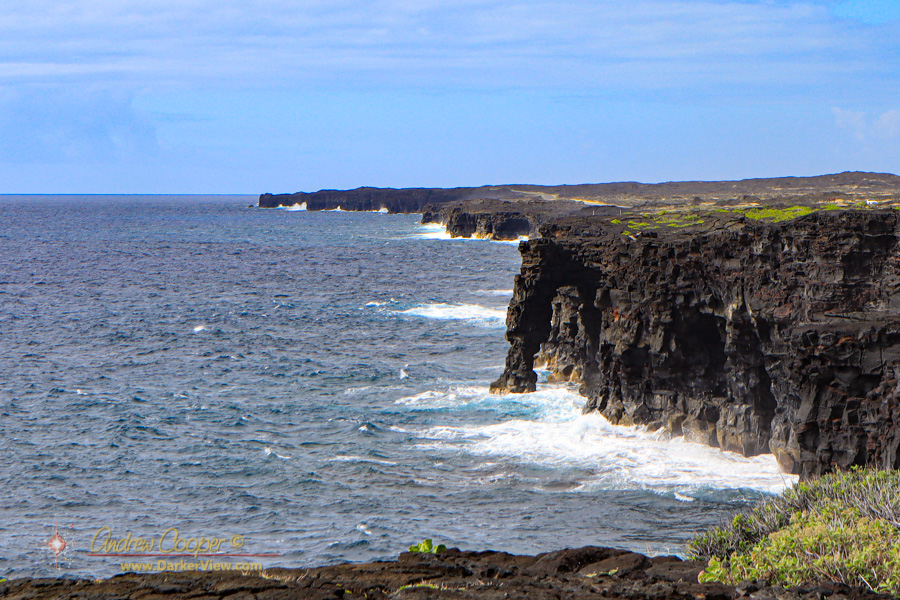
Hōlei Sea Arch and the sea cliffs along the southeastern coast of Hawai'i
Hōlei Sea Arch and the sea cliffs along the southeastern coast of Hawai’i in 2025

Hurricane Season

It is a wee bit active out there…

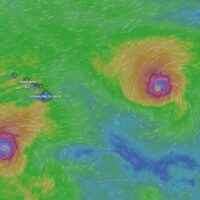
Hurricanes Lowell and Karina churn the ocean either side of the islands
Hurricanes Lowell and Karina churn the ocean either side of the islands on September 4th, 2026

Three major hurricanes are wandering the eastern Pacific right now, two uncomfortably close to the islands.

Last month’s hit from Hurricane Lala did significant damage to the southern parts of the island, dropping up to 40 inches of rain, flooding Waiʻōhinu and Nāʻālehu, destroying homes and businesses. At our house, we spent a day without power and lost one of our mature plumeria.

It was only a couple of weeks, and we are facing another round…

Hurricane Lowell has passed us here on the Big Island, but is forecast to take an abrupt turn to the north, threatening Kauaʻi and Niʻihau. Hurricane Karina is forecast to swing north of us, but close enough that we may experience some impact.

With a record-breaking El Niño warming the water of the central Pacific, it is more than likely we will see even more storms beyond these. To live in interesting times…

Hurricane Lala

Lala was not our first hurricane.

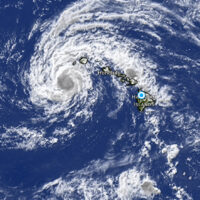
Hurricane Lala sweeps through the Hawaiian Islands

After two decades of island life, we have been through a few hurricanes. In general, our location on the island, in the lee of a 13,802ft mauna, has protected us from the worst. Stiff winds and heavy rain from some, while a couple of hurricanes have passed with blue skies and almost no wind for those of us in the lee.

Lala was not our first hurricane, but it was the most serious yet.

Continue reading “Hurricane Lala”

Crunchy

If I were to use one word to decribe a recent visit to the park it would be…

Crunchy.

Tephra from recent eruptions in the lawn at Kilauea Military Camp

The year and a half long series of eruptive episodes has been beautiful and exciting. Tall lava fountains every couple weeks that put the lava in Hawaiʻi Volcanoes National Park, drawing huge crowds and providing a spectacle for both tourists and us island dwellers alike.

A combination of several high lava fountains and our usual winter Kona storms has resulted in episodes of tephra falling across the main sections of the park, closing both the park and the Mamalahoa highway.

The southerly winds brought about by Kona low pressure systems has sent the tephra northeast instead of the usual southwest. Instead of settling in the desolate and uninhabited Kaʻu Desert, tephra has instead fallen heavily across the park entrance area and highway, the visitor center, and the main caldera viewpoints. Tephra has reached beyond the part to impact Volcano Village, and even reached as far as Hilo.

Continue reading “Crunchy”

Episode 45

Time for another volcano run.

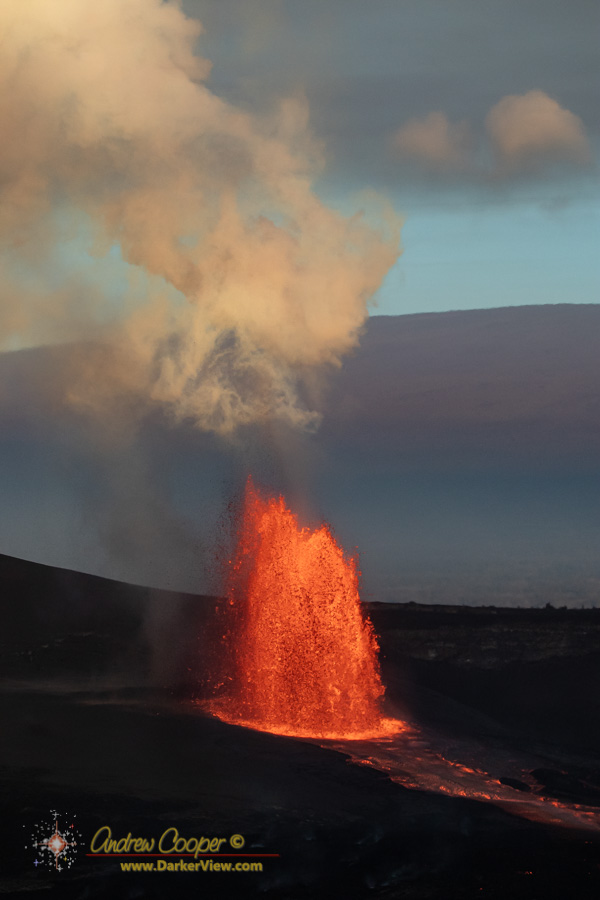
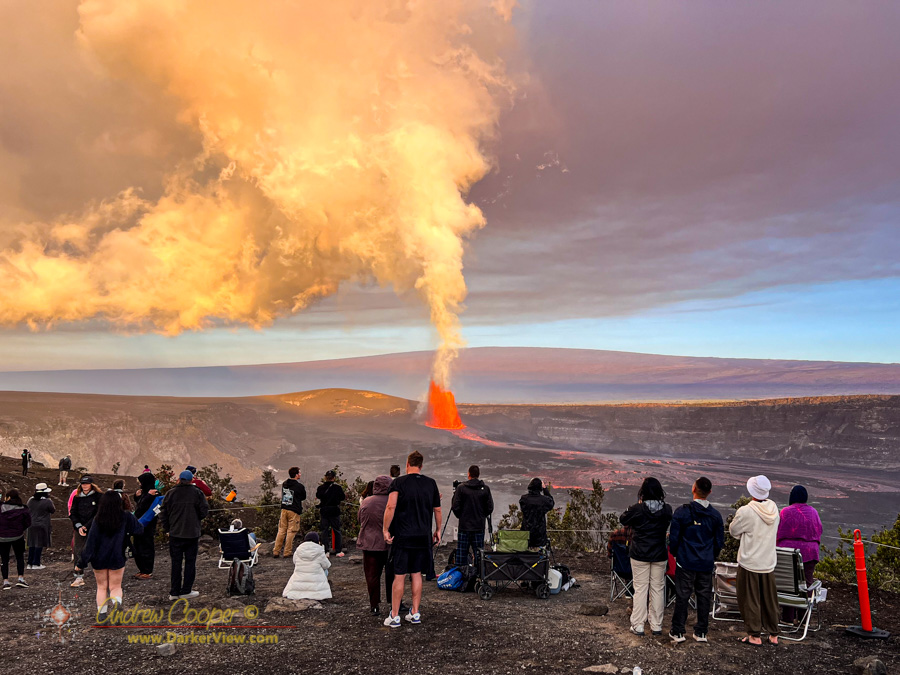
The tall lava fountian of episode 45 in Kilauea Caldera as photographed from the Keanakako'i Overlook, on the morning of April 23 , 2026
The tall lava fountian of episode 45 in Kilauea Caldera as photographed from the Keanakakoʻi Overlook, on the morning of April 23, 2026

I had skipped or even aborted going to several recent episodes as conditions looked bad. When Episode 42 looked imminent, I was packed and ready to go. Then I looked at the winds… From the south. I aborted before ever leaving the house. A good decision, it rained rock in the main section of the park and on the viewpoints, thus the park and the highway were quickly closed.

Episode 43 occurred in heavy rain, while episode 44 was a repeat of 42 with tephra blowing to the northeast, prompting the park and highway to be closed again. Based on the chatter, I think most of the volcano junkies on-island were feeling a bit of frustration.

With another eruptive episode looking likely, I put my boss on notice that I might just collect that day off I was owed. Waking to a 2 am alarm, I rolled over, grabbed the iPad and checked the USGS webcams… We have a go!!

Continue reading “Episode 45”

Bloom in the Lava

Hawai’i is not known for the sort of mass blooms that occur across large sections of the arid Southwestern US in years of favorable rainfall. But a smaller version does occasionally occur across the younger lava flows around Waikoloa and Kiholo.

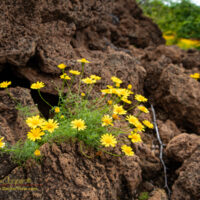
A spring bloom in the Waikoloa lava fields with bright yellow Dahlberg daisies (Thymophylla tenuiloba) carpeting the ground

Spring storms have brought several inches of rain to the normally arid Waikoloa area, the soils are saturated. A few species of wildflower have taken advantage of the conditions to bloom en-mass.

The primary species is Dahlberg daisy (Thymophylla tenuiloba) carpeting many acres in a bright yellow show. Among the rough terrian of rock and mesquite it is rather pretty.

Dalhberg daisy is an invasive, probably imported as an ornamental, but this short lived annual does not seem to have any worrisome ecological impacts and is not a high priority for eradication.

Continue reading “Bloom in the Lava”