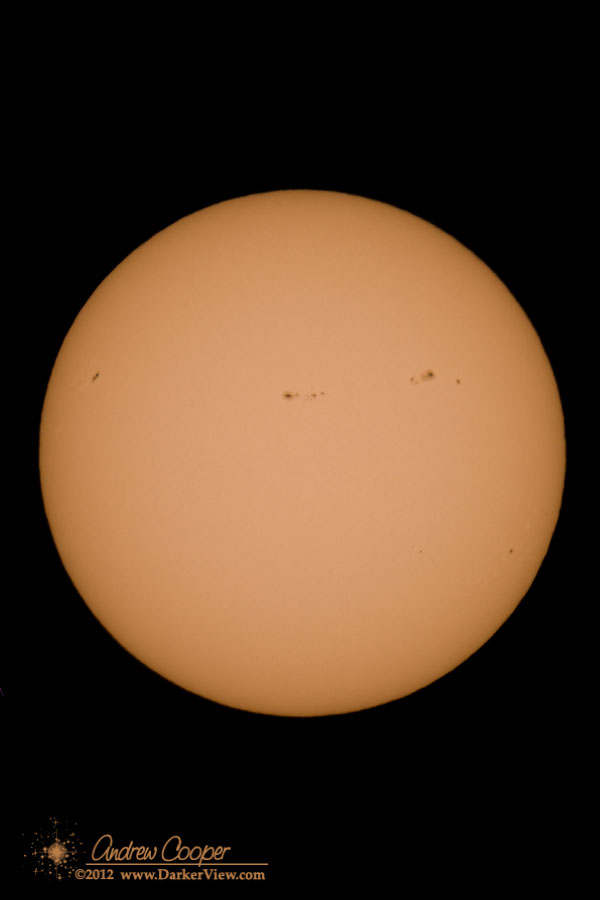
Set up the gear again to get ready for Venus Transit. Attempting to autoguide on the Sun. No luck with the guiding, the software just does not like a non-pinpoint target. I did take a few photos in the process of messing about…
When you want to see the stars, find someplace dark

Set up the gear again to get ready for Venus Transit. Attempting to autoguide on the Sun. No luck with the guiding, the software just does not like a non-pinpoint target. I did take a few photos in the process of messing about…
You have heard it before, but it really is true! Looking at the Sun for longer than a few brief moments with an unprotected eye can lead to permanent damage. Looking at the Sun with any sort of optical deceive that has not been properly filtered can lead to instantaneous eye damage.
Discussed below are the only safe methods I am aware of to view the Sun. There are some dodgy methods out there. Take chance with your irreplaceable eyesight? I think not. Be careful and do it right if you want a look.
For the unaided eye there are a couple options to view the Sun safely…
A much better view of the event can be seen if modest magnification is used. Do keep in mind that any soft of binoculars or telescope also concentrates much more light that the eye alone. Remember those childhood “experiments” involving a magnifying glass and ants? The best options here are the use of solar filters designed to be used on a telescope, or indirect means such as image projection.
Keep in mind that the beam of light out of the eyepiece is quite intense, potentially hot enough to burn a careless finger placed near the exit from the telescope.
The method works best with small optical systems, binoculars or the smallest of telescopes. You do not need big optics to project a very nice solar image.
You do not have any optics? Use the simplest optical arrangement of all, the pinhole camera!
If you do not have a safe means of viewing the transit and do want a look, you can go to one of the many public events being organized. Here on the Big Island there are quite a few options, one should be close to you.
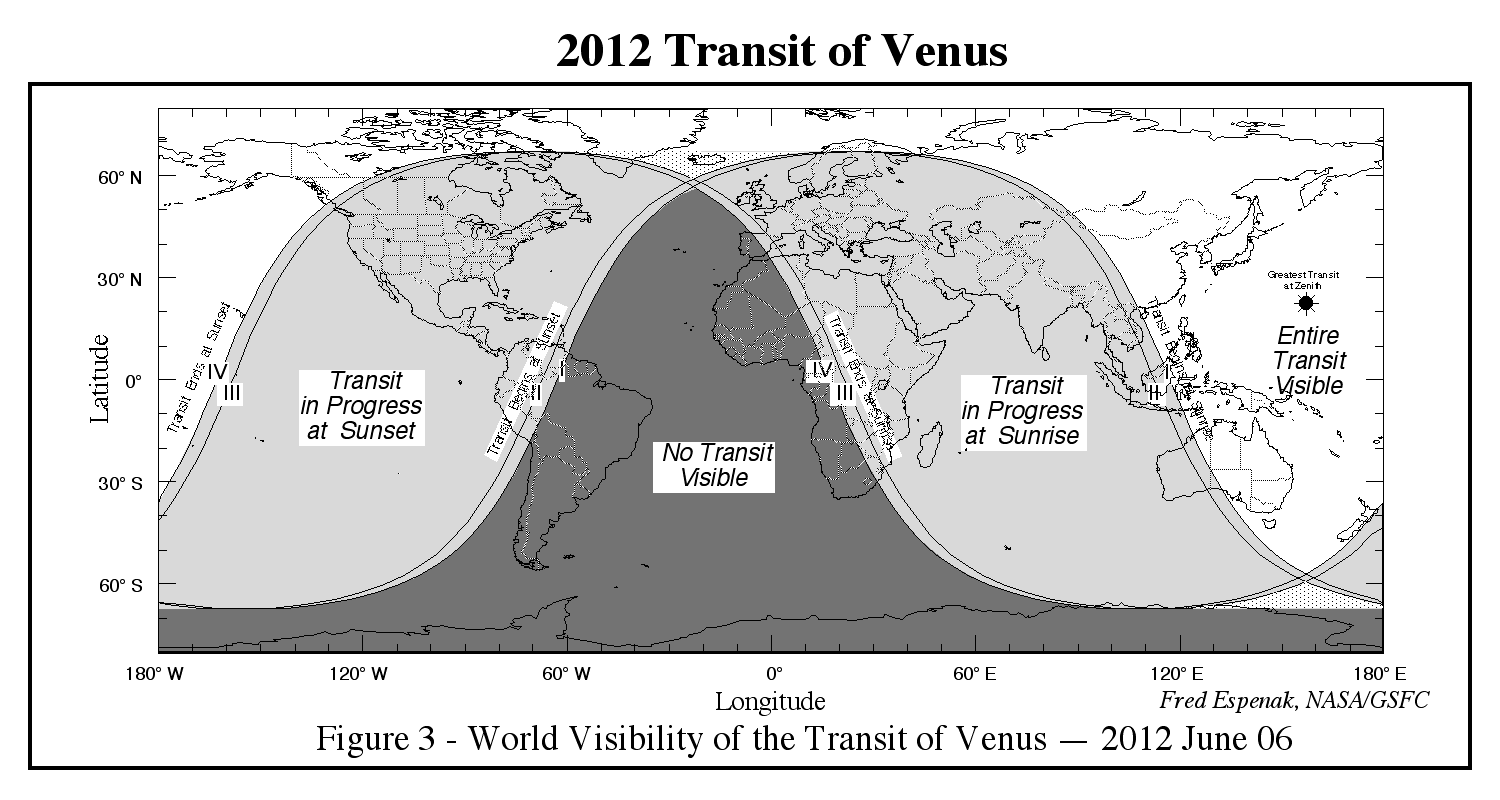
Everyone is gearing up for the Transit of Venus. Starting at just after noon on June 5th, Venus will cross the face of the Sun. This will be our last chance to see such an event in our lifetimes, as a result, many skywatchers are making an extra effort to see this transit. This includes a number of folks who are traveling to Hawai’i this June, just to be here for the transit.
There will be solar telescopes stationed at the MKVIS, at the summit, and at a number of other locations around the island. With many options to choose from, you do not need to go to the summit to get at least some view of this event.
The diehards, those wanting to see the entire transit, will probably go to Mauna Kea. I really do not know what sort of crowd to expect on the mountain. While it could be substantial, I really expect a more modest showing than some folks are predicting. In any case it will be a fun event.
Myself? I will be on the summit. I will be running the Keck live webcast of the event using one of my telescopes. From a vantage point behind the Keck 1 telescope we should be in position to witness the entire event from start to finish.
Dark sky filled with stars
Telescopes help us see them
Takes your breath away
– Jennifer Sanchez
Space explorers
In the night implore
Please let it not rain!
– Mz’ili McKezfue (age 7)
Falling from the skies
In our scary, lonely nights
Brightening the sky
– Angelita Camacho
It is amazing how much can be encompassed in so few words.
Poems used with permission.
As you might notice, the times change by a mere two seconds between Kona and Honolulu. These times will be pretty close for the entire island chain. That last number is the Sun’s altitude, the angle above the horizon. Note that this is near 90° for Hawai’i, nearly straight up for the start of the event. Final contact will occur with an altitude of about 5°, just above the horizon near sunset.
| Location Name | External Sun Ingress Alt h m s ° |
Internal Sun Ingress Alt h m s ° |
Greatest Sun Transit Alt h m s ° |
Internal Sun Egress Alt h m s ° |
External Sun Egress Alt h m s ° |
| Anchorage, AK | 14:06:30 51 | 14:24:04 51 | 17:26:53 38 | 20:30:46 16 | 20:48:32 14 |
| Honolulu, HI | 12:10:07 85 | 12:27:46 89 | 15:26:20 49 | 18:26:38 9 | 18:44:38 5 |
| Kona, HI | 12:10:09 86 | 12:27:48 87 | 15:26:16 47 | 18:26:33 7 | 18:44:33 3 |
| Los Angeles, CA | 15:06:26 58 | 15:24:02 55 | 18:25:33 18 | — – | — – |
| Phoenix, AZ | 15:06:03 54 | 15:23:40 50 | 18:25:32 13 | — – | — – |
| Portland, OR | 15:06:05 57 | 15:23:40 54 | 18:25:53 23 | — – | — – |
| San Francisco, CA | 15:06:29 61 | 15:24:04 57 | 18:25:39 22 | — – | — – |
| Seattle, WA | 15:05:58 56 | 15:23:32 53 | 18:25:57 23 | — – | — – |
All times are local time. Keep in mind that this event occurs on June 5th for viewers in the US and Hawai’i. Some sources show June 6th for a date, and so it will be for viewers on the other side of the date line in Australia, Japan and China.

There is only one more chance in our lifetimes to see a Transit of Venus. If you are curious about this event, where do you go to see it?
For those folks who just want a nice view of the event, and do not necessarily need to watch for the entire seven hours, there are a number of easier options. To accommodate the public, there will be solar telescopes setup and manned by volunteers at a number of locations around the island…
After years of a nearly blank solar disk, we have a beautifully active Sun. Any time you have a chance to see the Sun through a telescope this year, do so. The view is replete with sunspots, or if you have a Hα filter, prominences and more…


Stars in the night sky
Keck Observatory sees
When was the Big Bang?
– Barbara Russell
Thanks to the work of a lot of astronomers and observatories, including Keck, we can answer that one… The Big Bang was 13.75 ±0.11 billion years ago.
Modern astronomy has allowed us to answer questions that have been asked for as long as curious humans have looked at the universe around us. Curiosity as expressed in a poem is part of what we are as humans. That is why we build and maintain the big telescopes. Thanks Barbara!
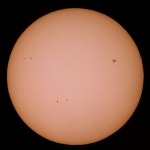
First up? just setup the ‘scope in the driveway and take a few photos of the Sun. Just checking the photographic setup, the necessary parts and pieces. Nothing misplaced? Where did I store the solar filter? A nice focus on the camera? Perhaps take some nice photos of the large sunspots that current grace the surface of the Sun while I am set up. I hope we have some nice spots during the transit, they make focusing so much easier!
Next step is to get autoguiding operational, this will be a seven hour event and I really do not want to manually guide for the entire duration. Particularly with a telescope that was setup in the daytime and is not properly polar aligned.
A couple other steps remain in the preparation. Automate the camera to take photos at a regular interval. Insure I can provide a good video feed to the computer sending out the webcast. I do have a few more weeks to accomplish this. I am certain those weeks with speed by surprisingly quickly. Time to get ready!