A secretive species, the cusk eels are seldom seen by divers on Hawaiian reefs. They shelter in caves and crevices during the day, emerging at night to forage. This eel was holed up in a shallow crevice low in a rock wall. I shot one half decent photo before it retreated further into the crevice, out of sight.
Bearded Cusk Eel (Brotula miltibarbata) in a crevice at 24' depth Amphitheater
The first galaxies had an extraordinary impact on the young universe. Their ultraviolet light destroyed nearly all of the atoms in the cosmos. This process, called reionization, had severe consequences for galaxies trying to form thereafter. Unfortunately, we have no idea how it happened. In galaxies today ultraviolet light cannot escape, so the first galaxies must have been very different from those we see today. Dr. Siana will describe the quest to detect these first galaxies and their impact on the early universe.
There is no charge for admission to any events in the Makana series.
Presented by W.M. Keck Observatory. This event will also be streamed live on the Keck Observatory website.
There are few open paths to trail ride on this island, a place where landowners gate every side road and jealously guard any access. There are a number of exceptions, but you have to look to find them. One such is a power line road off of Saddle Road. The power line is gone now, the stumps of poles remain where they were sawn down years ago. The road runs arrow straight across the landscape, now serving forestry crews, pig hunters and hikers. Enough traffic traverses the path the keep it clear of growth. Here is a glimpse of natural Hawai’i, where invasive species are relatively few and the calls of native birds echo amongst the ‘Ōhi’a.
Getting ready to set down the trail to Emesine CaveWhile I had hiked the trail a couple years past, cycling gave me a whole new appreciation for the ruggedness of this old power line road. Whole sections were cobble that shifted and rolled under the knobby tires. I got a lot of rock dodging practice, carefully choosing where to run my tires through the rough lava. In the end I was forced to walk the bike along whole lengths of the route where the loose cobble was simply too dangerous to ride. The sections among more recent flows were the rough parts where the road was simply bulldozed through the rock.
It may be a rough trail, but the goal is worth it, a relatively recent cave with an array of classic lava tube features. Emesine cave, is found in the 1881 lava flow that threatened to flow into downtown Hilo, but stopped just short of the city. Today, over a century later, the cave is now an excellent example of volcanic action and how life returns to reclaim the land afterwords.
The entry of Emesine CaveErupting from a vent high on the eastern rift zone of Mauna Loa, this flow was typical of Mauna Loa flows. There had been a small summit eruption several months earlier, then a series of lava fountains that fed ‘a’ā flows down either flank of the eastern rift zone. The most dangerous phase of the eruption began mid-November 1880, when a fissure opened lower on the mountain that fed a series of lava tubes. Pahoehoe lava traveling down-slope in these well insulated tubes allowed the flows to advance further and faster than the earlier ‘a’ā flows.
The flows did not stop until August 10th 1881, reaching within a few miles of downtown Hilo. Some fingers of the flow crossed the present day Komohana and Kumukoa Streets near the University of Hawai’i at Hilo campus. When the flows finally did stop a number of lava tubes were exposed, including Kaumana caves, a popular tourist attraction above Hilo. Also formed in the eruption was a series of tubes higher on the north flank of the volcano, Emesine cave.
I have not had a bad cold in quite a while. Wednesday last week I felt the first symptoms, a sore throat beginning. I expected it, Deb had been suffering for a couple days by then. Thursday morning it was inescapable, I called in sick to work. I hoped it would be over by the weekend, I had promised to help out with Astroday and present a lecture on behalf of Keck at the Mauna Kea VIS. This would be the second run across island to Hilo in as many weeks, after almost a year without visiting Hilo, funny how that works.
By Saturday morning things were better, but not great. So off to Hilo I went, a good dose of decongestant improving the situation. I may not have been at 100%, but I had commitments to keep.
David Lynn manning the Keck table at Astroday 2012Astroday is always fun, everyone from the astronomy community setting up tables and educational exhibits throughout the Prince Kuhio Plaza Mall in Hilo. At this point I know so many of the folks there, even the guys from Hilo I only meet a few times each year. The event is really designed for kids, with plenty of activites and a little education mixed in.
I manned the Keck table for a couple hours until David relived me. We did the Astro Haiku contest again. Not bad, but it was a repeat of last year. We really need to get some science experiment bling for our table next year. I have some ideas for that.
You may notice some old articles this month. I am continuing to re-post stuff from the old blogging platform to migrate the material to the new WordPress platform, the good stuff anyway. If you had not read these old posts before… Enjoy. If this is a repeat for you, I apologize. There will be plenty of new material being posted as well.
A fern draped opening into the earth, that beckons us to explore what was once the domain of Pele. A place of fire and molten rock, now a cool, dripping passage beneath the earth. The island of Hawai’i is riddled with hundreds of miles of lava tubes, most are inaccessible, but some are easy to get to. Kaumana Cave is one of the easy ones.
The fern draped entry to the Kaumana lava tube, HDR blend of three exposuresA steep staircase leads into a collapse pit. Here the cave roof collapsed and allows entry into the lava tube. From here you can enter different sections of the cave, going mauka (uphill) or makai (downhill) paths. I would suggest turning to the right from the staircase and taking the downhill section if a short exploration is desired, but both are good.
Going makai, a short path leads to the entrance. There are a few boulders to step carefully through, after which sections of smooth and mostly level surfaces allow a bit easier access. About 50 yards into the downhill section you will reach a choke point, a little scrambling and a bit of duck-walk is necessary to get through. After the narrow, the cave opens back up again. After another hundred yards there are a series of ledges, old crusts left by cooling lava when it half filled the cave. To continue from here requires crawling through another very low passage. Perhaps a good place to turn around if you are only interested in a short exploration.
This is your last chance this lifetime to witness a Venus transit! On June 5th the Earth, Venus and the Sun will line up correctly so that earthbound observers will see Venus cross the disk of the Sun.
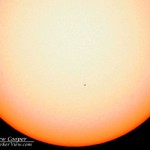
Mercury transiting the face of the Sun, 6 Nov 2006Venus transits are relatively rare events, that occur in pairs1, with the paired events separated by eight years. Each pair is separated from the next pair in a predictable pattern, alternating 105.5 or 120.5 year gaps. The first transit of the current pair was in June 2004, with the 2012 event completing the pair. The next pair of events will begin in December 2117. Given the century long separation between events Venus transits have only occurred seven times since the invention of the telescope (1631, 1639, 1761, 1769, 1874, 1882 and 2004)2.
For Hawai’i the event will begin at about 12:10pm with the Sun high in the sky, mid-point will be about 3:26pm and will end about 6:44pm, just before sunset. These times are only approximate, exact times will depend on the observer’s location and can vary by several minutes across the islands.
Keck Observatory will be making an extra effort for this transit as Mauna Kea is perfectly positioned to observe the event. We will be webcasting the transit from a small telescope located at the summit. The webcast can be seen on your computer, or come over to our headquaters in Waimea to see the webcast and a live view in a solar telescope if the weather cooperates. there will be extra staff on hand to answer your questions.
Stay tuned to DarkerView for further details as the transit draws near.