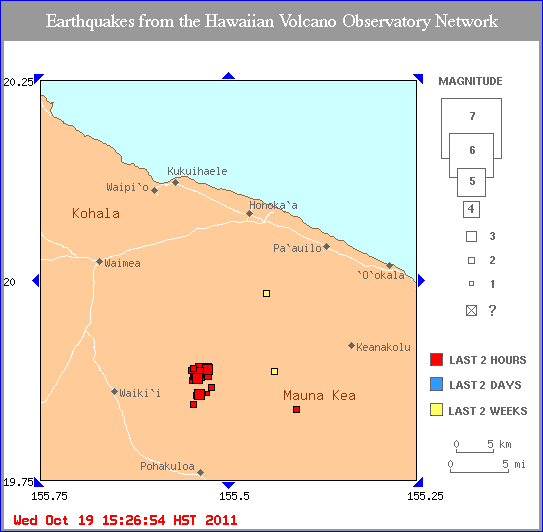
This is starting to look ominous! Nineteen events so far and counting, it seems the building rattles every 10-20min with another aftershock. Will it please settle down?
Word is that Keck1 is fine, we are scheduled to do some engineering with the AO laser. The laser itself is still on and operational, a minor miracle. There may be some issues with Keck 2 after the initial quake. We are waiting for a more detailed report from the summit crew.
An ongoing earthquake swarm underneath Mauna Kea, 19Oct 2011
Ok? That was fun. A fairly serious quake right underneath us. A preliminary mag 4.5 centered between town and the summit of Mauna Kea. The building was shaking pretty good, with a series of hard and sharp shocks. I felt at least three aftershocks, though the USGS website shows five additional events in quick succession at much the same location and depth.
We had a few minutes to enjoy a beautiful sunny day in Waimea, as all of the Keck staff waited outside for the shaking to stop.
Watching sunrise from the summit of Mauna Kea is often the highlight of many visitor’s trip to the island. Any given morning will see a handful of tour vans and rental Jeeps atop the summit ridge awaiting the first glint of sunlight. A small crowd of camera wielding tourists mill about, gazing at the spectacle or huddle in vehicles to avoid the bitter wind.
I do occasionally stop to watch myself. While the telescope operators head for breakfast down below. I stop and join the crowd for a few minutes. Sometimes you just have to take a moment and enjoy the privilege of working in a place like Mauna Kea.
Click on the image for a better appreciation of what it is like to be there… Without the wind.
Sunrise seen from the summit of Mauna Kea, panorama assembled from ten separate frames.
With my face behind the camera, and looking the other direction, I did not notice the commotion I had caused. A swirl of colorful motion caught the corner of my eye. I turned to see a horde of butterflyfish attacking a seemingly uninteresting rock face. I watched for a moment before a memory triggered… Of course!
A mixed school of butterflyfish feeding on the eggs of a Hawaiian Sergeant Abudefduf abdominalisI knew what to look for… Sure enough, a barred fish darted into the crowd, aggressively driving off a few members of the swarm. But for each fish driven off another two would sweep in behind to peck at the rock face.
It is likely the gang of butterflyfish used my presence as an opening to overwhelm the Sergent. Local lore is full of examples of this behavior. The passage of a larger predatory fish, or a diver, will give the guarding male Sergeant a pause. A slim opening upon which the gang will swarm the eggs and feed. During Sergent breeding season it is not unusual for divers to mention schools of butterflyfish or tangs following them in and around the nesting areas.
Eggs of the Hawaiian Sergeant (Abudefduf abdominalis) covering a one meter areaWith the feeding fish so oblivious to my presence I took advantage of the situation to blaze away with the camera at short range. The were a couple species here that I did not have decent photos of.
I literally have to push my way through the swirling fish to examine the nest. The rock is covered with eggs, an amazing number of little purple dots covering an area of about a meter square. Despite the ongoing feeding frenzy, the nest seems intact, with nearly every bit of the rock covered with the neat little lines of eggs.
Hoover1 makes an interesting observation… “One can only wonder why Sergent eggs are so conspicuous while most damselfish eggs are hardly visible”
A world shrouded in hydrocarbon smog, where there are rivers and lakes collecting methane rain. Despite numerous flybys of the Cassini spacecraft and landing of Huygens probe on the surface, Titan remains a very mysterious world. A thick atmosphere and exotic chemistries create conditions that might even harbor some form of life.
Taken from this angle, the view looks toward the side of Titan that always faces away from Saturn. Keep in mind that Titan is 5,150 kilometers (3,200 miles across), much smaller than the Earth, but quite a bit larger than our Moon. The image was taken with the Cassini spacecraft narrow-angle camera on Aug. 9, 2011 using a spectral filter sensitive to wavelengths of near-infrared light centered at 938 nanometers. The view was acquired at a distance of approximately 1.4 million kilometers (870,000 miles) from Titan and at a Sun-Titan-spacecraft, or phase, angle of 35 degrees. Image scale is 8 kilometers (5 miles) per pixel.
Saturn’s large moon, Titan, with edge-on rings seen behind, image taken 9Aug2011, acquired by the Cassini narrow angle camera and a 938nm infrared filter, credit NASA/JPL-Caltech/Space Science Institute
Despite millions of dollars spent repaving, or outright rebuilding this road, some of the old Saddle still exists. While the road is vastly better than is has ever been, no amount of rebuilding can completely eliminate the hazards of dense fog, wild animals, and the other conditions that make this road unique.
This particular curve seems to claim at least one car each year. I have seen three other wrecks here, including at least two other vehicles upside down within feet of where this Toyota rests. And those are only the ones I have seen, not counting the number of times the fence has been crushed amongst a litter of vehicle parts. At least this time the injuries were mostly inflicted on the vehicle, the police officer I spoke with indicated that the passengers were quite lucky.
I have a fair collection of wreck photos taken along the commute up and down the mountain. A reminder to take the roads of Mauna Kea seriously.
A vehicle rolled into a pasture along Saddle Road near Kilohana
Driving Saddle Road provides endlessly beautiful vistas. Every day the clouds and light are different. I never seem to tire of this road. Even when retuning home tired, the scenery is worth watching…
A sunset panorama of 6 images taken along Saddle Road near Waiki’i