
Rotating Tube Rings

No project is ever completely done, even one “finished” decades ago… My 6″ f/5 RFT is the current incarnation of my first telescope, Primero. Built into an 8″ irrigation pipe this ‘scope is a rich field ‘scope that is just fun to use. And yes, I worked on this telescope again.
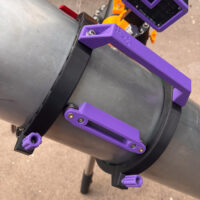
A set of new 3D printed tube rings for Primero, the 6" f/5 RFT
A set of new 3D printed tube rings for Primero, the 6″ f/5 RFT

One feature I have always meant to change is the tube rings. Simple aluminum straps that I kept loose enough to allow the ‘scope to be rotated to keep the eyepiece at a convenient angle for viewing. The issue is that in use the tube would constantly slide down through the rings throwing the mount off-balance.

I finally got around to fixing that. A set of 3D printed rings along with a stop mounted to the tube that prevented this sliding, keeping everything centered and balanced. The rings are attached to each other by the two dovetails and a handle forming a cage.

Continue reading “Rotating Tube Rings”

Astronomers Using Keck Observatory Discover Rain Falling from Saturn’s rings

W. M. Keck Observatory press release

NASA funded observations on the W. M. Keck Observatory with analysis led by the University of Leicester, England tracked the “rain” of charged water particles into the atmosphere of Saturn and found the extent of the ring-rain is far greater, and falls across larger areas of the planet, than previously thought. The work reveals the rain influences the composition and temperature structure of parts of Saturn’s upper atmosphere. The paper appears in this week’s issue of the journal Nature.

“Saturn is the first planet to show significant interaction between its atmosphere and ring system,” said James O’Donoghue, the paper’s lead author and a postgraduate researcher at Leicester. “The main effect of ring rain is that it acts to ‘quench’ the ionosphere of Saturn, severely reducing the electron densities in regions in which it falls.”

Continue reading “Astronomers Using Keck Observatory Discover Rain Falling from Saturn’s rings”

Titan before Rings

A world shrouded in hydrocarbon smog, where there are rivers and lakes collecting methane rain. Despite numerous flybys of the Cassini spacecraft and landing of Huygens probe on the surface, Titan remains a very mysterious world. A thick atmosphere and exotic chemistries create conditions that might even harbor some form of life.

Taken from this angle, the view looks toward the side of Titan that always faces away from Saturn. Keep in mind that Titan is 5,150 kilometers (3,200 miles across), much smaller than the Earth, but quite a bit larger than our Moon. The image was taken with the Cassini spacecraft narrow-angle camera on Aug. 9, 2011 using a spectral filter sensitive to wavelengths of near-infrared light centered at 938 nanometers. The view was acquired at a distance of approximately 1.4 million kilometers (870,000 miles) from Titan and at a Sun-Titan-spacecraft, or phase, angle of 35 degrees. Image scale is 8 kilometers (5 miles) per pixel.

Titan before Rings
Saturn’s large moon, Titan, with edge-on rings seen behind, image taken 9Aug2011, acquired by the Cassini narrow angle camera and a 938nm infrared filter, credit NASA/JPL-Caltech/Space Science Institute