Saturn at Opposition

Today the planet Saturn will pass through opposition, directly opposite the Sun in our sky.

Saturn
Saturn on April 15th, 2016

Saturn orbits the Sun once every 29.45 years. As the ringed planet continues on its way the Earth swings around much faster on our inside track. As a result we lap Saturn once every 378.1 days, passing between the planet and the Sun. During opposition Saturn will be well placed for observation all night long, rising at sunset, transiting at midnight, and setting at sunrise.

During opposition the planet and rings will be slightly brighter than normal, an effect known as the opposition effect. The effect is most notable in the rings where the apparent brightness can increase by 30%. The effect is a combination of two factors, shadow hiding and the retro-reflective properties of the ring particles.
A Second Chance for Lāhainā Noon

Lāhainā Noon is that moment when the Sun is directly overhead. At the moment of Lāhainā Noon shadows disappear.

The first Lāhainā Noon of the year occurs in May as the Sun is moving northwards in the sky. The second chance to see Lāhainā Noon is in July as the Sun moves back to the south.

The table below gives the dates and times for this second Lāhainā Noon across the islands.

Lahiana Noon for July 2019
CityLong.Lat.DateTimeElevation
Naalehu 155°35’W19°03’NJul 2712:29HST89.9
Hilo 155°05’W19°42’NJul 2412:27HST89.9
Kona 155°59’W19°39’NJul 2512:30HST89.9
Waimea 155°40’W20°01’NJul 2312:29HST89.9
Hawi 155°50’W20°14’NJul 2212:30HST89.9
Hana 156°00’W20°46’NJul 1912:30HST89.9
Kihei 156°27’W20°45’NJul 1912:32HST90.0
Kahalui 156°28’W20°53’NJul 1812:32HST89.9
Lahaina 156°40’W20°53’NJul 1812:33HST89.9
Lanai City156°55’W20°50’NJul 1812:34HST89.9
Kaunakakai157°01’W21°05’NJul 1712:34HST89.9
Honolulu 157°49’W21°18’NJul 1612:37HST89.9
Kaneohe 157°48’W21°25’NJul 1512:37HST89.9
Waialua 158°08’W21°34’NJul 1412:38HST89.9
Lihue 159°22’W21°58’NJul 1112:43HST89.9
Data from US Naval Observatory Data Services

Apehelion

Earth’s apehelion will occur at 12:11HST today.

Sunrise over Georgia Strait

Apehelion occurs when the Earth reaches its furthest distance from the Sun for the year.

It may seem odd to some the apehelion occurs in the middle of summer. One must recall that the distance from the Sun is not the cause of our seasons, that is the effects of axial tilt.

2019 Apsides and Seasons
Event Universal TimeHawaii Standard Time
Perihelion Jan 0305:20UTJan 0219:20HST
Spring Equinox Mar 2021:58UTMar 2011:58HST
Summer SolsticeJun 2115:54UTJun 2105:54HST
Aphelion Jul 0422:11UTJul 0412:11HST
Fall Equinox Sep 2307:50UTSep 2221:50HST
Winter SolsticeDec 2204:19UTDec 2118:19HST
Data from US Naval Observatory Data Services

Mercury at Maximum Elongation

Mercury, Venus and Jupiter
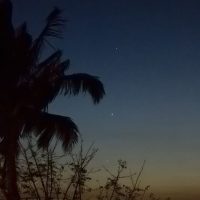
An evening conjunction of Mercury, Venus and Jupiter on 30 May, 2013

Today Mercury is passing through maximum elongation, the furthest it will rise above the setting Sun in the evening sky. After today the planet will slide back into the Sun’s glare headed for inferior conjunction on July 21st.

This is the most favorable evening apparition of the year, reaching over 25° from the Sun. The October apparition is almost as good
reaching over 24° from the Sun.

Continue reading “Mercury at Maximum Elongation”

Summer Solstice

The summer solstice will occur at 05:54HST today.

Sunset among the puʻu of Mauna Kea
Sunset light and fog in among the puʻu on the south flank of Mauna Kea

The Sun has reached the most northerly declination it will achieve this year. After today the Sun begins to move south in our skies.

Today will be the longest day of the year for those of us located in the northern hemisphere.

Today is considered the start of summer for most cultures in the northern hemisphere, or the start of winter for those in the southern hemisphere.

2019 Apsides and Seasons
Event Universal TimeHawaii Standard Time
Perihelion Jan 0305:20UTJan 0219:20HST
Spring Equinox Mar 2021:58UTMar 2011:58HST
Summer SolsticeJun 2115:54UTJun 2105:54HST
Aphelion Jul 0422:11UTJul 0412:11HST
Fall Equinox Sep 2307:50UTSep 2221:50HST
Winter SolsticeDec 2204:19UTDec 2118:19HST
Data from US Naval Observatory Data Services

Jupiter at Opposition

Jupiter will pass through opposition at 05:11HST today.

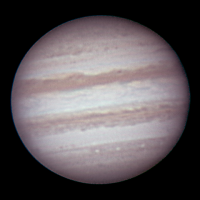
Jupiter 14Apr2016
Jupiter on April 15, 2016

Jupiter orbits the Sun once every 11.86 years. As the giant planet continues on its way the Earth swings around much faster on our inside track. As a result we lap Jupiter once every 399 days, passing between the planet and the Sun. During opposition Jupiter will rise at sunset, transit at midnight, and set at dawn. This makes the planet available for observation for the entire night.

Look for a bright object rising in the eastern sky after sunset. It is difficult to mistake for anything else, shining at it’s brightest during opposition, a brilliant -2.7 magnitude. For the remainder of the spring and much of the summer, the planet will be quite prominent in the evening sky.

An Evening Conjunction

e Moon, Venus and Aldebaran
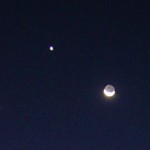
The Moon, Venus and Aldebaran join up for an evening conjunction

This evening will feature a a pretty set of planets and the Moon low in the sunset. Mercury, Mars, and a thin crescent Moon will be visible above the glow of the setting Sun.

The Moon will be a very thin sliver, a mere 4% illuminated. Look 7° above the Moon for Mars. Mercury will be harder to spot, about
7° below the Moon, closer to the sunset and a little north (to the right).