With 24 exposures, each 4 minutes long, it is possible to animate the comet’s movement among the stars. Just process the photos individually and import into photoshop as an animation, then export as an animated GIF. Just click on the image to view…

When you want to see the stars, find someplace dark

The solar system’s small stuff
With 24 exposures, each 4 minutes long, it is possible to animate the comet’s movement among the stars. Just process the photos individually and import into photoshop as an animation, then export as an animated GIF. Just click on the image to view…
An assembled version of the imagery I took of comet C/2014 E2 Jacques. 24 x 4min exposures, stacked in Images Plus and final processed in Photoshop. While traces of the tails were visible, I was unable to preserve the faint signal in this processed color frame.

The tails are faint!
I have talked to a couple folks who have observed the comet in mid-sized telescopes, 14 and 24 inch, instruments. One thing they note is the absence of any visual tails on this otherwise bright comet. In processing the imagery from last night I can see the tails, but only in a very strong stretch of the data.
Below is an inverted version of mostly the green channel. Both the ion tail and dust tail are visible, but they are truly subtle. The ion tail is visible as a streak going to the right in the image, quite thin and straight, extending well over three degrees. The dust tail is visible as a wide are below the coma in this image.
Still working to properly the process the full image, the data looks very good so far.

A bright comet is always a good reason to drag the telescope out of the garage. In this case it is comet C/2014 E2 Jacques, currently about magnitude 7 in Cepheus. The comet is rising over the house about 9pm and available for shooting from my usual driveway setup location.
Setup went pretty smoothly, I have not changed anything in the basic configuration for a while. Shooting the Canon 6D on the TV-76mm scope. I did have some issues getting the autoguider to calibrate. The low magnification and high latitude meant the the calibration moves are just too small. Realizing that this also meant that any potential guide errors would also be small, I just shut the autoguider off. No guiding errors are visible in the four minute exposures.

Yes, the shot looks pretty bad… The frame is a quick process of a single sub-frame, just a white balance and curve adjustment in Photoshop. As I write this there are 13 completed exposures with another 17 to go. I do not think I will complete the sequence, I do need to go to bed sometime soon, I have to head to Hilo early tomorrow morning for a conference at Gemini.
Given a couple dozen good exposures I should be able to produce a much better image than is seen here. So far all of the sub-frames look good indeed, nice signal to noise, a bit of nebulae showing near the comet, and maybe a trace of the wispy ion tail. It will be a few days before I have a chance to properly process the image.
Today the minor planet 4 Vesta will pass through opposition.
4 Vesta is one of the largest objects orbiting between Mars and Jupiter, a region often referred to as the Asteroid Belt. This is the second largest asteroid, at 530km (329miles) in diameter. It is also usually the brightest asteroid that can seen by earthbound observers. When Vesta is at opposition it is bright enough to be just visible to the unaided eye, usually around 6th magnitude.
This year Vesta will reach magnitude 5.7 at opposition. This magnitude requires a dark site to view without the aid of a telescope. Precise knowledge of the location is also helpful. Given these two items it becomes possible to see an asteroid with the unaided eye.
The minor planet is currently located in Virgo about 2.5° northwest of τVir. Interestingly enough the dwarf planet 1 Ceres will be located about 2° east and a touch south of Vesta. Despite being much larger than Vesta it will be over a full magnitude dimmer at about 6.9 magnitude.
Vesta was visited by the Dawn spacecraft during 2011 and 2012. Dawn is now on course for Ceres with a planned rendevouz in February 2015.
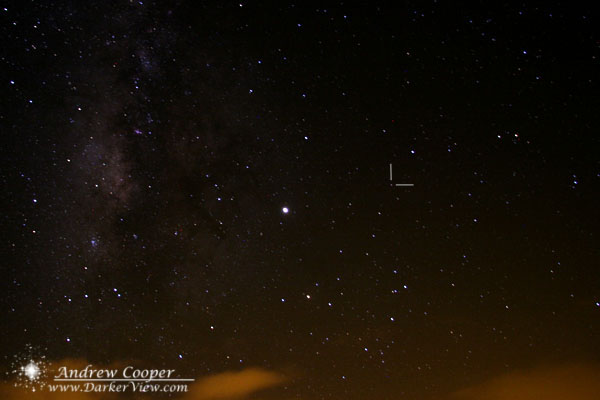
Amateur astronomers love lists… The Messier observing list, the Hershel 400, the Hershel II, and on. Some lists can be complete on a night or two, some lists may take years, or even a lifetime to accomplish. Amateur astronomy is not the only avocation to use lists like this. Birders attempt to see all of the birds known to occur in their home country. Aircraft spotters love to see each model of aircraft in the air. Divers keep lists of species seen underwater.
Lists like these are not only fun, but allow the list chaser to sample the wonders our universe has to offer. The challenge of finding and observing each of the items is worthwhile. Each object is a lesson into the science, hunting each object allows skills to be practiced.
Most of the astronomy observing lists require a small telescope to accomplish, or at least a pair of binoculars. One list is a bit different, it does not require any optical aid at all… The Naked Eye 100.

Update: Yes, this post was written and scheduled well before the comet disintegrated at perihelion. If there is anything left it is closest to the Earth today. Many amateurs, large scopes, even Hubble have attempted to recover the remains. No one has reported finding anything.
The definitive results are in from the Hubble Space Telescope… Comet ISON is still dead.

25th magnitude is a lot deeper than amateur attempts at recovery, though the amateur efforts likely covered a great deal more area than Hubble with wider fields of view. Still, there have been no reports of any remains detected by any searcher.
Does this rule out any surviving fragments?
We can’t completely rule out the possibility that something is left of the comet. After all, it was seen after its passage close to the Sun, but disappeared not long after. This material would still exist, but is likely very diffuse gas, dust, and very small pieces spread over an extremely large area. – Zolt Levay, The HubbleSite Blog
I think it is pretty safe to call this comet dead.
What is left of the comet is rapidly fading.
During the hours after perihelion the comet brightened again, providing hope that some large fragment had survived. Many commentators were speculating that news of the comet’s demise was greatly exaggerated.
Watching further is providing further evidence that no substantial fragments remain, the flareup was brief, ices originating from the debris cloud providing one last burst of activity.
Over the last twenty-four hours even this has faded, what is left of the comet continuing to disperse and fade. It will be interesting to see what remains when the comet is at last far enough from the Sun for large telescopes to examine the debris field.
Will anything be visible to small telescopes? Possibly, but if there is anything it will be quite faint, something barely seen visually, or photographic only. I am certain that the amateur community will attempt observations. Again, it will be very interesting to see what is found.
When will we again see comet C/2012 S1 ISON in the morning sky?
Much depends on how bright the comet has become, thus how far it must be from the Sun’s glare before we can see it well. If the comet has become truly spectacular we may see the tail rising before the comet quite early. If it has disintegrated, we may see nearly nothing.
It is probably on the morning of Dec 3rd that we can start looking for the comet to be above the horizon at dawn. On this morning the comet will be 14° away from the Sun, rising at 05:58 HST as seen from the island of Hawai’i. On the 4th this will be 05:51 and 16°, on the 5th the angular separation will be 19° while rising at 05:43HST.
When planning your comet viewing keep in mind that the comet will rise nearly 25° north along the horizon when compared to where it was rising before perihelion. This is closer to due east, at about azimuth 100°.
Unlike some comets, the comet will not emerge into the evening sky after perihelion. It remains in the morning sky for earthbound observers. It will eventually be visible in the evening sky, but not for some time, a few weeks or more depending on the observer’s latitude. The high inclination of the comet’s orbit will take the comet through the northern constellations, into the circumpolar sky at the end of the year.
What morning will you first see the comet?
