Total Solar Eclipse March 8, 2016

On March 9, 2016 a total solar eclipse will sweep across Indonesia and into the central Pacific. This will be an late afternoon eclipse, with maximum occurring just before sunset at around 17:37 HST (5:37pm HST).

1999 Total Solar Eclipse
The 1999 Total Solar Eclipse from France, image credit Luc Viator
The path of totality passes well north of the Hawaiian Islands, just south of Midway Island. If you want to see this eclipse as a total your best bet is an eclipse cruise. For the islands this will be a deep partial eclipse, ranging from about 67% for Kauai and the around 55% for the Big Island. Of course, the exact amount of the Sun covered by the Moon will depend greatly on your location. See the table below for predictions and timing for your location.

Note, you might be confused by some references that state the eclipse occurs on March 9th. It does occur on the 9th! For our islands greatest eclipse occurs around 03:30 on March 9th universal time. If we convert to Hawaiian Standard Time this will be the 17:30 (5:30pm) on the afternoon of March 8th. You must remember that universal time is ten hours ahead of Hawaiian Standard Time.

Eclipse 20160309
Diagram of the March 9, 2016 Total Solar Eclipse
There are several cruises scheduled to intercept this eclipse. Most look to observe the eclipse somewhere near Indonesia, where the eclipse will be at its maximum. This is where you will find the hardcore eclipse chasers, including a few island folks I know. Most of us will just have to settle for seeing this eclipse as a partial, including myself. The information presented here covers viewing the eclipse from the islands.

A deep partial can be very interesting. Even people not expecting the eclipse may notice a dimming of the Sun and an odd, subdued nature to the sunlight. Even a quick glimpse of the Sun will reveal that half of the disk is covered. Eclipse glasses or a welding filter will provide a nice image of a partially eclipsed Sun. Tree leaves and other makeshift pinhole cameras will show crescent images of the Sun on the ground. For best viewing a small telescope with a solar filter, or a pinhole camera will allow excellent images of the eclipse. My standard eclipse viewing setup is a 76mm refractor with a Baader film solar filter. I assembled this gear for the 2012 Venus transit and it has seen several eclipses since.

Solar Eclipse Data for March 8th, 2016


  Mag Begin Max End
Hilo 55% 16:37 17:37 18:32
Honolulu 63% 16:33 17:36 18:33
Lihue 67% 16:31 17:35 18:33
Kahului 60% 16:35 17:37 18:33
Kona 56% 16:36 17:37 18:32
Mauna Kea 56% 16:37 17:37 18:32
Midway Is 97% 16:04 17:20 18:29
 

All times HST
Source: EclipseWise Interactive Map

 
The table at the right gives the eclipse timing for a few locations across the Hawaiian Islands. All times are given in Hawaiian Standard Time, just remember that 17:36 is 5:36pm in 12 hour time, just subtract 12.

As you can see the magnitude of the eclipse increases notably the closer you are (further north in the main islands) to the path of totality. The timing does not vary by nearly as much, with maximum eclipse occurring around 17:36 for the islands.

If you would like to see precise information for your location, or for someplace other than the islands, just use the interactive map and click on your location for data.

Partial Solar Eclipse
A partial solar eclipse from Kawaihae, 9 May 2013
Observing a partial solar eclipse requires proper eye protection. If you can not look safely, do not look! Even dimmed by 50% or more the Sun can cause permanent eye damage if viewed without proper protection. A solar filter is required for telescopic or binocular use. A good view can be had without magnification simply using a welding filter (shade 13 or darker) or solar viewing glasses to look directly at the Sun. A pinhole camera can be made out of things lying around in your kitchen that provides a very good image. Read my Guide to Safe Solar Viewing for a lot more information on viewing the Sun safely.

There are no further solar eclipses near the Hawaiian islands until 2031 and 2035, the path of totality for both of which pass well south of the main islands. There is also an annular eclipse in 2024, for which the center line also passes well south of the islands.
Transit of Mercury May 9, 2016

On May 9th, 2016 Mercury will transit the Sun. While transits of Mercury are not rare, they are not all that common either. The last transit was almost a decade ago in November of 2006. On average there are fourteen transits of Mercury each century or one every seven years. If you wish to observe one the situation is much better than transits of Venus which occur in pairs over a century apart.

This particular transit will favor observers in Europe and North America where the entire transit will be visible. Unfortunately for observers in the islands only the final three hours of the transit will be visible having begun well before local dawn. Sunrise will occur around 05:48 for the island of Hawaiʻi, with the transit ending at 08:42 in the morning.

Mercury Transit
Mercury transiting the face of the Sun, 6 Nov 2006
Mercury Transit May 9th, 2016


  UT (geo) HST HST (offset)
First Contact 11:12 01:12 –:–:–
Second Contact 11:15 01:15 –:–:–
Greatest 14:57 04:57 –:–:–
Third Contact 18:39 08:39 08:39:58
Fourth Contact 18:42 08:42 08:43:10
 

Source: NASA Eclipse website

 
The table at the right gives the transit geocentric UT and offset HST times. As our line of sight is shifted slightly from Hawaii there is a slight offset in the timing from our vantage point.

First contact is simply the first moment that the disk of Mercury begins to impinge on the disk of the Sun. Second contact will be the moment when Mercury is entirely in front of the Sun. Third and fourth contacts are a reverse of first and second with fourth contact as the end of the event.

Observing a planetary transit of the Sun requires proper eye protection. If you can not look safely, do not look! The Sun can cause permanent eye damage if viewed without proper protection. As Mercury is quite small some magnification will be useful in observing this event, a telescope of binoculars with a solar filter. A pinhole camera can be made out of things lying around in your kitchen that provides a very good image. Read my Guide to Safe Solar Viewing for a lot more information on viewing the Sun safely.

The next transit of Mercury will occur November 11, 2019 at 15:20UT (mid-transit). This next transit also favors Europe and eastern North America where the entire transit will be visible.

Total Lunar Eclipse Reminder

Total Lunar Eclipse 14Apr2014
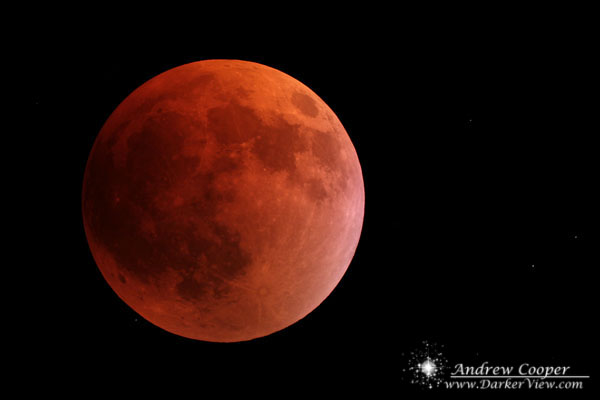
The total lunar eclipse on Apr 14, 2014, Canon 6D on 90mm f/12 APO
Early tomorrow morning a total lunar eclipse will be visible across the Pacific. Sky watchers in Hawaiʻi will be able to observe this event from beginning to end.

Penumbral Eclipse Begins  11:01 HST   09:01 UT
Partial Eclipse Begins   00:15 HST   10:15 UT
Total Eclipse Begins   01:57 HST   11:57 UT
Greatest Eclipse   02:01 HST   12:01 UT
Total Eclipse Ends   02:02 HST   12:02 UT
Partial Eclipse Ends   03:44 HST   13:44 UT
Penumbral Eclipse Ends   04:58 HST   14:58 UT

Timing for the 4Apr2015 total lunar eclipse

Total Lunar Eclipse

Early on the morning of April 4th a total lunar eclipse will be visible across the Pacific. Sky watchers in Hawaiʻi will be able to observe this event from beginning to end.

Total Lunar Eclipse 14Apr2014
The total lunar eclipse on Apr 14, 2014, Canon 6D on 90mm f/12 APO
This eclipse is just barely total with an umbral magnitude of 1.0008. The northern edge of the Moon will be barely inside the umbra and probably much brighter than the south hemisphere. The eclipse is also quite short, with a total phase lasting only four minutes. Compare this to the next total eclipse of 2015 where totality lasts over an hour.

Maximum totality will occur at 12:02UT or about 02:02HST. First contact will occur at 11:01HST on the evening of the 3rd, with umbral first contact a little after midnight at 00:15HST. It is this umbral contact that will be the first obvious effect of the eclipse to a visual observer, a notable notch out of the Moon.

Observing a total lunar eclipse requires no special equipment, simply the desire to look up. The most useful piece of equipment will be a reclining chair or some other method of staying comfortable while watching the sky. A pair of binoculars or small telescope can provide beautiful views of the Moon during an eclipse. Photography is somewhat more challenging, but not that difficult. Focal lengths of around 1000mm will fill the field of most DSLR cameras allowing photos like that shown here.

Penumbral Eclipse Begins  11:01 HST   09:01 UT
Partial Eclipse Begins   00:15 HST   10:15 UT
Total Eclipse Begins   01:57 HST   11:57 UT
Greatest Eclipse   02:01 HST   12:01 UT
Total Eclipse Ends   02:02 HST   12:02 UT
Partial Eclipse Ends   03:44 HST   13:44 UT
Penumbral Eclipse Ends   04:58 HST   14:58 UT

Timing for the 4Apr2015 total lunar eclipse
The entire eclipse will be visible during the night, quite convenient for amateur and casual sky-watchers.

Total Lunar Eclipse 7 Oct 2014

A total lunar eclipse will occur on the next full Moon, Oct 8th. The eclipse will be visible across much of the western hemisphere, including the west coast of North America and across the Pacific. This is an excellent eclipse for observers here in Hawai’i, the entire eclipse will be visible from start to end.

Lunar Eclipse 28Aug2007
Total lunar eclipse, photo is a 8sec exposure with a Canon 20Da on a 90mm f/12 APO
Some references note that this eclipse will occur on the 8th, and so it will for much of the world. For Hawai’i this will start late on the 7th when considering the time zone correction.

The Moon will be thoroughly submerged in the umbra, the darkest part of the Earth’s shadow, with an umbral magnitude of 1.16. The Moon will not pass directly through the umbra, but rather through the northern section, thus the north pole of the Moon will remain somewhat brighter, even at maximum. The eclipse occurs at the Moon’s descending node in southern Pisces, two days after perigee (October 06 at 09:41 UT). This means that the Moon will appear 5.3% larger than it did during the April 15 eclipse (32.7 vs. 31.3 arc-minutes).

Observing a total lunar eclipse requires no special equipment, simply the desire to look up. The most useful piece of equipment will be a reclining chair or some other method of staying comfortable while watching the sky. A pair of binoculars or small telescope can provide beautiful views of the Moon during an eclipse. Photography is somewhat more challenging, but not that difficult. Focal lengths of around 1000mm will fill the field of most DSLR cameras allowing photos like that shown here.

Penumbral Eclipse Begins  22:15:33 HST   08:15:33 UT
Partial Eclipse Begins   23:14:48 HST   09:14:48 UT
Total Eclipse Begins   00:25:10 HST   10:25:10 UT
Greatest Eclipse   00:54:36 HST   10:54:36 UT
Total Eclipse Ends   01:24:00 HST   11:24:00 UT
Partial Eclipse Ends   02:34:21 HST   12:34:21 UT
Penumbral Eclipse Ends   03:33:43 HST   13:33:43 UT

Timing for the 7Oct2013 total lunar eclipse
The entire eclipse will be visible during the night, quite convenient for amateur and casual sky-watchers. This is an excellent eclipse to publicize and use for outreach purposes.

The final eclipse of 2014 will be a partial solar eclipse visible in late October across North America.

Total Lunar Eclipse 14 April 2014

A total lunar eclipse will occur on the next full Moon, April 14th. The eclipse will be visible across much of the western hemisphere, including the west coast of North America and across the Pacific. This is an excellent eclipse for observers here in Hawai’i, the entire eclipse will be visible from start to end.

Lunar Eclipse 28Aug2007
Total lunar eclipse, photo is a 8sec exposure with a Canon 20Da on a 90mm f/12 APO
Some references note that this eclipse will occur on the 15th, and so it will for much of the world. For Hawai’i this will occur late on the 14th when considering the time zone correction.

The Moon will be thoroughly submerged in the umbra, the darkest part of the Earth’s shadow, with an umbral magnitude of 1.29. The Moon will not pass directly through the umbra, but rather through the northern section, thus the north pole of the Moon will remain somewhat brighter, even at maximum.

Observing a total lunar eclipse requires no special equipment, simply the desire to look up. The most useful piece of equipment will be a reclining chair or some other method of staying comfortable while watching the sky. A pair of binoculars or small telescope can provide beautiful views of the Moon during an eclipse. Photography is somewhat more challenging, but not that difficult. Focal lengths of around 1000mm will fill the field of most DSLR cameras allowing photos like that shown here.

Penumbral Eclipse Begins  18:53:37 HST   04:53:37 UT
Partial Eclipse Begins   19:58:19 HST   05:58:19 UT
Total Eclipse Begins   21:06:47 HST   07:06:47 UT
Greatest Eclipse   21:45:40 HST   07:45:40 UT
Total Eclipse Ends   22:24:35 HST   08:24:35 UT
Partial Eclipse Ends   23:33:04 HST   09:33:04 UT
Penumbral Eclipse Ends   00:37:37 HST   10:37:37 UT

Timing for the 14Apr2013 total lunar eclipse
In Hawai’i the eclipse will begin not long after moonrise. The entire eclipse will be visible during the evening hours, quite convenient for amateur and casual sky-watchers. This is an excellent eclipse to publicize and use for outreach purposes.

The next total lunar eclipse in October will also be visible across the Pacific region. It will occur somewhat later in the night and be slightly brighter, only 1.16 umbral magnitude. With two good lunar eclipses 2014 is a treat for sky watchers across the western hemisphere. An annular eclipse is visible later in April in Australia and the South Indian Ocean, a partial solar eclipse is visible in late October across North America.

Naked Eye 100 Challenge

Amateur astronomers love lists… The Messier observing list, the Hershel 400, the Hershel II, and on. Some lists can be complete on a night or two, some lists may take years, or even a lifetime to accomplish. Amateur astronomy is not the only avocation to use lists like this. Birders attempt to see all of the birds known to occur in their home country. Aircraft spotters love to see each model of aircraft in the air. Divers keep lists of species seen underwater.

Rainbow Wheel
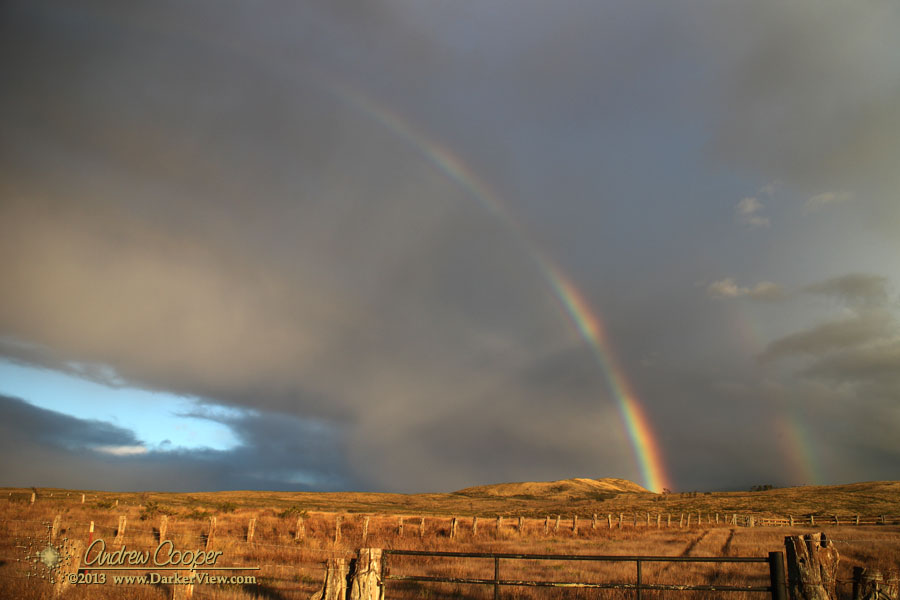
A rainbow and cloud shadows produce a rainbow wheel

Lists like these are not only fun, but allow the list chaser to sample the wonders our universe has to offer. The challenge of finding and observing each of the items is worthwhile. Each object is a lesson into the science, hunting each object allows skills to be practiced.

Most of the astronomy observing lists require a small telescope to accomplish, or at least a pair of binoculars. One list is a bit different, it does not require any optical aid at all… The Naked Eye 100.

Continue reading “Naked Eye 100 Challenge”