A supernova, a comet, a new camera and a dark night.
I have had the Canon 60D for a while now. Since April in fact. It was my main carry camera in Alaska this summer. This was the camera used to produce the laser shots and videos that were published far and wide. But I have never used the camera on a telescope. A new Moon observing weekend is an opportunity to change that.
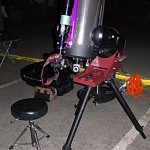
The NexStar 11″, the TV76mm and a Canon 60D setup for astrophotography at the MKVISI have recently re-assembled my astrophotography rig in the garage. But that rig has some technical issues that need to be solved before it is ready to use. Instead I packed up the NexStar 11″ scope, a scope usually used for public observing, but also a nice photographic platform. Piggyback the TeleVue 76mm atop the larger scope, attach the 60D and I am ready to shoot. Well? Maybe a bit more work than that. With alignments, focusing and more it was an hour before the first exposure.
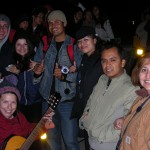
While my camera was busy shooting sequences, I wandered around and visited with the other folks enjoying the night. A few peeks through other scopes at favorite objects was about all the visual observing I did. There were a couple groups using cameras without telescopes to shoot stars capes under the dark sky. We traded hints as multiple cameras worked the night.
An orange glow in the clouds betrayed new lava flows on Kilauea. Even thirty miles away we could make out bits of a channelized a’a flow. The pair of binoculars I had brought became one of the most popular optical instruments around.
I was using the rig without any autoguiding, as a result guiding errors spoiled a number of exposures. I kept the exposures short, and shot bright objects. I have sequences to process of a lot of old favorites… M31, M42, a few open clusters like M11 and M38, the Pleiades and more. Just before dawn I even shot a sequence of the Tarantula Nebula skimming the slope of Mauna Loa. Two 8Gb SD cards filled and part of a third. I will be some time processing the many images taken through the night. There is even some video of Jupiter and Mars to process into high resolution planetary images.
There were three telescopes still operating when dawn appeared. Maureen, Cliff and myself watched as the sky grew bright and a thin crescent Moon rose above the slopes. Even then we spent a little time observing and photographing the Moon or Mars as the stars disappeared. We were still breaking down gear as sunlight swept the hillsides around us. Tired and yet elated we greeted the Sun.
The usual suspects setting up gear for a great night of observing on Mauna Kea...
Planning a night of observing is a challenge. There is the choice of equipment, setting up observing lists of objects to target. And then there is deciding where to go.
Finding a dark spot can be a challenge in Hawai’i. Almost every bit of land is gated and tied up in bureaucratic rules. We often use the area around the Mauna Kea VIS to observe. Located at 9,000ft on the south side of Mauna Kea the area has much to recommend it for amateur astronomy. This land is under the administrative control of OMKM, who actively support astronomy, both professional and amateur. But the area does have a number of lights, and there is regular vehicle traffic, even in the middle of the night. Thus I have been actively looking for other places.
The 18″ setup at 9000ft on the side of Mauna KeaThe area around the MK VIS is state land, under the control of the State of Hawaii Department of Land and Natural Resources. Just below the VIS is the start of a back road that almost entirely circles the mountain, R-1, also part of the Na Ala Hele trial system, a road designated for public access. Perfect! All I need is a place just enough out of the way to avoid any lights or activity in the night.
State land is an interesting issue in Hawai’i. No camping is allowed outside of designated sites, period. But, according to the DLNR administrative rules it is not camping unless you are… “in possession of a backpack, tents, blankets, tarpaulins, or other obvious camping paraphernalia, any time after one hour after sundown until sunrise in a forest reserve” (Section §13-104-2 Hawai’i Division of Forestry and Wildlife). I made certain I had no “camping paraphernalia” with me. I am merely picnicking… in the middle of the night.
Visual astronomy is the practice of pushing our built in optical detectors to the limits of performance. Our eyes are surprisingly good optical instruments, and until the advent of film about a century ago were the only means we had of observing the universe. Even now, in the age of sensitive electronic detectors there are those who appreciate the view of the heavens through our own eyes.
The edge on spiral M104 photographed with a Collins I3 Image IntensifierThis does not keep some from trying other ways to improve the view. Night vision technology, devices pioneered by the military that amplify the available light, offer intriguing possibilities. Available in compact packages these amplifier image tubes have been incorporated into an eyepiece sized package that can replace a standard eyepiece and offer an amplified image.
The image tube operates by charging a grid to a high voltage inside a small vacuum tube. Incoming light (photons) strike this grid and create a shower of electrons that continue onwards to strike a phosphor screen at the rear of the tube. A single photon can create a shower of hundreds of electrons, a very large signal gain. The phosphor screen glows where struck by photons, creating a image of the amplified signal.
A bright image is seen on the screen of the object, hundreds of times brighter than the original. The image is green, as result of the phosphor, this amplification is a monochromatic process. There is some noise in the image, random “sparkles” called scintillation that result when electrons leave the charged grid in a random fashion.
The images shown here are taken with the Collins I3 eyepiece or I3piece. The device is a very nicely built unit that is about the same size as a modern high quality eyepiece. Actually it is much smaller than some of the large designer eyepieces seen on some telescopes. An internal battery means there are no cables resulting in a neat package. The intensifier has a standard 1.25″ or 2″ nose piece threaded to accept standard astronomy filters.
The image intensifier is not a panacea, there are some objects where the intensifier works well, and others where it does not perform. Globular clusters and planetary nebulae are quite dramatically represented in the intensified view. It is faint, low surface brightness objects like galaxies and extended nebulae that are often better appreciated with a normal eyepiece. Switching back and forth is generally a poor idea as using the intensifier decreases dark adaptation.
The edge on spiral M51 photographed with a Collins I3 Image IntensifierDuring personal observations of galaxy views in two large telescopes side by side, I noted more detail in the un-amplified images compared to those using the intensifier, particularly where subtle detail was concerned. I have had opportunity to observe the same galaxy in my 18″ f/4.5 followed by the view in a 24″ with the intensifier. The images in the intensifier were much brighter, but the contrast range seem compressed, such that HII regions and similar low contrast details disappeared.
One place where the value of the intensifier is undeniable is in public outreach. The live views of bright galaxies show far more detail to the inexperienced observer that they would otherwise have missed in the eyepiece view. A spiral galaxy is clearly a spiral galaxy, even to a first time observer. In addition the intensifier can be used to provide views of faint objects under less that ideal conditions. Addition of a narrowband filter can increase the signal to noise and allow viewing of emission nebulae even with substantial light pollution from natural (e.g. the Moon) or artificial sources.
Unfortunately the Collins intensified eyepieces are no longer available from the manufacturer, though the website still appears functional. There is an equivalent product from BIPH which uses the same technology. At nearly four thousand dollars these devices are not for everyone. they can be used to good effect under the right conditions.
A crescent Mercury, 16Apr2010Earlier this month, as Mercury was slipping back into the glare of the Sun, I had an opportunity to shoot some webcam material of the planet in hopes of getting an image of the crescent shape. The resulting image does not look like much, but I have to think it really isn’t all that bad.
The photo does represent Mercury fairly well, at least the normal view you get in a telescope. As the innermost planet does not get very far from the Sun, it is typically seen quite low on the horizon. This leads to poor views seen through a great deal of atmospheric distortion.
What the photo does not show is the chromatic distortion, this was corrected during processing of the photo. The atmosphere will also break up the color, refracting the light when an object is low on the horizon. The processing software allows realigning the color planes, correcting much of the effect.
Deb and I did a volunteer evening at the VIS last night. A great night with a great crowd, the sort of evening that defines the reason we continue to volunteer at the Mauna Kea VIS. Lots of great questions, great conversations and a little learning about the sky and Mauna Kea. As the southern cross hung above the slopes of Mauna Loa my green laser was busy pointing out constellations and bright stars.
The only real problem with the evening was the nearly full Moon hanging in the sky. The bright moonlight drowning out many of the deep sky objects we would normally view. Even bright objects like M13 were merely dim smudged in the eyepiece in place of the beautiful sights they offer under darker skies. With these conditions much of the telescope viewing was concentrated on the Moon and a beautiful planet Saturn.
One activity that is always a hit with a bright Moon partly makes up for the loss of dark sky viewing. I hold and quick course in introductory lunar photography using the afocal method. Show a few people how to take lunar photos and there is soon a line of people waiting at the refractor for their turn to try a few frames. A few hints and people are quickly taking great lunar shots, a photo and a memory to take home from the mountain.
The evening sped by quickly, spent in conversation with guests from the islands and from across the US. People ask about the sky as seen from different latitudes and locations. A few visitors from other countries add their perspective. It is often interesting to hear about other names for constellations or to learn bits of folklore from many other cultures.
So often the crowd disappears an hour after dark, driven off by the cold and wind. This night many didn’t go until it was time to shut down the telescopes. I guess they were not ready to end an enjoyable evening under moonlight.
The Moon one day short of full, afocal photograph taken with a 102mm refractor, 32mm eyepiece and a Canon G9 camera.
In the tropical climate of Hawaiʻi small creatures are commonly found among one’s belongings. Spiders, centipedes, scorpions and more are a fact of life and can be found in anything that has not been carefully stored. Telescopes are often housed in the garage, particularly the large dobsonians that are too large to easily be carried into the house.
A gecko in the center of a 24″ telescope mirrorIn the process of setting up telescopes at the Mana Kea VIS we found another critter that had sought a home. Upon unpacking the 24″ scope belonging to Cliff Livermore we were all amused to find a gecko atop the primary mirror when opening the cover of the box.
One can only imagine the poor creature’s predicament. A seemingly nice quiet, warm and dark place now subject to a great deal of motion and upheaval. Then the cover is removed to allow admission of cold mountain air. Hardly the safe refuge expected when the animal crawled into the box.
A gecko in the center of a 24″ telescope mirrorThe discovery of this poor creature evoke an immediate response, a crowd of laughing humans quickly gathered round the mirror box.
It was notable that everyone’s reaction was the same. Not the revulsion that finding a cockroach or centipede would have caused in the same situation. A gecko is almost universally liked, the results were laughter and amusement.
Instead of being hunted down and squished, this gecko was carefully caught to be given a ride back down the mountain to the warm tropical climate of Waikoloa. The next day he was released into the new rock wall I am building in the back yard for a vegetable bed. With the voids among the rock, this wall is a perfect gecko habitat.
A good lunar eclipse high in the sky. This was something I have not seen for a while. I have seen several lunar eclipses over the last few years. But they always seemed to be low in the sky from Tucson, rising with the eclipse already in progress. Thus as the date of this eclipse approached I was planning to view it properly. The eclipse would be high in Hawaiian sky, transiting with the Moon in totality. Perfectly placed to view the entire eclipse under the most ideal conditions.
Everyone at the VIS was enjoying the night!The timing was highly convenient as I was scheduled to be on the mountain in any case that evening to help prepare for an interferometer run that night. Simply pack the telescope in my vehicle and drive to Hale Pohaku at the beginning of the day so it is waiting with what I need that evening. The scope I chose was my 90mm APO, the focal length was appropriate to frame the Moon well on the Canon 20Da camera. This I mounted on the Losmandy G-11 mount quickly polar aligned with the polar scope and set to track at lunar rate. This particular setup had not been tested together and I thought it would work. I was pleasantly surprised when everything not only worked, but worked quite well.
There was quite the crowd gathered at the Mauna Kea VIS. No surprise, the VIS is the best place on the island to view anything astronomical. Above the clouds and tropical haze the side of Mauna Kea offers a clear view of pristine skies and several telescopes available for anyone to look through. What was surprising was the weather, while the skies are usually clear the VIS can be very cold, and if you add wind the conditions can be miserable. This was not the case! It was cool but not cold and there was no wind beyond a slight breeze.
How to properly observe an eclipse, set the camera on automatic and sit back and enjoy!We had a couple busloads of high school students, quite a few local folks who knew where to go for an eclipse and the usual group of tourists. The atmosphere was rather festive, a couple musical instruments had appeared and everyone enjoyed the night as the moon slid out of the light.
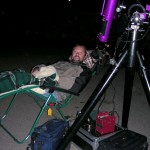
The proper way to watch the several hours of a lunar eclipse is in comfort. Thinking ahead I brought a lounge chair and setup properly where I could monitor the camera and see the frames on the LCD screen as they came in. This worked perfectly. I could view each frame as it was taken without getting up and adjust settings on the camera simply by reaching over. Between each frame just lay back and enjoy the view.
Well, maybe I am understating the amount of work, things were not that relaxed and the camera took a fair amount of tending. I could not get the camera to autoexpose well with a single bright object in an otherwise black frame. The camera insisted on overexposing the Moon badly, even with automatic bracketing the situation did not work until I just put the camera in manual and adjusted the exposure regularly. The scope did not track perfectly and I did need to adjust the position a few times each hour. But the setup and tending were worth it as the resulting pictures are quite satisfying.
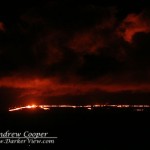
Lava flowing from the July 21 vent of Kilauea as seen from the Mauna Kea VIS about 30 miles away, taken with the TV-76This eclipse was darker than any I have seen lately, the Moon dimly seen high in the sky, my camera exposures running to 30 seconds to get a decent image. Once the view of totality had worn off it’s novelty the other telescopes began taking advantage of the truly dark conditions to show deep sky wonders to the crowd. The scopes jumped from Galaxy to globular clusters with the view being fully as good as a moonless night. It seemed of to be looking at M31 and other deep sky objects with the unaided eye on a night of a full moon.
As the eclipse wound down word of another spectacle made its way to me, the glow of something odd seen to the south. This got me out of my comfortable chair to go and see. Surprisingly the usual solid clouds on the east side of the island had parted and the brilliant golden glow of fluid lava was to be seen! There was some confusion as to what it was, some thought it was the lights of Hilo, but there was no confusion to those of us familiar with the view from Hale Pohaku.
The latest lava flow from a rift on the eastern flank of Kilauea was a river 100m wide and several miles long, even from our vantage point thirty miles away we could clearly see the stream. We could see the lava falls near the head of this river with binoculars as well as most of the course. The view of an eruption and an eclipse was and extraordinary reminder of the dynamism of the earth and universe around us.
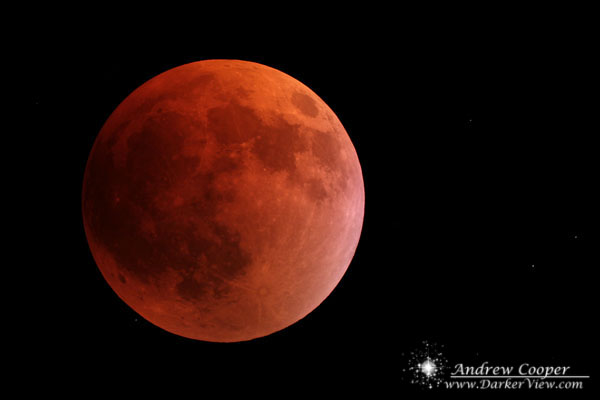
Above is one of my photos from mid-totality taken with the 90mm APO and a Canon 20Da DSLR, note that several stars frame the moon. Check out a few more pictures of the eclipse from the visitor center by Simona Vaduvescu
Total lunar eclipse, photo is a 8sec exposure with a Canon 20Da on a 90mm f/12 APO
Pu’u dot the landscape of the Island of Hawai’i. Pu’u, (pronounced poo-oo) is an interesting Hawaiian word that can mean hill, bump, pimple, wart, or any similar concept, but in this case generally means cinder cone. These reminders of the volcanic origins dot the sides of the big volcanoes like pimples on the face of the island. They are everywhere and each has a traditional name. Locals have used them since the dawn of civilization on the islands to give directions, describe legal land boundaries and name roads throughout the island.
Learning your way around the island is often learning the names of the Pu’u. I use them to mark my progress along my morning commute to work and note the weather above Wiamea. A large pu’u stands above the end of Saddle Road where it turns into the center of the island and another pu’u marks the intersection of Saddle Road and the Mauna Kea access road that climbs to the summit winding through the pu’u that cover the flanks of the mountian. Keck Observatory itself sits on the rim of Pu’u Hou ‘Oki.
The West Hawaii Astronomy Club’s dark sky observing site sits directly beside a small pu’u that goes by the name of Pu’u Kuainiho in a unit of State DLNR land named for Pu’u Anahulu. Nothing fancy, a large gravel lot just off a major state highway, but far anough off to avoid the headlights. Easy to find along the road from Waimea to Kona. It sits at about 2,000ft elevation, high enough to be above most of the low altitude tropical haze. Being in the rain shadow of a 14,000ft peak the site offers surprisingly reliable weather, it is often cloudy in the evening but almost always clears after dark. The only real issue is the often heavy formation of dew and some ground mists that will plague observers. The site is a comprimise between fairly decent skies offered by lower elevations here in Hawaii and the truly spectacular observing that can be had from sites high on the side of Mauna Kea at 9,000ft. The only issue is that those perfect Mauna Kea skies are accessed by a rough hour long drive up Saddle Road and are often windy and quite cold. Sometimes a warm site 15min from home on a good road wins the toss.
This time the target was meteors, a shower I had often not observed because it generally occured in the middle of Tucson’s rainy monsoon season. But a dark sky with no Moon and access to a decent dark site a few minutes away was simply too attractive. Except, of course, for the 2am setting in the alarm clock. I had expected a few other observers to be out for the peak, but when I got to the site I was alone. No matter, nothing new for me. I had brought along the Losmandy mount and the DSLR for a little attempted meteor photography and a lounge chair for relaxed meteor observing.
Set the mount up, a quick polar alignment with a polar scope good enough for wide field photography, bolt the camera on and let it go. Just lie back in the chair with a couple blankets and I am set!
OK, start the show now…
…I must have waited five minutes for the first meteor.
But meteors did appear. A few dim ones widely scattered and a few bright ones from time to time to annouce that something out of the ordinary was going on. I kept a few rough counts to do a quick estimate of rates using the camera’s shutter interval as a timer. I would get three to five every five minute interval giving rates of around 30-60ZHR. Nothing spectacular, just a decent show as the Perseids are so well known for. Though after the true Leonid meteor storm I witnessed in Tucson a few years back anything else does seem a little tame.
As for the photographs? A careful examination of every photo shows a staggering number of meteors were captured by my extensive photographic effort. I had to painstakingly go though each photo to come up with a grand total of…
zero.
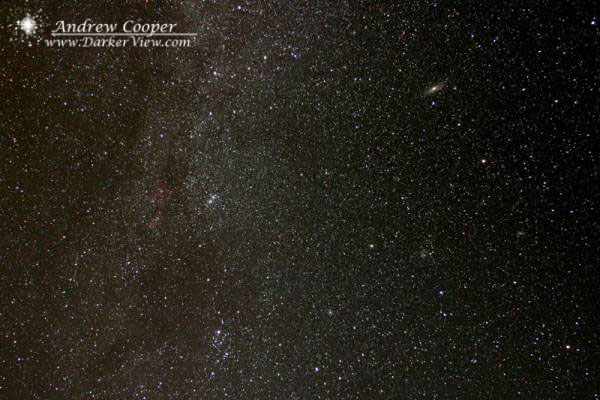
I did get a nice photo of the Perseus-Cassiopea region of the Milky Way however…
Cassiopeia and Perseus region of the outer Milky Way, Canon 20Da, 14 5min exposures stacked, M31 and the Double Cluster are easily visible
See a naked eye asteroid? Why not? I had never seen an asteroid with the unaided eye before and here was a good chance. Was it worth setting the alarm clock for 2am? Sure, you cannot answer that with a no if you are truly an amateur astronomer.
Off goes the alarm… wife starts grumbling… throw a few things in the vehicle… a few more complaints from my wife now up and awake… feed the cats… A kiss… and off into the dark. I setup at the end of the development where the streetlights have yet to be turned on, at the end of a dead end road surrounded by lots that have been graded but not yet built on. While setting up the gear I discover I am not quite alone, listening to hooves clattering up the road towards me. Someone riding by moonlight? No, just three feral donkeys that wander past. Later, the calm was broken by a male donkey being, ah, quite energetic, just up the hill, and willing to tell the world about it.
Conditions could have been better, Jupiter was a swimming ball, so much for a little planetary viewing to pass the time awaiting moonset. Transparency was only so-so with the usual low altitude tropical haze and the occasional cloud scudding through. So just sit back and enjoy the night for a while, and try to ignore the loud braying that occasionally disturbed the otherwise peaceful night.
As I waited for the moon to set I noticed a bank of clouds approaching from the northeast. The usual cloud bank over the Kohala volcano was reaching out a little further than it usually does. This was a bit of a concern, when the trade winds are blowing this cloud bank usually forms over the Kohala and with it a heavy misting rain that drizzles constantly in Waimea. I looked about at my gear and decided to cover some of it up in case this cloud bank got closer.
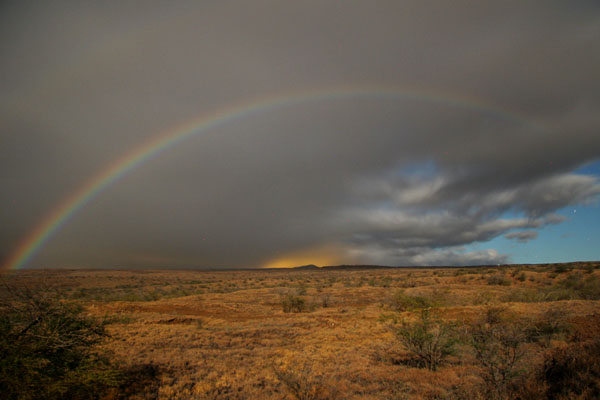
And it did, and as usual the mist was falling ahead of it driven by the steady breeze. Combine a wall of mist and a setting bright moon and the unexpected can occur. I looked out to check the cloud’s position and quickly did a double take. Hanging there in the wall of mist was a beautiful, ghostly moonbow. Grab the camera time!
Camera, tripod, remote shutter release… dash 50yds to where the big power lines would not dominate the picture… hope not to find the donkeys that are around here somewhere… find a spot on the rocks of the ancient lava flow where I could setup the tripod without endangering the camera or my ankles… in the dark… focus the camera… in the dark… frame… program the shutter release for a one minute shot… fire! Time for two frames before the moonbow faded from sight. A quick check of the frames and victory! Got it!
Moonbow! 1min, Canon 20Da, 17mm@f/4 with the lights of Waimea at center
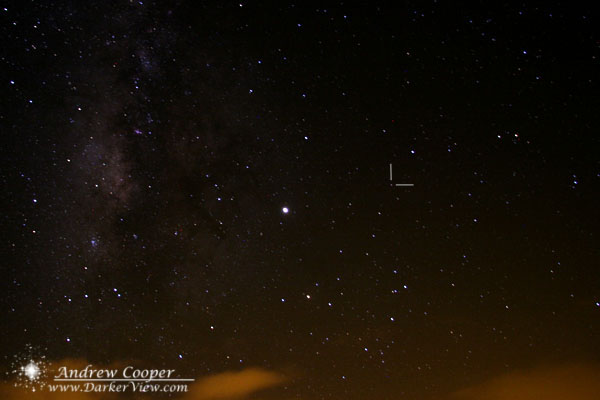
With the fading moonbow and the setting Moon I was able to return to my mission objective, Vesta without optical aid. Finding the asteroid was trivial, just starhop up from Jupiter or down from ζOph and there is was. Swung my little TV-76 to the correct location and there it was, right on the location plotted. Easy to see at about 5.5 mag. a little brighter than HIP80793 at 5.6 mag. that was located about 1°sp. Naked eye was tougher, there was a line of 4-4.2 mag. stars coming up from Sco that was relatively easy, but it took averted vision to find Vesta and then only occasionally as it would appear and dissapear before my eye. I was clearly being hampered by the lousy seeing and poor transparency down lower in the sky. I am sure from a better site, possibly up on the side of Mauna Kea without the moonlight it would be quite simple to spot. I will need to try again before this opposition is over. That will have to wait a bit until after full Moon.
About a dozen times a century Mercury passes in front of the Sun as seen from Earth. The event is observable with a modest telescope and a solar filter, Mercury can be seen as a small black dot crossing the surface of the Sun. If half of those happen when the sun is below your horizon the average person will have the chance to observe five or six in a lifetime. Since the next opportunity will not occur until May 9th, 2016 I didn’t want to miss this one!
90mm refractor Violet Haze photographing the transitI took the day off.
Considering that Mercury never gets very far from the Sun means that most of the time you can observe Mercury it is low on the horizon and is typically seen through a great deal of atmospheric distortion. A transit is one exception to this, during a transit mercury is a sharp disk, very different from the multicolor jello ball that is usually seen.
The 2006 Transit was well timed for observation across western North America, starting just after noontime and ending at 5:09pm MST. This put the Sun high in the sky for all but the last part of the event. Our weather cooperated as well, delivering a cloudless blue sky the entire day in place of the clouds that had been forecast. The air was reasonably steady as well allowing good photographic and observing conditions.
I took advantage of the weather and photographed almost the entire transit, all but the very end when the sun sank below the trees in my neighborhood. I used the Canon 20Da and setup a timer to shoot every 5min. The only issue was the inability to do a polar alignment on the mount when setting up in the middle of the day. The result was I had to manually guide the scope every 10-15 min to keep the sun centered.
I got plenty of good photographic material, enough for a few single photos as well as an animation of the transit. A transit is an impressive demonstration of the scale and arrangement of our solar system. Not hard to visualize the reality of those textbook drawings of planetary orbits after you have had such an opportunity to see the real thing.
No complaints on my second Mercury transit.
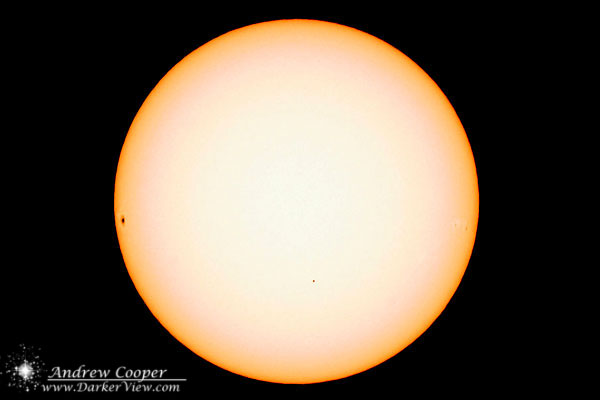
The Mercury transit of 8 Nov 2006 in progress. Mercury is about halfway between the center to the bottom, a large sunspot complex is visible on the left edge. Photo with a 90mm APO refractor, a Thousand Oaks full aperture filter and a Canon 20Da camera.