Moonset would not be until nearly 11pm, otherwise the weather looked quite promising for a night on the mauna. The plan… A late arrival and setup at the substation site across the street from the Mauna Kea VIS
Arriving late would mean most of the evening crowd at the visitor station would be gone, taking their headlights with them, hopefully leaving a dark and quiet night to enjoy. This early summer season places the center of the Milky Way high overhead for much of the night for excellent observing possibilities.
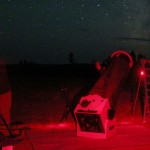
Deep Violet set up under Mauna Kea skies waiting for moonset and full darknessSometimes things work out exactly as planned.
Meeting me on the mountain would be David Kriege, owner of Obsession Telescopes. This trip marked his first opportunity for Hawaiian observing and to take advantage of that he brought along a 22″ ultra-compact model. Along with David came Mike, he brought a camera in place of a telescope, not a bad choice with the Milky Way high overhead all night.
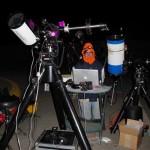
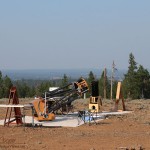
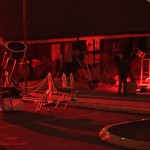
A trio of telescopes set up for astrophtography at the Mauna Kea VIS
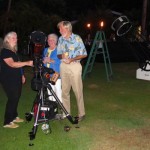
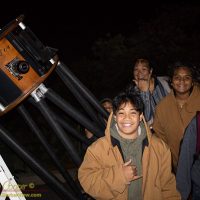
Maureen sharing her telescope with guests at Keck’s Evening with Astronomers
Cliff sets up his 24″ scope on the next target.
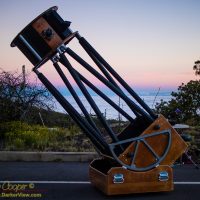
The restored 20″ Obsession telescope set up at Hale Pohaku on the side of Mauna Kea
Visitors enjoy telescopes under the star at the Mauna Kea VIS
Everyone at the VIS was enjoying the night!
Tony’s 14″ dob with a long line of folks waiting to view
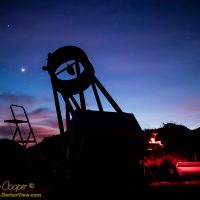
Bright sunset colors silhouette a telescope at Oregon Star Party 2013
A trio of telescopes awaiting darkness at Oregon Star Party
Telescopes at Oregon Star Party 2013
Observing from the Mauna Loa research station, the trace of red lights in 116 x 20sec exposures, the AMiBA telescope is in the background
The author waiting for dark at the 2005 All Arizona Messier Marathon with my usual visual setup including Deep Violet
The observing field at the Farnsworth Ranch, with the Silverbell Mountains in the background and Kitt Peak just visible at far right. The field is unusually green after heavy spring rains. The clouds are rapidly departing to the east.
Deb pointing out the star βPhoenicis to VIS volunteer Joe McDonough
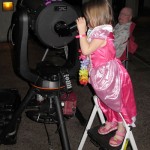
A princess looking through the telescope while we were set up at the King’s Shops
Debbie Goodwin gazes at Saturn through a C-14 at an evening star party in Waikoloa
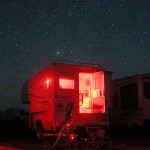
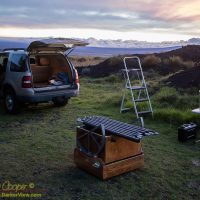
A camper and telescope set up under a starry sky
A line of big ‘scopes to greet a huge Saturday crowd at the MKVIS
Tony shows a group of enthusiastic student views with his 12.5″ dob.
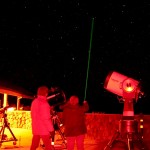
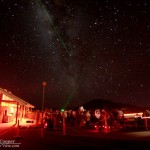
Green lasers in use at the Mauna Kea VIS nightly observing with the Milky Way high overhead
Steve Dillinger’s 20″ Dob awaiting full dark at Sentinel, AZ with Venus and the Moon shining behind
The 20″ Obsession telescope being set up at Kaʻohe, on the side of Mauna Kea
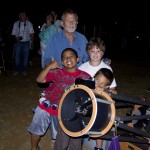
A group of local school students with the 20″ telescope
My 18″ telescope Deep violet set up under the stars at the MKVIS.
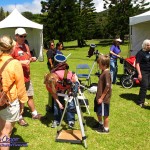
A family enjoys a view of the Sun in the telescope
The telescope line at Sentinel for the 2005 Sentinel-Schwaar Star Gaze
The telescopes are nearly ready, now to wait for dark!
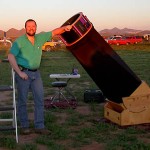
Olivier beside his new telescope, a 12″ Orion Dobsonian
Local amateur astronomers set up their own telescopes behind the main building at Lick Observatory
Ken and Ann Jones oberving with their 18″ at Oregon Star Party 2013
Chris Fuld collimating his 40.5 inch dobsonian
The NexStar 11″, the TV76mm and a Canon 60D setup for astrophotography at the MKVIS
A telescope set up on the grounds of the Mauna Kea resort awaiting dark skies
The 11″ NexStar GPS telescope, GyPSy set up at Ka’Ohe
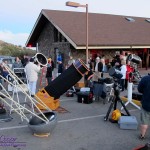
Almost all of the big dobsonian telescopes to be found on Hawai’i show up at the VIS for the night.
Maureen setting up for some public observing to support Keck’s Evening with Astronomers
The 20″ Obsession telescope awaiting full dark at Kaʻohe, on the side of Mauna Kea
Visitors enjoy great views of an active Sun at the 2012 Waimea Planet Walk
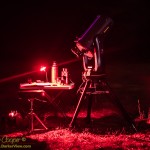
The observing table during visual observing, all the necessities… charts, guides, binoculars, observing notebook and something to drink.
A dark night under the stars! It has been too long… Why not?
The 20″ Obsession telescope awaiting full dark at Kaʻohe, on the side of Mauna Kea
After all the work restoring the 20″ Obsession it was time to get it out under the stars for a decent observing run. During the many hours of work I had looked forward to simply using this telescope for a bit. While it would eventually be stored at the observatory and used for outreach, it seemed a shame not to spend a night or two under the stars with this instrument. Not like I need a 20″ telescope, my 18″ is just fine, but I loaded it up just the same, leaving Deep Violet in the garage.
The 20″ Obsession telescope being set up at Kaʻohe, on the side of Mauna Kea
My favorite close by site is KaʻOhe, taking only a twenty minute drive from home to reach. At 5,700 feet on the side of Mauna Kea nearby home does not mean second rate. I really like this spot, the view is spectacular with the coastline below and the Mauna Loa and Hualālai volcanoes dominating the horizon. The entire southern horizon is unobstructed, allowing observations of southern objects right down to the horizon.
Better yet, recent rains meant green grass and a spot near the road maintenance gravel pile was hard packed rock, no dust! The area had even been mown recently! I sometimes have a few uncharitable words to describe DLNR, but not this evening.
It was a beautiful morning! Alarm set for 4:30am, out of the house at 5am, setup just at sunrise on the old Saddle Road. The sun rose through low clouds over the grasslands of Parker Ranch with Waimea to one side and Mauna Kea on the other.
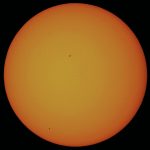
Mercury transiting the Sun on May 9, 2016. Celestron C8 and Canon 6D at f/10.Setting up a telescope as the Sun was rising seemed just wrong. I am used to breaking down a telescope as the Sun comes over the horizon at the end of a night’s observing. It is not often that an observing session results in my risking sunburn!
The seeing was pretty horrible at sunrise but rapidly improved as the Sun rose. As the transit ended the seeing was quite sharp and the photos not all that bad. At least as long as I kept the shutter speeds high. Visually the view was quite nice, a sharp black dot against the Sun, a far cry from the dancing blur you usually see when trying to view Mercury in the glow of Sunset.
Jupiter passed through opposition back on March 7th. Thus the giant planet is high in the sky through much of the night, well placed for observations.
Jupiter on March 24th from WaikoloaI was thinking of going to bed, but it was a hot windless evening in Waikoloa, not much point in trying to sleep before it cooled off a bit. The dead calm conditions made me think… What is the seeing like? A question only an amateur astronomer would ask.
Turns out the seeing was pretty good. The typical horrible seeing in Waikoloa is 2 to 3 arcseconds or worse, when the trades are blowing it can be quite bad. I suspect the seeing was 1 arcsecond or better last night, the view of Jupiter in the eyepiece was quite pleasing. Putting a camera in place of the eyepiece yielded video worth the effort in processing.
Yeah, I did another Messier marathon, You know, that crazy exercise where you attempt to find all 110 Messier objects in a single night. A bit crazy, but also rather addicting. I am a somewhat of a purist, I use no computerized telescope, just a chart, a Telrad, and my knowledge of the night sky. This makes a Messier marathon a real challenge.
A few clouds wandering across the western horizon, some near, some far. At least there is some blue sky!I had invited a few other folks to join me at the Kaʻohe observing site on the side of Mauna Kea. A few other observers had indicated they would be there, I even had a DLNR permit for a small group to join me and a few extra checklists printed out. It was the clouds that convinced the others not to make the attempt. Thus, in the end I had the night to myself. Mostly.
Even if the clouds spoiled the event there was not much to risk. May as well pack up and drive to the site, as the organizer I pretty much had to be there in case any of the others responded to my invitation. This outing would not take much preparation, a cooler packed with munchies and drinks to get me through the night and one of my smaller telescopes. There is not much question as to which telescope I will use… Primero, my 6″ RFT and the veteran of many Messier marathons. it is this instrument with which I achieved my one perfect 110 score at the All Arizona Messier Marathon many years ago.
My first attempt at a proper Milky Way arch photograph. Not easy to stitch properly, but worth the effort! Click on the image for a file size large enough to properly enjoy…
The winter Milky Way arches over Hualālai with Orion and the setting Moon at the center, taken from the Kaʻohe observing site, panorama of five images taken with a Canon 6D and a Rokinon 14mm lens with over 300 degrees of horizon
We are good to go! I have the DLNR permit for using the site. We will hold the Mauna Kea Messier Marathon 2016 on the evening of March 12 at the Ka’ohe observing site.
The 11″ NexStar GPS telescope, GyPSy set up at Ka’OheSunset: 18:31 HST
Astronomical twilight ends: 19:44 HST
Astronomical twilight begins: 05:19 HST
Sunrise: 06:32 HST
Please arrive before sunset so as not to annoy other observers with lights and dust, allowing a few extra minutes to find the setup site. This will provide plenty of time to set up gear and have a picnic dinner. I hope to be at the site around 5:30pm. I will sign the group in at the check-in station with the permit number, you need not sign in.
For those who wish to marathon I will have a checklist available for the effort. There are a lot of MM checklists, the one I provide is optimized for our 20N latitude which changes the priority of the evening and morning objects. If you do not want to participate, just come to observe.
If you are participating in the MM I would also suggest a low-power, wide field instrument. Smaller telescopes are actually better at this pursuit than larger. For MM I leave the 18″ at home and bring a 6″ telescope. Any finding aids are acceptable, including GOTO. If you are a purist like me? I will use nothing but a chart and a Telrad to locate the objects.
The site is to be found along the old Saddle Road just above the Kilohana hunter check in station. There is a line of pine trees a couple hundred yards above the gate, I plan to set up on the makai side of the trees where you will find a large flat area and a big pile of gravel stockpiled. A precise location and Google map for the Ka’ohe site can be found here.
A reminder that the DLNR permit has a few restrictions, nothing we would not do anyway… No open flame, no hunting, and please keep the area clean.
Now all we need is clear weather for a successful Marathon!
You have heard it before, but it really is true! Looking at the Sun for longer than a few brief moments with an unprotected eye can lead to permanent damage. Looking at the Sun with any sort of optical deceive that has not been properly filtered can lead to instantaneous eye damage.
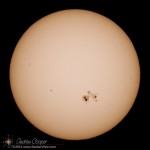
The complex sunspot AR2192 visible on 24 October, 2014
Discussed below are the only safe methods I am aware of to view the Sun. There are some dodgy methods out there. Take chance with your irreplaceable eyesight? I think not. Be careful and do it right if you want a look.
For the unaided eye there are a couple options to view the Sun safely…