
Category: Lunar Events
Waxing and waning from new to full and back again
Full Moon
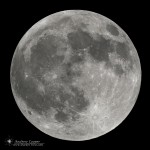
This full Moon will be a perigee full Moon, with the Moon appearing a bit larger and brighter. Today lunar perigee occurs within minutes of full, producing a full moon that is about 12% larger and 30% brighter than if full occurs while the Moon is at apogee.
The SuperMoon is Back
I saw it on Facebook first, shared by a family member… The meme that will not die…

The claims are the usual… The Moon will be huge in the sky. The Moon will be closer than is has been in some huge time span.
There is some truth here, the June full Moon will be a bit bigger and brighter than usual. And it will be closer to the Earth than it has been in a long time, if you consider 27.5 days to be a long time.
The SuperMoon meme exaggerates the truth to varying degrees.
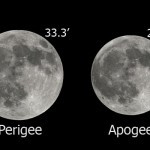
It all relates to lunar apogee and perigee. As the Moon’s orbit is elliptical, it does get a little further and closer during each orbit, but the difference is fairly minor, the distance varies from 405,000km (251,000miles) to 360,000km (223,000miles) from the Earth. This difference in distance results in the Moon appearing up to 12% larger at perigee compared to apogee. For a better explanation you can go to another post that explains this more fully, with graphics.
12% difference, noticeable if you look close, but hardly a “SuperMoon”.
The Moon passes through perigee, the closest point every 27.5 days, about once each orbit. Not a very long time. But SuperMoon only occurs if perigee happens to coincide with full Moon. As these two cycles are usually out of sync with each other people do not usually notice. About once a year the two cycles coincide and we get a slightly larger, brighter full Moon… The SuperMoon. Interesting, but not as dramatic as the hype.
Geologists have studied the lunar earthquake/volcano possibility for decades with varying results. Indeed, some older studies seemed to indicate a link. More recent studies have pretty much ruled out any association, better data associated with more instrumentation and improved worldwide coverage has shown that if there is any effect it is quite small.
Besides, if there were a link, the earthquakes should occur every 27.5 days as the Moon passes through perigee, they do not. There is no reason to make anything special of the full Moon/perigee synchronicity.
June 23rd will offer a nice, bright full Moon. A great time to take a moonlit walk, or a night dive. Ignore the scaremongers, and use this as an excuse to enjoy our beautiful universe.
New Moon
Full Moon
A penumbral lunar eclipse will occur, but it is so minor there is little point in trying to observe it. As the NASA eclipse site notes… “With a penumbral eclipse magnitude [6] of 0.0158, just 0.5 arc-minutes of the Moon’s southern limb will pass into Earth’s pale penumbral shadow; such a shallow eclipse is only of academic interest since it will be all but impossible to detect.”
Partial Solar Eclipse Reminder

Please exercise caution when viewing the Sun! Use appropriate eye protection or indirect observing techniques to project an image of the Sun. The link at the start of this paragraph leads to a great discussion on viewing the Sun safely. As always the single best source on the web (or anywhere) for eclipse and transit information is Fred Espenak’s eclipse website at NASA. Stop by whenever you have a question on upcoming events as well as viewing and photography tips.
During a deep partial such as this one check out the shadows under nearby vegetation. Small gaps in leaves can act like pinhole cameras projecting small crescent images of the Sun.
| Location | Begins | Maximum | Ends | Altitude | Azimuth | Magnitude |
| Honolulu | 14:23 | 15:48 | 17:01 | 43 | 275 | 44 |
| Hilo | 14:31 | 15:56 | 17:05 | 61 | 270 | 47 |
New Moon
An annular solar eclipse will sweep across Australia and the southern Pacific Ocean. For viewers in the Hawaiian Islands this eclipse will be seen as a deep partial eclipse, with a maximum of over 40% of the Sun obscured.
Partial Solar Eclipse
For viewers here in the Hawaiian islands this will be a deep partial solar eclipse, with well over 40% of the Sun obscured by the Moon. This is enough to produce a noticeable drop in the Sun’s brightness at mid-day.
Please exercise caution when viewing the Sun! Use appropriate eye protection or indirect observing techniques to project an image of the Sun. The link at the start of this paragraph leads to a great discussion on viewing the Sun safely. As always the single best source on the web (or anywhere) for eclipse and transit information is Fred Espenak’s eclipse website at NASA. Stop by whenever you have a question on upcoming events as well as viewing and photography tips.
| Location | Begins | Maximum | Ends | Altitude | Azimuth | Magnitude |
| Honolulu | 14:23 | 15:48 | 17:01 | 43 | 275 | 44 |
| Hilo | 14:31 | 15:56 | 17:05 | 61 | 270 | 47 |
Full Moon
Viewers across Africa, Central Asia and Australia will be able to see a partial lunar eclipse. Pacific and North American observers will not be able to see any of this event. No matter, this is a fairly minor eclipse, with the Moon just brushing the umbra.
New Moon