Transit Webcast Comments

Almost a week later and the comments keep coming in… E-mails to the observatory, comments on my blog, people are still pulling me aside to offer their comments in person. It is somewhat overwhelming. Did we really manage to do this?

Transit Webcast
The transit webcast station while on-the-air, photo courtesy Mark Senft

I spent 6 and change hours with you guys and I really appreciated your dedication to keeping everything up and running for us all around the world. HATS OFF YOU YOU ALL! – Kyle

We are in currently rainy Western Australia, and your webcast was the only way that we got to see the transit at all. My kids’ primary school all tuned into you at some point during the day. 🙂 – Carina

I have been reading the comments as they come in. It is truly gratifying that we managed to share this unique event with so many people.

You made my wife’s day! She was stuck at work & had you and the Keck team in the background for the entire transit! She is eternally grateful! Mahalo nui loa! – Joel

I watched your webcast of the transit from start to finish (with a few breaks here and there). What a great job you guys did! Fascinating, funny and I learned a lot in the process. Thank you for your efforts, and I too look forward to other webcasts from Keck. – Carol

I do not expect we will be doing this again right away. It takes the right sort of event. The one previous webcast was during the close approach of the asteroid 2005 YU55 in November of 2011. That time we webcast from the remote operations room in Waimea. It was also a good success, with great cooperation from the astronomers doing the observation. Need to take advantage of the best opportunities.

Thank you all for your hard work and dedication. I signed on t minus 10 min and stayed until you guys went off the air. I enjoyed myself the entire time. I know for a fact that a lot of people learned tons during this broadcast. My wish, hope and dream is that you continue to do events like this. You all gave it such a warm (beep) behind the scenes feel that made us all feel “part of the science.” The picture in picture was awesome and the graphics support mid-show was much appreciated. I can’t wait until next time! – Eric

We supported an average of between 5k and 6k viewers at any given time, with a total of over 100,000 live views. This viewer count may have badly underestimated the actual number of viewers, often the feed was being shown to large crowds at other public venues. Andrea Ghez mentioned that they were showing our feed at the UCLA event, the feed was on at at least two schools, and our own crowded Hualalai auditorium at Keck Headquarters in Waimea. I keep learning of other crowds the feed was shown to…

“Our observatory in Sonoma County was clouded out much of the day so we had your feed up for our 300+ visitors to supplement live viewing between the clouds. After sunset I went home to watch the rest of the transit on UStream and read the firehose of comments. It was a giant star party! Thanks for all the effort. Best outreach ever!” – Cecelia

A great experience shared with so many people across the globe. Thanks to everyone who made the Transit of Venus such a great day… Our Keck crew and the viewers who were there with us.
The Transit of Venus

We did the Transit of Venus right.

The plan was to stream the transit live from the summit. With access to the Keck facilities we had internet, a comfortable break room, and an excellent vantage point from which to view the entire transit. It sounded so easy at first, just put a camera on a telescope and connect it to the computer for the duration. Easy, in concept. The reality? Not so much.

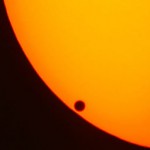
Venus Transit Second Contact
Transit of Venus 2012, second contact at 12:27pm

It was an incredible amount of work. I had spent several days during the preceding weeks preparing the gear for transit. I admit some of that was fun, an excuse to get the gear out in the day and look at the Sun, even photograph Venus quite near the Sun.

The webcast team consisted of three people, Larry O’Hanlon, the Keck PIO, Mark Senft, a volunteer from our astronomy club, and myself. Larry and I met a HQ to begin our drive up the mountain at 8am.

At Hale Pohaku we picked up Mark and enjoyed breakfast. Here we found a massive buildup in progress, a gathering of troops… Visitor center staff, Hawai’i County police and fire, and the Mauna Kea Rangers, all present in force. Stephanie Nagata, the director of the Office of Mauna Kea Management helped man the roadblock. Stewart Hunter, the head of Mauna Kea Support Services with her in an orange vest. Their preparations looked to be necessary, three hours prior to first contact the crowds of transit tourists were already growing.

Continue reading “The Transit of Venus”

Postcard from the Universe – Venus Transit

Transit is over, an exhausting and exhilarating day! I am headed to bed, but still totally jazzed with the experience. Keeping the webcast going for seven hours was a huge effort. Given the comments from our viewers it was worth it. I will have to more fully write up the experience for a later post.

The best visual for the day was the few minutes just before second contact… A beautiful, razor thin arc of light coming through the Venusian atmosphere, connecting the two horns of the occluded Sun. It was delicate and sublime, one of the most memorable sights I have ever seen through a telescope. With the excellent seeing of Mauna Kea, and the wonderful optics of my TV-76 telescope, the sight was clear and steady. I have yet to find a photograph that captures what I saw through the eyepiece.

I will post a quickly processed version of one of the frames from the second camera…

Venus Transit Second Contact
Transit of Venus 2012, second contact at 12:27pm

Transit of Venus is Today

Transit of Venus
The June 2004 Transit of Venus, image credit Jan Herold
The gear is tested, packed and ready. All of the arrangements have been made. It is time for the 2012 Transit of Venus!

We will be webcasting the transit live from the Keck telescopes at the summit of Mauna Kea. Tune in for images of the transit, and a lot of information about the transit. Larry O’Hanlon and I will be talking about the transit, the science, the history, and just generally enjoying the experience. You are invited to join us. Expect the broadcast to start about 11:45HST, or about 25 minutes before first contact.

Want to see for yourself? There are multiple locations around the island where you will find solar telescopes and volunteer guides to answer your questions about this event. Not on the Big Island? Check you local paper or look up your local astronomy club to find public events. Science museums, colleges, astronomy clubs and other astronomy organizations are organizing public events wherever the transit can be seen.

Location Name External Sun
Ingress Alt

h m s °
Internal Sun
Ingress Alt

h m s °
Greatest Sun
Transit Alt

h m s °
Internal Sun
Egress Alt

h m s °
External Sun
Egress Alt

h m s °
Anchorage, AK 14:06:30 51 14:24:04 51 17:26:53 38 20:30:46 16 20:48:32 14
Honolulu, HI 12:10:07 85 12:27:46 89 15:26:20 49 18:26:38 9 18:44:38 5
Kona, HI 12:10:09 86 12:27:48 87 15:26:16 47 18:26:33 7 18:44:33 3
Los Angeles, CA 15:06:26 58 15:24:02 55 18:25:33 18 — – — –
Phoenix, AZ 15:06:03 54 15:23:40 50 18:25:32 13 — – — –
Portland, OR 15:06:05 57 15:23:40 54 18:25:53 23 — – — –
San Francisco, CA 15:06:29 61 15:24:04 57 18:25:39 22 — – — –
Seattle, WA 15:05:58 56 15:23:32 53 18:25:57 23 — – — –

All times local. The data is taken from Fred Espenak’s NASA Eclipse Website. I extracted the cities that are of most interest to my Hawaiian readers. For the full list of US cities you can go here.

Please exercise caution when viewing the Sun! Use appropriate eye protection or indirect observing techniques to project an image of the Sun. The link at the start of this paragraph leads to a great discussion on viewing the Sun safely. As always the single best source on the web (or anywhere) for eclipse and transit information is Fred Espenak’s eclipse website at NASA. Stop by whenever you have a question on upcoming events as well as viewing and photography tips.

Dress Rehearsal for Venus Transit

It was a full dress rehearsal. Both telescopes, two cameras, the entire streaming rig set up on the lanai. No less than three computers with cables all over the driveway! Surprisingly enough, everything went pretty well!

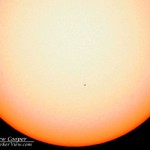
Sol 2Jun2012
The Sun on June 2, 2012
If you had been watching the Keck Transit of Venus stream, you would have been looking at a live image of the Sun for several hours. The seeing from my driveway was pretty poor, but there is a nice collection of smaller sunspots across the disk.

Everyone wandering by the house noted the telescopes. I gave peeks to our mail-lady and a couple young women who stopped by, intending to read me a bible verse or two (that was fun;)

Two technical issues were key today… Using thirty feet of active USB extension cables to run the streaming camera remotely, no problem. Co-aligning the two telescopes to aim at the same point, no action needed, aligned from the start. I had thought I might need to shim the mount for the piggyback ‘scope. I was also able to play with the streaming camera further. The Baader film filter gives a blue-white image. Adjustment of the camera white balance will restore a little yellow cast. I do not have much problem with the white, but a hint of yellow will allow people to instantly realize they are seeing the Sun. The same reason I adjust my processed photos for a golden orange hue.

We are all swapping gear around to get the set-up ready. Chris was nice enough to loan me a Canon T-ring and some Baader film. I built a battery pack and some sun-finders for several telescopes. Last night I picked up a whole solar rig from Cliff for delivery to Olivier. Olivier lent a 40mm eyepiece to Keck for the public telescope that will be setup at HQ. The list goes on…

I was not the only one doing a dress rehearsal. So far today I have been on the phone to other folks setting up and using a sunny Saturday to check gear. Some of the guys over on Maui even posted a video of their test run. I should have thought to do the same thing! Will have to time lapse the summit setup.

Venus Transit Reminder

This is your last chance this lifetime to witness a Venus transit! On June 5th the Earth, Venus and the Sun will line up correctly so that earthbound observers will see Venus cross the disk of the Sun.

Mercury Transit
Mercury transiting the face of the Sun, 6 Nov 2006
Venus transits are relatively rare events, that occur in pairs1, with the paired events separated by eight years. Each pair is separated from the next pair in a predictable pattern, alternating 105.5 or 120.5 year gaps. The first transit of the current pair was in June 2004, with the 2012 event completing the pair. The next pair of events will begin in December 2117. Given the century long separation between events Venus transits have only occurred seven times since the invention of the telescope (1631, 1639, 1761, 1769, 1874, 1882 and 2004)2.

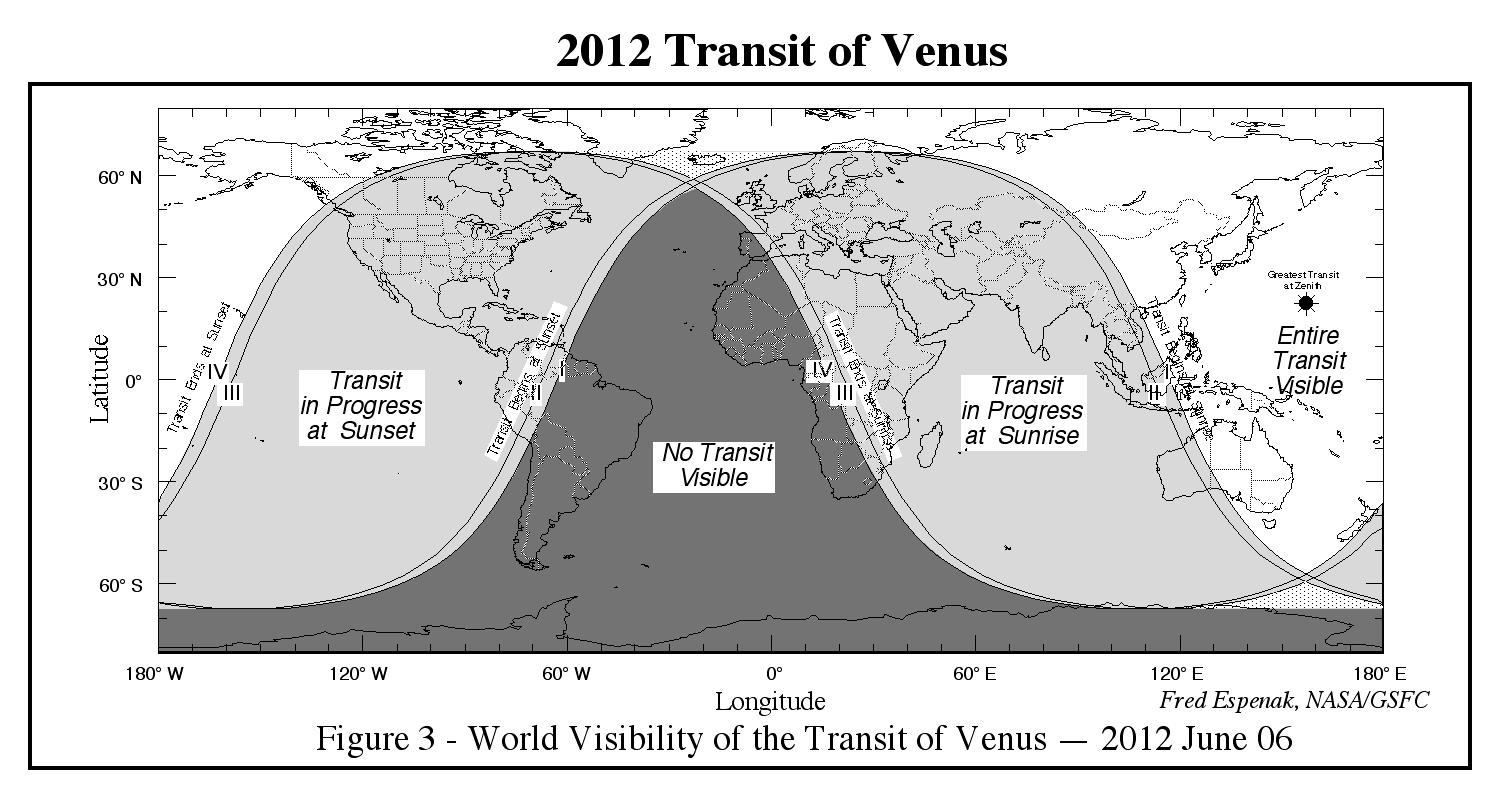
To witness this event you only need to be on the daylight side of our planet when it occurs. The 2012 event favors the Pacific, Australia, Japan and eastern Asia.

For Hawai’i the event will begin at about 12:10pm with the Sun high in the sky, mid-point will be about 3:26pm and will end about 6:44pm, just before sunset. These times are only approximate, exact times will depend on the observer’s location and can vary by several minutes across the islands.

As always the single best source on the web (or anywhere) for eclipse and transit information is Fred Espenak’s eclipse website at NASA. Stop by whenever you have a question on upcoming events as well as viewing and photography tips.

Keck Observatory will be making an extra effort for this transit as Mauna Kea is perfectly positioned to observe the event. We will be webcasting the transit from a small telescope located at the summit. The webcast can be seen on your computer, or come over to our headquaters in Waimea to see the webcast and a live view in a solar telescope if the weather cooperates. there will be extra staff on hand to answer your questions.

Stay tuned to DarkerView for further details as the transit draws near.

1) Transit of Venus, Wikipedia Article, retrieved 8 Feb 2009

2) 2004 and 2012 Transits of Venus, Fred Espenak, NASA/GSFC, NASA Eclipse Website, retrieved 8 Feb 2009

Safe Transit Viewing

You have heard it before, but it really is true! Looking at the Sun for longer than a few brief moments with an unprotected eye can lead to permanent damage. Looking at the Sun with any sort of optical deceive that has not been properly filtered can lead to instantaneous eye damage.

Discussed below are the only safe methods I am aware of to view the Sun. There are some dodgy methods out there. Take chance with your irreplaceable eyesight? I think not. Be careful and do it right if you want a look.

For the unaided eye there are a couple options to view the Sun safely…

  • Solar Viewing Glasses Proper solar viewing filters are made from a thin plastic film, usually mylar, coated with metal to properly filter the Sun’s light for viewing with the unaided eye. These are widely available and quite cheap. Local astronomy organizations have been giving them away in preparation for the transit. Do not attempt to use these viewers in conjunction with binoculars or small telescopes, they do not provide sufficient filtering for optics!

  • Welding Glass Filters used for viewing welding offer much the same protection as solar filters. A shade 13 or darker welding filter can provide good protection for the unaided eye. Again, do not use a welding filter with any sort of optical device such as binoculars, they are not designed for such use and may not block enough light.

A much better view of the event can be seen if modest magnification is used. Do keep in mind that any soft of binoculars or telescope also concentrates much more light that the eye alone. Remember those childhood “experiments” involving a magnifying glass and ants? The best options here are the use of solar filters designed to be used on a telescope, or indirect means such as image projection.

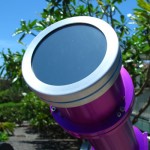
Solar Filter
A solar filter mounted on a refracting telescope

  • Solar Filters for Telescopes Filters specifically designed for telescopes consist of either a plastic film, or a sheet of glass, coated with a thin layer of metal to block the Sun’s light. These filters pass about 1/1000 of one percent of the light. More importantly, they block the harmful infrared and ultraviolet light that could so easily cause damage. The filters can be purchased in many sizes as appropriate for various models of telescopes, costing between one hundred and several hundred dollars.

  • Image Projection One of the simplest methods of displaying a solar image is projection. A white screen placed a foot or two behind a telescope will produce a very nice image of the Sun that can be safely viewed by a number of people simultaneously.

    Keep in mind that the beam of light out of the eyepiece is quite intense, potentially hot enough to burn a careless finger placed near the exit from the telescope.

    The method works best with small optical systems, binoculars or the smallest of telescopes. You do not need big optics to project a very nice solar image.

    You do not have any optics? Use the simplest optical arrangement of all, the pinhole camera!

If you do not have a safe means of viewing the transit and do want a look, you can go to one of the many public events being organized. Here on the Big Island there are quite a few options, one should be close to you.

Viewing the Transit of Venus on Mauna Kea

Everyone is gearing up for the Transit of Venus. Starting at just after noon on June 5th, Venus will cross the face of the Sun. This will be our last chance to see such an event in our lifetimes, as a result, many skywatchers are making an extra effort to see this transit. This includes a number of folks who are traveling to Hawai’i this June, just to be here for the transit.

Transit of Venus
The June 2004 Transit of Venus, image credit Jan Herold
The Office of Mauna Kea Management and and Mauna Kea Support Services are making an extraordinary effort for the transit. An interesting exercise, protecting the mountain, ensuring everyone is safe, and allowing reasonable access to the summit. This is a challenge under normal circumstances. Throw in the possibility of a much larger crowd and it could be a real problem. Thus, the following extra measures will be in place…

  • The summit access road will be closed to public vehicular traffic at the Visitor Information Station.
  • Access to the summit will be provided via free shuttle service between the Visitor Information Station (VIS) and Mauna Kea summit.
  • Parking at the Visitor Information Station (VIS) is limited. Additional parking will be provided, however If parking spaces fill up, vehicles will be held below the VIS until parking becomes available.
  • Mauna Kea Rangers and Hawaii County Police Officers will be present to assist with parking and public safety.

There will be solar telescopes stationed at the MKVIS, at the summit, and at a number of other locations around the island. With many options to choose from, you do not need to go to the summit to get at least some view of this event.

The diehards, those wanting to see the entire transit, will probably go to Mauna Kea. I really do not know what sort of crowd to expect on the mountain. While it could be substantial, I really expect a more modest showing than some folks are predicting. In any case it will be a fun event.

Myself? I will be on the summit. I will be running the Keck live webcast of the event using one of my telescopes. From a vantage point behind the Keck 1 telescope we should be in position to witness the entire event from start to finish.

More Astronomy Haiku

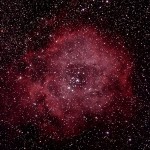
Rosette Nebula
The Rosette Nebula and cluster

Dark sky filled with stars
Telescopes help us see them
Takes your breath away
    – Jennifer Sanchez

Space explorers
In the night implore
Please let it not rain!
    – Mz’ili McKezfue (age 7)

Falling from the skies
In our scary, lonely nights
Brightening the sky
    – Angelita Camacho

It is amazing how much can be encompassed in so few words.

Poems used with permission.

Viewing the Transit of Venus on Hawaii

There is only one more chance in our lifetimes to see a Transit of Venus. If you are curious about this event, where do you go to see it?

Transit of Venus
The June 2004 Transit of Venus, image credit Jan Herold
Hawai’i is well placed to see the entire event. The transit starts just after noon, with the sun high in the sky. As the transit ends just before sunset, a clear western horizon will be required to witness final contact. For the true astronomical diehards, the summit of Mauna Kea will be the destination. With a clear view, above the clouds, the entire event will be visible.

For those folks who just want a nice view of the event, and do not necessarily need to watch for the entire seven hours, there are a number of easier options. To accommodate the public, there will be solar telescopes setup and manned by volunteers at a number of locations around the island…

  • Mauna Kea Visitor Information Station (MKVIS) A portion of the VIS parking lot will be converted into a viewing station. Telescopes with solar filters will be available. A NASA-sponsored live web cast of the Transit will be displayed inside the VIS and in the presentation room. Parking space at the VIS is limited. If parking fills, vehicles will be held below the VIS until parking becomes available. You may want to consider some of the other sites listed below.
  • ʻImiloa Astronomy Center of Hawaii, Hilo ʻImiloa will display the NASA webcast of the Transit. Leading up to the day of Transit, ʻImiloa will also be running a special planetarium show titled “When Venus Transits the Sun.”
  • W. M. Keck Headquarters, Waimea Livestream from the summit at headquarters in Waimea. Headquarters will be open until 6 p.m. Solar telescopes will be available. Free solar cards for viewing the Transit directly will be provided, while supplies last.
  • Canada France Hawaii Telescope (CFHT), Waimea Solar telescopes and a sunspotter will be available for the public. A raffle for a copy of “Hokuloa: The 1874 Transit of Venus Expedition to Hawaii” by Michael Chauvin will also be held.
  • Puʻu Koholā Heiau National Historic Site, Kawaihae From Noon till 4:30pm. Special glasses will be available, and a live webcast from the summit of Mauna Kea in the Visitor Center theater. As well, park rangers will give special presentations about the historical significance of this event throughout the day.
  • Natural Energy Lab in Kailua-Kona Mahalo to the Natural Energy Lab for sponsoring this event!
  • Keaʻau In the lot across from the Fire Station, Mahalo to W. H. Shipman Ltd for sponsoring this event!