Keck Lecture Webcast Link

Here is the stream for tonight’s Keck lecture. Nothing to see if you stop by early (or late). Come by at 7:00pm HST to see Dr. Richard Wainscoat of the University of Hawai’i Institute for Astronomy, “City Dark: Search for Night on a Sleepless Planet.”

Better yet… drop by the Kahilu Theater in Waimea to see the talk in person.


Live broadcasting by Ustream

Reminder- Keck Lecture Tomorrow Night

You are invited to attend a free Keck Observatory lecture…

Earth at Night
A view of the Earth compiled from nighttime shots from the DMSP satellites during October 1994 to March 1995. Image credit NASA/Goddard Space Flight Center
City Dark: Search for Night on a Sleepless Planet
Dr. Richard Wainscoat
University of Hawai’i Institute for Astronomy

Kahilu Theater
Thursday, April 5th, 2012
7:00pm

The advent and spread of electrical lighting has made it ever harder to find the dark skies valued by professional and amateur astronomers, not to mention lovers of starry skies in general. Dr. Wainscoat tells the story about light pollution and astronomy, with special emphasis on light pollution’s effects on the world’s best astronomical observing site: Mauna Kea on the Big Island of Hawai’i. Dr. Wainscoast is an astronomer as well as an accomplished photographer.

There is no charge for admission to any events in the Makana series.

Presented by W.M. Keck Observatory.

Keck Lecture

You are invited to attend a free Keck Observatory lecture…

Earth at Night
A view of the Earth compiled from nighttime shots from the DMSP satellites during October 1994 to March 1995. Image credit NASA/Goddard Space Flight Center
City Dark: Search for Night on a Sleepless Planet
Dr. Richard Wainscoat
University of Hawai’i Institute for Astronomy

Kahilu Theater
Thursday, April 5th, 2012
7:00pm

The advent and spread of electrical lighting has made it ever harder to find the dark skies valued by professional and amateur astronomers, not to mention lovers of starry skies in general. Dr. Wainscoat tells the story about light pollution and astronomy, with special emphasis on light pollution’s effects on the world’s best astronomical observing site: Mauna Kea on the Big Island of Hawai’i. Dr. Wainscoast is an astronomer as well as an accomplished photographer.

There is no charge for admission to any events in the Makana series.

Presented by W.M. Keck Observatory.

Venus Transit on Mauna Kea

A Venus Transit is a truly rare event. Transits occur in pairs eight years apart, with the next pair not occurring for another 120 years. The first event of the current pair occurred in 2004. Thus the next event will happen in June 2012. Considering the century long period between events, this is the last chance to witness a Venus transit during our lifetimes.

The 2012 event will be visible from the west coast of North America to Japan, China, Australia and Central Asia. For those wanting to observe the entire event from start to finish the choices narrow quite a bit. You have the choice of the Central Pacific, Japan, as well as Eastern China and Eastern Australia. This, of course, includes here in the Hawaiian Islands.

Many sky-watchers from North America will see only one choice if they wish to observe the event… the Big Island. The only place easily accessible by air, featuring excellent visitor accommodation, and an observing site that sits above the clouds that could so easily interfere with carefully laid plans. For the serious observer there is one obvious choice… Mauna Kea.

We saw the first signs of this well over a year ago. The tour companies that specialize in astronomy related travel, the folks that feature solar eclipse tours and similar events, began scouting Mauna Kea as a destination. Then the ads appeared, in Sky & Telescope magazine, Astronomy magazine, etc., “See the transit from Mauna Kea!” We had fair warning that this event was not going to pass peacefully.
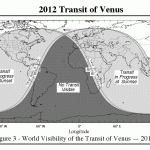
2012 Venus Transit Visibility
Visibility chart for the 2012 Venus transit, image credit: Fred Espenak/NASA

Some folks seem to think the crowd will be huge, a thousand people or more. I am not so certain, this does not have the general appeal of a total solar eclipse. The transit is something that will be of interest to amateur astronomers and some interested segments of the public. I personally expect hundreds of people coming to Mauna Kea to view the transit, not thousands.

However many folks do ascend the mountain for this event, we have begun putting plans in place to handle it. Various groups have met to do a bit of planning. Most significantly, those in charge of managing the mountain, The Office of Mauna Kea Management, are putting a few measures in place. As usual, expect to stop at the Mauna Kea Visitor Information Station on the day of the transit. But this day there will be a few differences…

  • All available MKSS staff will be on duty. All of the Mauna Kea rangers and visitor station staff will be helping make sure assistance is available to visitors when traveling to the high altitude environment of the summit.
  • Access to the mountain will be controlled for the day, a gate at the VIS allowing access for official vehicles only.
  • A free shuttle will run from the VIS to the summit. The Mauna Kea tour companies providing the vehicles and drivers.
  • Solar telescopes and video monitors will be set up at the VIS to allow safe viewing. Staff will be available to answer questions and assists with the equipment.
  • Several other locations on the island will be setup for viewing the transit with solar telescopes and staff. Expect these to include ‘Imiloa, Keck HQ in Waimea, and some possible other locations.

All of these plans are somewhat preliminary, details may change as the date approaches and final arrangements are made. I will attempt to post what I know here on Darker View.

Myself? I plan to observe the event from the summit. Set up behind Keck with a solar telescope to photograph the transit. We plan to set up a live feed of the transit for use by other sites, and available to viewers across the internet.

WHAC Monthly Meeting

The West Hawai’i Astronomy Club Meeting is nearly upon us. As a reminder we will be at CFHT Headquarters this month. We have a guest speaker this month, so it should be a good evening…

Decoding starlight with infrared spectroscopy: Finding water in places where planets might form around new stars
Greg Doppmann, Keck Observatory
7:00pm, Feb 14th

Greg Doppmann is recent transplant to the Big Island, now working at the Keck Observatory as a Support Astronomer. He received his professional training in astronomy from the University of Texas at Austin. In addition to research, Greg was also active in infrared instrumentation for the McDonald Observatory while at Texas. After graduating in 2002, he took a postdoc position at NASA’s Ames Research Center.

In 2004, Greg moved down to La Serena Chile and became an instrument scientist at the Gemini Observatory. More recently, he was a member of the scientific staff at the National Optical Astronomy Observatory in Tucson for 5 years before moving to Hawaii.

His current research interests are focused on star formation, where he uses large telescopes with infrared spectrometers to measure physical properties of young stars that are embedded within nearby star forming clouds. In his spare time he enjoys hiking, cycling, gardening, and flying.

Live Webcast for Keck Lecture

On Thursday, Feb. 9, 2012, Keck Observatory will be hosting a live webcast of an astronomy talk by Dr. Tom Soifer of Caltech. The title of the talk is “Seeing the Invisible Universe.” Dr. Soifer also serves as the Director of the Spitzer Science Center and is a member of the Keck Observatory Board of Directors.

The webcast begins at 7 pm Hawaiian Time, 9 pm Pacific Time (5 am GMT, Feb 10) and will be streamed from the Kahilu Theatre in Waimea-Kamuela, on the Big Island of Hawaii. Watch in the window below, or click on the UStream link.

The live webcast will play in the box below beginning at 7 pm HST / 9 pm U.S. PST, or can be found via the Keck Observatory Facebook page.


Live broadcasting by Ustream

Reminder – Keck Lecture Tomorrow

Tom Soifer
Seeing the Invisible Universe

Kahilu Theater
Thursday, February 9
7:00pm

Astronomy is enjoying a golden age and the W M Keck Observatory is a world leader in cosmic exploration. With generous support from Rob and Terry Ryan, Keck Observatory invites you to take a journey beyond this world to the frontiers of discovery. Your guides are Keck’s astronomers. They will bring you a rich and varied Universe and an evening filled with beauty, drama, mystery and surprise.

Tom Soifer is professor of physics at the California Institute of Technology and the Director of the Spitzer Science Center. He is also the Chair of the Division of Physics, Mathematics and Astronomy at Caltech and a member of the Board of Directors of the W. M. Keck Observatory. The Spitzer Space Telescope is NASA’s latest Great Observatory, designed to explore the infrared portion of the electromagnetic spectrum. Spitzer was launched in August of 2003. In his talk, Soifer will describe some of the most exciting results from the Spitzer mission, among its many discoveries have been measuring the thermal emission and spectra from hot Jupiters orbiting other stars, finding “Fullerene (buckyball)” molecules in space, observing prebiotic molecules in galaxies seen less than 3 billion years after the big bang, and measuring the masses of the most distant and youngest galaxies known.

There is no charge for admission to any events in the Makana series.

Presented by W.M. Keck Observatory.

Keck Lecture at Kahilu February 9th

Tom Soifer
Seeing the Invisible Universe

Kahilu Theater
Thursday, February 9
7:00pm

Astronomy is enjoying a golden age and the W M Keck Observatory is a world leader in cosmic exploration. With generous support from Rob and Terry Ryan, Keck Observatory invites you to take a journey beyond this world to the frontiers of discovery. Your guides are Keck’s astronomers. They will bring you a rich and varied Universe and an evening filled with beauty, drama, mystery and surprise.

Tom Soifer is professor of physics at the California Institute of Technology and the Director of the Spitzer Science Center. He is also the Chair of the Division of Physics, Mathematics and Astronomy at Caltech and a member of the Board of Directors of the W. M. Keck Observatory. The Spitzer Space Telescope is NASA’s latest Great Observatory, designed to explore the infrared portion of the electromagnetic spectrum. Spitzer was launched in August of 2003. In his talk, Soifer will describe some of the most exciting results from the Spitzer mission, among its many discoveries have been measuring the thermal emission and spectra from hot Jupiters orbiting other stars, finding “Fullerene (buckyball)” molecules in space, observing prebiotic molecules in galaxies seen less than 3 billion years after the big bang, and measuring the masses of the most distant and youngest galaxies known.

There is no charge for admission to any events in the Makana series.

Presented by W.M. Keck Observatory.

Science Illiteracy at the Star-Advertiser

We do like it when Keck Observatory is featured in the local papers. We are proud of the ‘scopes and take notice when we get some good press. The Star-Advertiser is the major daily paper for Honolulu and much of the state. I have even had some of my photographs published in the paper. Another article about Keck appeared today, but this time they simply display their ignorance of basic science.

Keck telescope helps discover 3 small planets outside Milky Way

The headline quickly had my attention. Exoplanet discoveries are coming fast with the Kepler Spacecraft / Keck Observatory team confirming alien worlds at a breakneck pace. It was the “outside the Milky Way” part that had my attention. I had no idea our current technology was capable of that! KOI-961 is a red-dwarf, a small, fairly dim class of star. It is difficult to even detect these stars at great distances, much less get the data needed to confirm orbiting planets. Something wrong here.

I double checked other sources… KOI-961 is actually fairly close to us in galactic terms, a mere 130 light years away. Given that the Milky Way Galaxy is well over 100,000 light years across, it puts KOI-961 well inside our galaxy. The article is actually reasonable, it appears to have simply taken the information from a press release, hard to screw up a cut and paste job. The headline however is where they stumbled hard.

Someone at the Star-Advertiser needs to take a basic astronomy course. Or maybe, simply check Wikipedia!

Update… They have fixed it. I forwarded the link to Larry O’Hanlon, the Keck PIO, whom I work with regularly. He called the S-A and apparently pointed out the issue. I would have loved to listen in on that conversation. The headline and text are edited now on the S-A website, but I kept a screenshot…


Outside the Milky Way?  Not really...
Outside the Milky Way? Not really...