Eighteen gallons of drinking water sitting in jugs in the guest bathtub, all of the lanai furniture is stashed away, a supply of propane is on-hand, the vehicle tanks are full… We are prepared for the storm.
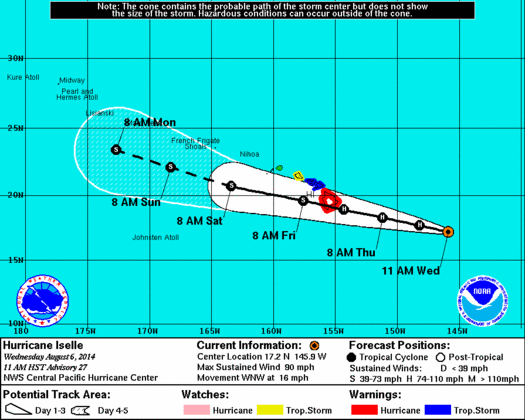
Considering that Iselle has failed to weaken as the earlier predictions forecast, it is now going to hit the island as a full hurricane. The cone of possible paths has narrowed to where there is no doubt, the eye of the storm will come right over the island.
I have never experienced the center of a hurricane, this will be new. Getting brushed by the outer edge of hurricane Howard while in Mexico a decade back is as close as I have been before. If the predictions hold we will see the eye go right over us. It will also be interesting to see what the interaction with two nearly 14,000ft mountains will do to the storm.
I am not expecting damaging winds on our side of the island. Perhaps a lot of rain? My worst fear is an extended power outage. There is a lot of Alaskan halibut in the freezer that would be painful to lose. I have filled the remaining space in the freezer with water bottles, now ice, to increase the thermal mass and the hold time without power.
I am on the minimal summit crew that will head up first thing tomorrow morning. We depart at the usual 7am and hope to be off the summit before noon. Certainly before the storm makes landfall later in the day. In any case tomorrow will be an interesting day.
Hurricane Iselle approaching the island of Hawai’i
Iselle is now forecast to hit the island as a full hurricane. The most likely path has shifted a little south, aiming directly for Puna. This may get interesting!
The forecast for hurricane Iselle as of Wednesday morning
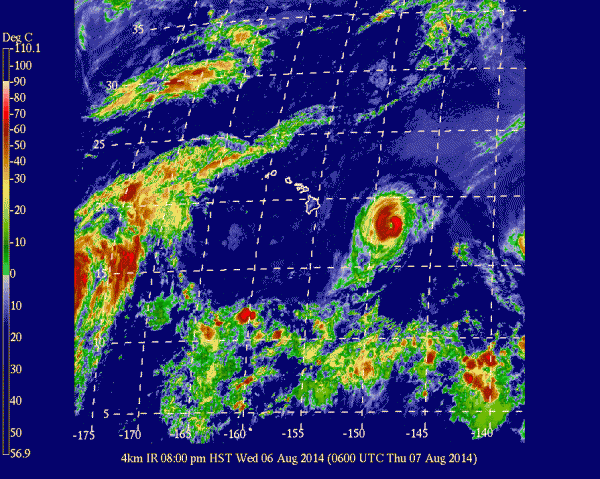
A GEOS infrared image of the Eastern pacific on the afternoon of August 5th. Visible are three hurricanes… Genevieve, Iselle and Julio (west to east)First up is hurricane Iselle, currently a category 2 storm with 110mph sustained winds. Fortunately the storm is expected to weaken and cross the island as a mere tropical storm on Thursday. The track does predict that the storm will come right over the island, bringing heavy rains and possibly damaging winds.
Behind Iselle is Julio, now 1900 miles southeast of Hilo. This storm is expected to cross the island as a hurricane, the first hurricane to hit a Hawaiian island in over two decades. This is the storm everyone is watching. It is still a bit early, the storm is not expected to arrive until Sunday. The forecasts will be interesting and well read over the coming days.
The forecast path for hurricane Iselle, 5 Aug 2014Fortunately our house is on the lee side of the island from these approaching storms, and is somewhat better sheltered than many of our neighbors. Storm preparations are quickly accomplished… Secure any outside furniture and gear, and insure we have a little extra water and propane on hand.
Preparations at the observatory are notably more complex.
The major concern is an extended power outage. We rely on long power lines that cross the saddle between Mauna Loa and Mauna Kea. If one or both of these storms prove damaging the power lines are likely to be part of the damage. These lines are also likely low on the list of repairs if there is extensive damage across the island.
Yes, there is a backup generator on site with a storage tank filled with diesel. How long will it last? What if the power lines along Saddle road are damaged? The power lines to the summit may be low on the priority list to repair if there are lines down all over the island.
If we are without power for a long period, we could lose power when the generator runs out of fuel. Of first concern are the instruments… The sensitive interiors of these cameras and spectrographs are kept at cryogenic temperatures, hundreds of degrees below freezing. Without power the instruments will start to warm up. Returning the instruments to service can take weeks. The vacuum dewars will have to be pumped again to restore the high quality vacuum conditions, then the instrument carefully cooled again.
Not that we are plunging blindly into this. We have a plan. Shutting down as much as we can, with priority given to the instruments. Hopefully the worst will not occur and we can continue smoothly on. But if the island does take damage we will be prepared to weather out the worst of it and preserve the facility.
Following the approval of a sublease on July 25 by the Hawaii Board of Land and Natural Resources, the Thirty Meter Telescope (TMT) announces the beginning of the construction phase on Hawaii Island and around the world throughout the TMT international partnership. Contingent on that decision, the TMT International Observatory (TIO) Board of Directors, the project’s new governing body, recently approved the initial phase of construction, with activities near the summit of Mauna Kea scheduled to start later this year.
An artist concept of TMT at night, with the laser guide star system illuminated.Kahu Ku Mauna and the Mauna Kea Management Board reviewed, and the University of Hawaii Board of Regents recently approved, the proposed TMT sublease. The final approval from the Board of Land and Natural Resources—the last step in the sublease process—allows TMT to begin on-site construction on Mauna Kea, home to many of the world’s premier observatories.
“It has been an amazing journey for TMT, from idea to shovel-ready project,” said Henry Yang, TIO Board Chair and Chancellor of the University of California Santa Barbara. “We are grateful to the Gordon and Betty Moore Foundation, the Hawaiian government, its citizens, and our project partners in bringing this important astronomical science effort to fruition. It is also my rewarding experience to work with so many community friends, University of Hawaii colleagues, and officials on both the Big Island and Oahu in this journey.”
Continued wet weather has kept the landscape green and allowed the weeds in my yard to multiply. It has also permitted a population explosion in the local mouse community here in Waikoloa. Now they are getting into the house.
A mouse, caught by the cats and photographed by the humansFortunately, we have cats.
Our cats had never caught a mouse before, we were not really sure that they would hunt mice. They are a terror for the geckoes and cockroaches. This worry was quickly laid to rest when the first mouse was killed. Multiple mice later and it becomes apparent that the hunting instinct is strong.
The garage had been forbidden territory, the cats kept out to keep them from getting into trouble. With the mice appearing that decision has been rescinded. The current morning routine is feed the cats, then open the garage door. Both felines immediately disappear into the garage. They may appear briefly to be fed, then it is back on post monitoring the rich hunting grounds of the garage.
The cats have shown their hunting prowess by putting the human to shame. My traps have only led to the capture of a single mouse. Currently the score is cats five, human one. I expect the score to rise far higher in the coming month.
Our well fed cats do not typically eat the mouse, but rather play with it until dead. Only one mouse has been recovered from the cats in good shape. Time to take another walk to the field above the house for release, after a few portraits.
We are not alone in our mouse issue, the entire village is being invaded. Elsewhere along the Kona coast it is much the same. I heard from my boss, who’s wife works at the macadamia nut processing facility in Kawaihae, that the mouse catch has risen from the usual handful, to over a hundred mice caught each day.
I had hoped the weather was drying out, that hope has been dashed by the breakup of a tropical storm and another rainy weekend. The mice will keep coming for a while. The humans may not appreciate this, the cats however…
July 20 Update: Human 3 Cats 5!
https://darkerview.com/wordpress/wp-admin/post.php?post=13890&action=edit# July 22 Update: Humans 4 Cats 6… Cats assessed a penalty, the mouse was let loose in the kitchen! Humans recover the fumble, caught in trap behind stove and released away from the house. New score Humans 5 – Cats 5… The score is tied!!.
July 23 Update: Humans 5 Cats 6 Evidence that humans missed one in trap as it ate all bait and got out…
July 27 Update: Humans 5 Cats 13 This is getting old, the mice just keep coming. At least one learned how to rob me of the bait in the traps, hopefully that was one of the three the cats got today.
July 29 Update: A mouse caught by Electra escapes in the bedroom, not recovered despite a major mousehunt by humans and cats. Sticky traps deployed.
July 30 Update: Two mice in one trap in the garage! Humans 7 Cats 13. Later in the day another mouse caught by a cat escapes in the bedroom. Caught by one of the sticky traps… Humans 8 Cats 13.
Final Update a month later… Humans 18 cats 16, we pull it out at the end. A few more traps deployed makes a difference. The mouse plague seems to have ended… For now.
The film truly highlights the problem of plastic pollution in the ocean. Modern plastics do not decompose readily, but persist in the environment for decades. This is a problem that deserves more attention and should be in the mind of anyone who treasures our seas.
Apparently the biggest problem is not the large pieces of plastic like those used in making the chair, but rather the microplastics. Under the influence of wave and sunlight, plastic slowly breaks down into smaller and smaller bits. These are sand size or smaller granules that have come to pervade the entire ocean. The granules are easily ingested by the smaller creatures of the plankton community, the food on which all ocean life depends.
Walking a Hawaiian beach you see some plastic, even far from the major urban sources of this pollution. Walking the tide-line on any beach or cove reveals small bits of colorful plastic. There is not a lot, but it is always there.