
Postcard from Hawai’i – Big Guns
When you want to see the stars, find someplace dark

Exploring the islands

After five years of living on the Big Island we finally took a few days to hop to another island and do some exploring. The selected target was Oahu, a place we have never properly visited before, changing planes at the airport does not count.
First impressions… Oahu can be a nice place to visit, but the traffic is beyond terrible! The roads packed with cars playing by aggressive city rules. Even the North Shore and Windward were bad, not just Honolulu. After years of driving on the Big Island, where there are no interstate freeways and the driving is quite relaxed, it was an unpleasant experience. I managed, and we got around with little real trouble, re-learning the old skills of dealing with heavy city traffic. I am so glad to be back to Hawai’i and out of that traffic.
The Fourth of July is a pretty good day to visit patriotic monuments like the battleship Missouri and the Pacific Aviation Museum. This was the plan and it executed well.
For the Fourth all of the ships in the harbor were decked out in flags, including the Missouri, the many US Navy and foreign ships gathered for the upcoming RIMPAC exercises. Another treat was the Mississippi Lions All State Band performing pier-side the battleship.


We managed three dives last weekend. It was a holiday weekend, Kamehameha Day, that helped. But still, we average a couple dives a month, three dives in a weekend was a bit unusual. We dove with some friends at Pukao on Saturday. Then two more on the following Monday. This was conservative, a few of the guys dove on Sunday too!
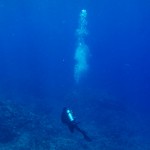
Thus, Monday morning saw us packing up the dive gear, a cooler with drinks and sandwich makings for everyone, and heading for Honokohau. There Deb and I joined Dennis and Mark for a very nice day diving.
We have been diving a lot in the NELHA area lately, I expect we will be diving some more there. It is some spectacular diving in the area. A rich reef sloping out to a steep drop-off that descends far beyond scuba depths. You look into the deep blue and know that somewhere down there is the abyssal plain, 8,000 feet below.
As usual I had my face in the coral, in and out of every crevice or small cave I came across. This is a great way to find the little stuff I love to photograph, but you can miss the big stuff… A series a sharp clangs gets my attention, the sound of Mark’s tank banger. I pull myself out of an alcove and swim over the large coral outcropping just in time to see a ten foot manta sweep by! The manta was just beyond the reef drop-off, against the deep blue of open water.
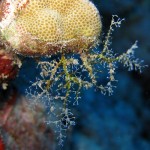
The find of the day was a Spanish Dancer, the largest nudibranch found in the islands. I do mean large, while most nudi’s I locate are an inch or two long, this fellow was the size of a dinner plate. Dancers have another feature… They Dance! Actually a form of swimming through undulating the body. I flushed him out of a crevice in the cave and the nudi proceeded to dance for us, everyone got a good look. After a few photos, actually quite a few photos, I carefully shepherded the pretty fellow back into the crevice I found him in.
No dives this weekend, I was on call. But we are already planning another outing next weekend. Summer diving season is here, bringing calm and clear water to the Kona side. The crew is ready to go, discussing where we will dive next.
This is not a case of “I wish you were here”, but rather another lesson in the many hazards of diving.
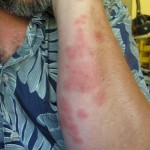
I know when I got hit, a series of pricks down my left forearm. I didn’t even react, I was concentrating on the photo. I continued to brace myself against the surge by using the rocks of the cave floor. Those rocks were home to some little critters that had an issue with the disturbance I was creating… Hydroids.
Through the rest of the dive my arm continued to sting, discomfort that persisted but was not really all that bad. I took no action other than noting that I had gotten hit. It wasn’t until the next day that I realized that the stings were not going to go away quickly. I had a series of red welts across my forearm, and they itched. Time to break out the hydrocortisone cream. A week later the welts have faded and shrunk to pinpoints, no longer itch, but are still there.
Friday evening we stopped into the shop of Kohala Divers for a bit. There were a few folks we know in the shop as they were having an open house. As I chatted with Lina Preskitt, a local marine biologist, I mentioned the stings, showing her my forearm. She raised her forearm to display a very similar set of red welts on her left arm! We laughed as we looked at a mirror of almost identical stings.
This is the second time I have been seriously stung by hydroids. Will it stop me from diving? Not at all. Perhaps be a bit more careful when mucking about on a cave floor.

We did the Transit of Venus right.
The plan was to stream the transit live from the summit. With access to the Keck facilities we had internet, a comfortable break room, and an excellent vantage point from which to view the entire transit. It sounded so easy at first, just put a camera on a telescope and connect it to the computer for the duration. Easy, in concept. The reality? Not so much.
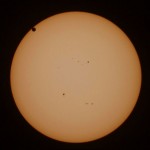
It was an incredible amount of work. I had spent several days during the preceding weeks preparing the gear for transit. I admit some of that was fun, an excuse to get the gear out in the day and look at the Sun, even photograph Venus quite near the Sun.
The webcast team consisted of three people, Larry O’Hanlon, the Keck PIO, Mark Senft, a volunteer from our astronomy club, and myself. Larry and I met a HQ to begin our drive up the mountain at 8am.
At Hale Pohaku we picked up Mark and enjoyed breakfast. Here we found a massive buildup in progress, a gathering of troops… Visitor center staff, Hawai’i County police and fire, and the Mauna Kea Rangers, all present in force. Stephanie Nagata, the director of the Office of Mauna Kea Management helped man the roadblock. Stewart Hunter, the head of Mauna Kea Support Services with her in an orange vest. Their preparations looked to be necessary, three hours prior to first contact the crowds of transit tourists were already growing.
Continue reading “The Transit of Venus”Sad news that two of the telescopes atop Mauna Kea will be losing funding. Word comes from Tom on his blog Pacific View…
• extend operation of JCMT to end September 2014, to allow for completion of the agreed science programme for the SCUBA-2 instrument on the JCMT
• cease STFC support for the operation of UKIRT from end September 2013, a year after the completion of its current survey programme
These shutdowns have been threatened for some time. It is disheartening to learn that the worst outcome is now reality.
