Tomorrow morning, June 24th, will see a brilliant Venus paired with a crescent Moon. Look for the pair to rise about 03:45HST to be 25° above the horizon at sunrise. A 7% illuminated Moon will be a nice match for Venus shining brilliantly at -3.9 magnitude. Separation will be just over 2.5°.
Category: Astronomy
Exploring the cosmos
Summer Solstice
Summer solstice occurs today at 00:52HST. Today the Sun will occupy the most northerly position in the sky of the year. The term solstice comes from the latin terms Sol (the Sun) and sistere (to stand still). On this day the Sun seems to stand still as it stops moving northwards each day and begins move to the south. This is the first day of summer as marked by many cultures in the northern hemisphere. Alternately this is the first day of winter for those living south of the equator.
| 2014 Solstices and Equinoxes | ||||
|---|---|---|---|---|
| UT | HST | |||
| Perihelion | Jan 4 | 05:59UT | Jan 3 | 19:59HST |
| Vernal Equinox | Mar 20 | 16:57UT | Mar 20 | 06:57HST |
| Summer Solstice | Jun 21 | 10:52UT | Jun 21 | 00:52HST |
| Apehelion | Jul 3 | 22:59UT | Jul 3 | 12:59HST |
| Autumnal Equinox | Sep 23 | 02:30UT | Sep 22 | 16:30HST |
| Winter Solstice | Dec 21 | 23:03UT | Dec 21 | 13:03HST |
| Source: NASA Sky Calendar | ||||
Mercury at Inferior Conjunction
Today the planet Mercury passes through inferior conjunction, passing between the Sun and the Earth. In a week or so the planet will again be visible in the dawn sky, climbing higher each day. Maximum elongation will occur July 12th.
Keck Lecture Reminder
Join us for an astronomy talk tonight at the Kahilu Theater in Waimea…
First Light in the Universe: The End of the Cosmic Dark Ages
Dr. Michael Bolte from UC Santa Cruz
7:00pm, June 19th 2014
Kahilu Theater, Waimea
Free and open to the public
In the first several hundred million years after the Big Bang, the Universe was too hot for stars and galaxies to form. As the Universe cooled and its expansion slowed, gravity caused the first stars to collapse and re-light the Universe. Most theories suggest these first stars were unusual super-massive objects that evolved quickly and ended their lives in gigantic explosions. In this talk, Dr. Michael Bolte from UC Santa Cruz will discuss observations from Keck Observatory that identify the physical properties of the first stars based on the chemical elements they produced as they ended their lives.
Postcard from the Summit – IRTF

The WHAC Submillimeter Slide Show
A Tour of the Submillimeter Realm
In past years the club has toured the various optical observatories on Mauna Kea. Telescopes like Keck, Gemini and CFHT represent some of the largest optical telescopes in the world. There are a set of telescopes on the summit that often get overlooked, the submillimeter observatories. CSO, JCMT, and SMA all operate beyond the infrared in the submillimeter wavelengths of 0.3 to 1.4mm. These instruments enable the study of the cold and dark universe. The vast clouds of gas and dust than make up so much of the cold material between the stars and galaxies. The raw material from which everything we know is created, and to which we will return one day when the Sun has exhausted its hydrogen fuel.

Personally I had never visited these facilities, not during my seven years on the mountain. This is something that had to change. I suspected that this was true of most of the West Hawaii Astronomy club membership. It is even more imperative in that one of the facilities, CSO, is to be decommissioned and dismantled in the next few years. Thus the goal of visiting at least a couple of the submillimeter facilities to see the other side of Mauna Kea astronomy.
When arranging the tour I contacted all three submillimeter facilities on the summit. I would have considered getting two out of three a success, I knew that there was no way I would manage to get all three scheduled for a single day. The submillimeter observatories have much smaller staffs than the large optical telescopes like Keck, thus providing a tour to a visiting group is much more difficult. In the end all three observatories were able to provide a tour on the same afternoon, something I am still surprised about. A great deal of gratitude is due to the folks who drove up the mountain on a Saturday to give our group a wonderful tour.
Postcard from the Summit – Moonset

Milky Way
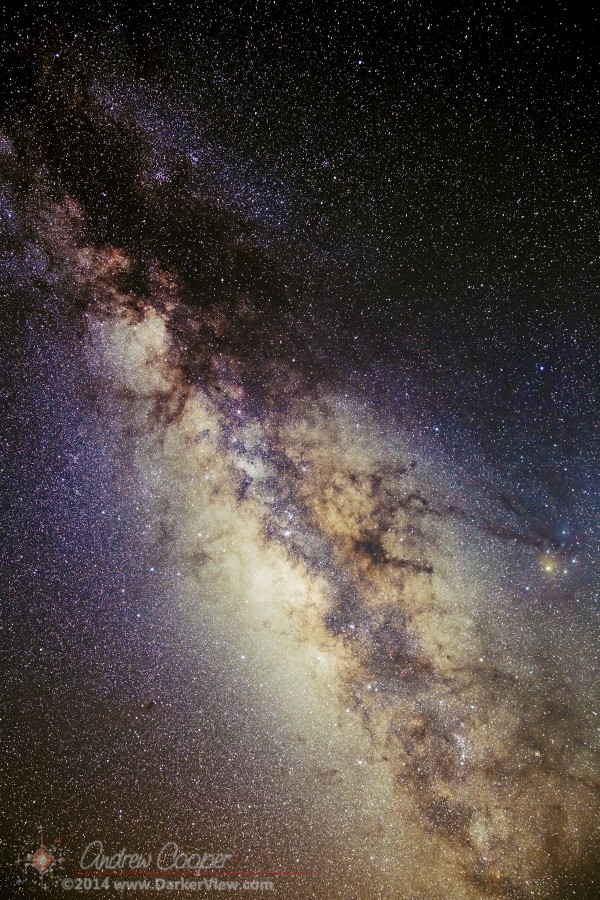
Observing at the VIS