Postcard from the Universe – M82 with SN2014J

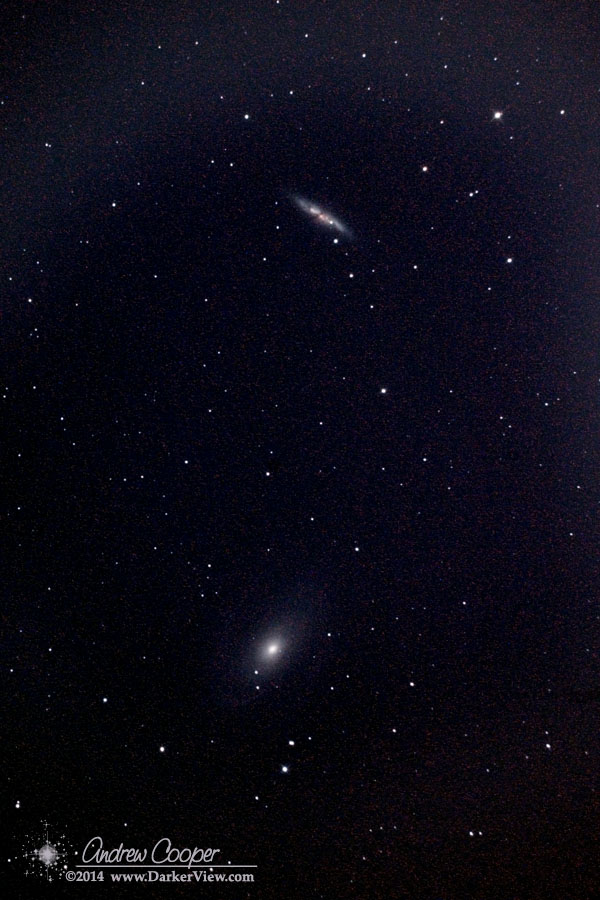
The brightest nearby supernova in may years is currently visible in the bright galaxy M82. I did want to photograph the supernova before it fades much more. It apparently reached a maximum brightness of magnitude 10.5 a few days ago and is starting to dim. But has so far only slid a few tenths of a magnitude.

So I tried to photograph a supernova, and Murphy came to visit.

The last week has seen me dealing with a sinus infection, which combined with terrible weather has kept me from setting up in the driveway for photography. Taking advantage of a few clear hours last night I did make an attempt. Things continued to go wrong.

A high thin haze would not go away, lit up by the light of a bright quarter moon it created high background and gradients in the imagery that would not calibrate out. I forgot to install the LPS filter, meaning that the low pressure sodium lighting of the village compounded the moonlight in creating a poor signal to noise and bad gradients. The autoguider would not behave. This was eventually solved by adjusting the tuning parameters in PHD guide. Not before ruining most of my exposures, I ended up throwing out 24 of 32 exposures. When I did get everything figured out and corrected, and the Moon had fianlly set, the clouds rolled back in.

The final eight usable exposures did result in a somewhat acceptable final product. It could have been so much better…

M81 & M82 with SN2014J
The galaxies M81 & M82 with SN2014J seen in the disk M82 at top

Sunspots – Take 2

Another process run on the sunspot image I posted earlier, a stack of 800 out of 1200 frames, with notably better detail. The large complex is AR1967 just rotating into view. This spot has already spawned an M-class flare and more is likely. Forecasters have given the chances of more M-class flares at 60% with the chance of an X-class flare at 10%.

Sol 30Jan2014
The Sun on 30Jan2014 with the large sunspot complex AR1967.

Sunspots

Some unaided eye sunspots visible today and for the next few days. The huge group, AR1967 is probably another visitation of AR1944, which spawned a few large solar flares during the first week of January.

I took a few quick images using the AT6RC and a Canon 60D. A quick process is shown below, give me a bit I should be able to produce a better image.

Sun 30Jan2014
The Sun on 30Jan2014 including the large sunspot group AR1967

Mercury at Maximum Elongation

Today Mercury reaches maximum elongation, the furthest point it will reach from the Sun in our sky and the highest it will be above the sunset for this evening apparition. The planet is easily visible as a bright, starlike object about 18° above the setting Sun as twilight begins. Over the next couple weeks Mercury will slide back into the sunset, heading for inferior conjunction on February 15th.

Continue reading “Mercury at Maximum Elongation”

Naked Eye 100 Challenge

Amateur astronomers love lists… The Messier observing list, the Hershel 400, the Hershel II, and on. Some lists can be complete on a night or two, some lists may take years, or even a lifetime to accomplish. Amateur astronomy is not the only avocation to use lists like this. Birders attempt to see all of the birds known to occur in their home country. Aircraft spotters love to see each model of aircraft in the air. Divers keep lists of species seen underwater.

Rainbow Wheel
A rainbow and cloud shadows produce a rainbow wheel

Lists like these are not only fun, but allow the list chaser to sample the wonders our universe has to offer. The challenge of finding and observing each of the items is worthwhile. Each object is a lesson into the science, hunting each object allows skills to be practiced.

Most of the astronomy observing lists require a small telescope to accomplish, or at least a pair of binoculars. One list is a bit different, it does not require any optical aid at all… The Naked Eye 100.

Continue reading “Naked Eye 100 Challenge”