Seven Years on the Mountain

Numerologists love the number seven. Another odd number that has come to have a special meaning for no real reason.

First Target of the Night
The Keck 2 AO Laser attempting the first target of the night with the light of sunset and a setting Moon behind
I have been working atop Mauna Kea for seven years now. This place that once seemed so alien is now so familiar. I walk through the observatory and look about, noting all of the things I have worked on, installed, or been involved with in some way. There are few parts of the facility I have not touched.

I helped install much of the Keck 1 laser system, from running the cables to aligning the launch telescope. The weather monitoring system atop the roof and in the domes is all my work, a complete replacement of the system over the last few years.

Secondary Selfie
A self shot looking into the Keck 2 secondary, at a reflection of the primary.
It is the AO systems I have been most involved with, responsible for the day-to-day functionality of the hardware. Entering an AO enclosure so many memories stream about. There is little I have not had to repair or work on in some capacity. I am familiar with every cable, every button and switch. I can recall schematics of many of the devices, the documents that show where everything is interconnected, I have drawn or edited most of them. I have had my small part in every discovery that comes from these amazing systems.

Mauna Kea Shadow
The shadow of Mauna Kea appears through the mist and haze at sunrise
I recall nights with both lasers stabbing the sky, golden beams amongst the bright stars. There have been glorious sunsets, of foggy sunsets when the world turned golden. There have been days we have dug our way into the building through drifts of snow, coatings of ice on every surface with foot long sideways icicles. Of driving through drifts of snow, tire chains scraping the ice, with snow flying and the vehicle skidding towards the guardrail. Of winds so strong they threatened to overturn the vehicles as we scramble to abandon the summit. I have watched the dawn after a long night of observing, the Sun rising above billowing clouds, the first brilliant rays etched into my memories.

Mauna Kea is a place of wonder and beauty that I have been privileged to experience, a treasure of memories to enjoy for a lifetime.

The Moon and Venus

Crescent Venus
Venus approaching inferior conjunction, 24Dec2013
Tomorrow morning, January 28th, will see a brilliant Venus paired with a thin crescent Moon. Look for the pair to rise about 5:08HST to be 23° above the horizon at sunrise. A 7% illuminated Moon will be a nice match for Venus shining brilliantly at -4.5 magnitude. Separation will be about 6.5&deg.

The following morning, January 29th, will see the Moon 10° below Venus, halfway to the rising Sun.

Rare Brown Dwarf Discovery Provides Benchmark for Future Exoplanet Research

W. M. Keck Observatory press release

A team of researchers led by Justin R. Crepp, the Freimann Assistant Professor of Physics at the University of Notre Dame, has directly imaged a very rare type of brown dwarf that can serve as a benchmark for studying objects with masses that lie between stars and planets. Their paper on the discovery was published recently in Astrophysical Journal.

HD19467B
Direct image detection of a rare brown dwarf companion HD19467B taken at Keck Observatory. Credit: Crepp et al. 2014, ApJ
Initial data came from the TRENDS (TaRgetting bENchmark-objects with Doppler Spectroscopy) high-contrast imaging survey that uses adaptive optics and related technologies to target older, faint objects orbiting nearby stars, and precise measurements were made at the W. M. Keck Observatory on the summit of Mauna Kea, Hawaii. Brown dwarfs emit little light because they do not burn hydrogen and cool rapidly. Crepp said they could provide a link between our understanding of low-mass stars and smaller objects such as planets.

HD 19467 B, a T-dwarf, is a very faint companion to a nearby Sun-like star, more than 100,000 times as dim as its host. Its distance is known precisely, and the discovery also enables researchers to place strong constraints on important factors such as its mass, orbit, age, and chemical composition without reference to the spectrum of light received from its surface.

Continue reading “Rare Brown Dwarf Discovery Provides Benchmark for Future Exoplanet Research”

UCSC Scientists Capture First Cosmic Web Filaments at Keck Observatory

W. M. Keck Observatory press release

Astronomers have discovered a distant quasar illuminating a vast nebula of diffuse gas, revealing for the first time part of the network of filaments thought to connect galaxies in a cosmic web. Researchers at the University of California, Santa Cruz, led the study, published January 19 in the journal, Nature.
Cosmic Web Filament
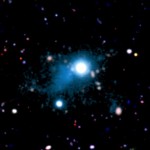
This deep image shows the nebula (cyan) extending across 2 million light-years that was discovered around the bright quasar UM287 (at the center of the image). Credit: S. Cantalupo, UCSC
Using the 10-meter Keck I telescope at the W. M. Keck Observatory in Hawaii, the researchers detected a very large, luminous nebula of gas extending about 2 million light-years across intergalactic space.

“This is a very exceptional object: it’s huge, at least twice as large as any nebula detected before, and it extends well beyond the galactic environment of the quasar,” said Sebastiano Cantalupo, first author of the paper and a postdoctoral fellow at UC Santa Cruz.

The standard cosmological model of structure formation in the universe predicts that galaxies are embedded in a cosmic web of matter, most of which (about 84 percent) is invisible dark matter. This web is seen in the results from computer simulations of the evolution of structure in the universe, which show the distribution of dark matter on large scales, including the dark matter halos in which galaxies form and the cosmic web of filaments that connect them. Gravity causes ordinary matter to follow the distribution of dark matter, so filaments of diffuse, ionized gas are expected to trace a pattern similar to that seen in dark matter simulations.

Continue reading “UCSC Scientists Capture First Cosmic Web Filaments at Keck Observatory”

The Hotech CT Laser Collimator

With Jupiter still near opposition and Mars opposition approaching I would like to do a little high resolution planetary imaging. For planetary I use our Nexstar 11″ telescope, with 2800mm of focal length is has the high magnification needed.
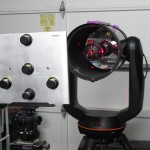
SCT Alignment
Aligning our Nexstar 11″ with a Hotech CT Collimation Tool
One lesson in high resolution imaging is that collimation matters. Having the optics in your telescope precisely aligned makes all the difference in the results. A small misalignment will result in mushy images that will not quite focus properly. No amount of fancy image processing will salvage the image.

The Nexstar has not been giving me the results I know it is capable of. I shot Venus just before inferior conjunction and noted that there was probably some issues in collimation that were not addressed in the quick star collimation I had performed.

Thus I borrowed a Hotech CT Laser Collimatior from a friend. The collimator is an interesting piece of kit, enabling the user to check more than simple the tip-tilt of the secondary.

Continue reading “The Hotech CT Laser Collimator”

Venus Appears in the Dawn

Venus is quickly rising in the dawn, appearing higher each morning. Today the planet will rise at 06:08HST, about 50 minutes before the Sun and be almost 12° above the horizon at sunrise. The planet will be quite prominent in the dawn sky for the next few months, reaching maximum elongation on March 22nd at 46.6° west.

When the planet rises far enough to catch in a telescope you will see a thin crescent that waxes a little each day.

Look for a nice pairing of this brilliant planet and a thin crescent Moon on the morning of January 28th.

John Dobson (1915-2014)

Today an amateur astronomy icon passed away.  John Dobson popularized the very simple design of telescope that came to bear his name, the Dobsonian.  As a Vedantan monk John possessed few material means, pursuing a passion for telescope building in the monastery garden shed he designed a telescope that could be built from whatever scrap parts he could scavenge.  He could often be found around San Fransisco showing the wonders of the night sky to anyone who would look through one of his telescopes.   His infectious enthusiasm for astronomy led him to help co-found the San Francisco Sidewalk Astronomers.

Monster
Chris Fuld using his monster 40″ dobsonian at Oregon Star Party 2013

The Dobsonian is a telescope that is characterized by an extraordinary simple and robust design. Made of plywood and other hardware store parts, there was nothing in the design that could not be built by hand.

The optical layout is a standard Newtonian design with the eyepiece at the front of the telescope.  This allows the heavy primary mirror to be located quite close to the ground.  The entire telescope rotates on a simple lazy-suzan azimuth bearing made of plywood, formica and teflon blocks.  A simple set of trunnions allows the telescope to be raised and lowered in elevation.

Dob Silhouette
Steve Dillinger’s 20″ Dob awaiting full dark at Sentinel, AZ with Venus and the Moon shining behind

The Dob brought large aperture astronomy into reach of thousands of backyard observers.  Anyone with a modicum of skill could build a Dob in a garage with simple hand tools.  Commercial designs soon appeared at very affordable prices.

Amateur telescope makers have built upon John’s ideas, creating elegant designs that far surpass those simple telescopes made from scrap. Aircraft grade plywood, machined aluminum frames, carbon fiber and computerized controls are common in modern Dobsonians. The design can be scaled up, Dobsonians are sometimes enormous, with telescopes of 30 or 40 inches aperture seen at many star parties. At OSP last year I setup next to a 40″ built by Chris Fuld, a monster telescope built by hand.

John spent much of his later life touring wherever dark skies, telescopes and people could be found. This often included national parks and regional star parties. I met John a few times across the years, at Grand Canyon Star Party and at an evening observing session at Starizona, an astronomy shop in Tucson. His signature graces the secondary cage of my 18″ f/4.5 Dobsonian, Deep Violet, beside the signature of David Levy.

John Dobson Signature
John Dobson’s signature on the secondary cage of Deep Violet

John was also a proponent of a decidedly non-standard cosmology, believing that the Big-Bang model had fatal flaws.  His alternate ideas make…  Uh?  Interesting reading.  He describes a recycling steady state cosmos heavily influenced by the teachings of eastern religions and mystical thought.

John Dobson died today, 15 January 2014 at the age of 98 in Burbank, California.  John leaves behind a son, many friends, and a community indebted by his contributions to amateur astronomy.  My friend Dean Ketelsen knew John far better than I did, I suggest you read his notes on his passing.

I spent a few moments and put all of the photos of dobsonian telescopes that have appeared here on Darker View into a gallery.  The photos are just a little sliver of what John Dobson meant to amateur astronomy…