
Postcard from the Summit – Laser
When you want to see the stars, find someplace dark

Exploring the cosmos
Venus is quickly rising in the dawn, appearing higher each morning. Today the planet will rise at 06:08HST, about 50 minutes before the Sun and be almost 12° above the horizon at sunrise. The planet will be quite prominent in the dawn sky for the next few months, reaching maximum elongation on March 22nd at 46.6° west.
When the planet rises far enough to catch in a telescope you will see a thin crescent that waxes a little each day.
Look for a nice pairing of this brilliant planet and a thin crescent Moon on the morning of January 28th.
Today an amateur astronomy icon passed away. John Dobson popularized the very simple design of telescope that came to bear his name, the Dobsonian. As a Vedantan monk John possessed few material means, pursuing a passion for telescope building in the monastery garden shed he designed a telescope that could be built from whatever scrap parts he could scavenge. He could often be found around San Fransisco showing the wonders of the night sky to anyone who would look through one of his telescopes. His infectious enthusiasm for astronomy led him to help co-found the San Francisco Sidewalk Astronomers.
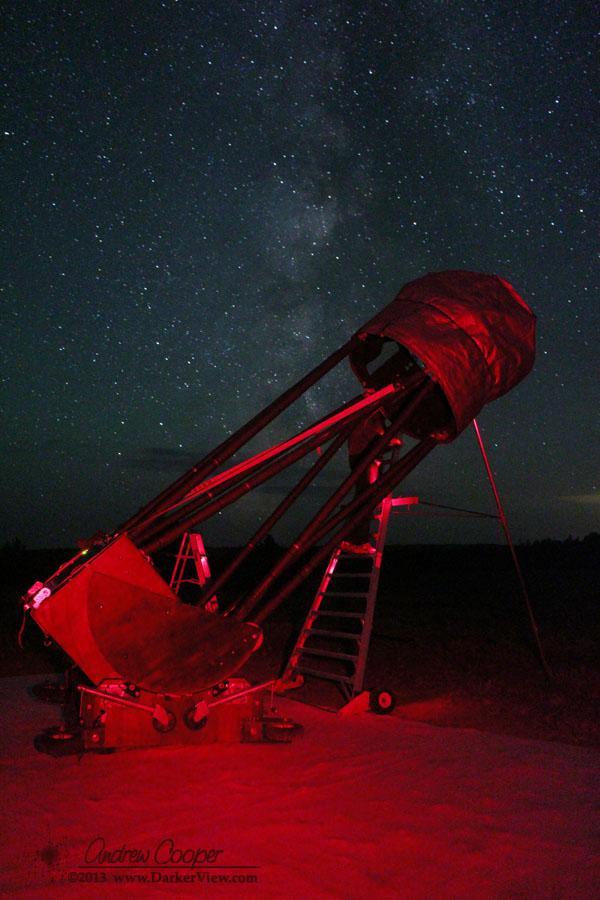
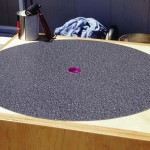
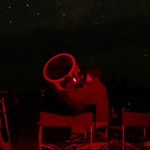
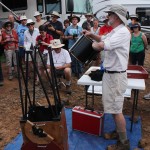
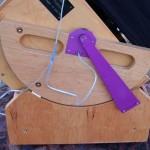
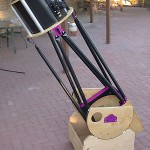
The Dobsonian is a telescope that is characterized by an extraordinary simple and robust design. Made of plywood and other hardware store parts, there was nothing in the design that could not be built by hand.
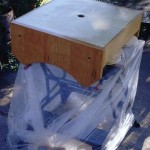
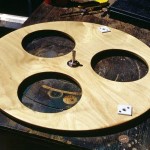
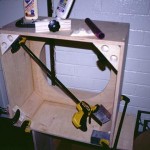
The optical layout is a standard Newtonian design with the eyepiece at the front of the telescope. This allows the heavy primary mirror to be located quite close to the ground. The entire telescope rotates on a simple lazy-suzan azimuth bearing made of plywood, formica and teflon blocks. A simple set of trunnions allows the telescope to be raised and lowered in elevation.
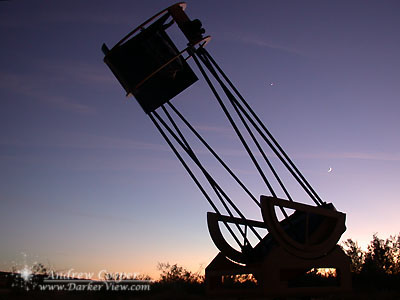
The Dob brought large aperture astronomy into reach of thousands of backyard observers. Anyone with a modicum of skill could build a Dob in a garage with simple hand tools. Commercial designs soon appeared at very affordable prices.
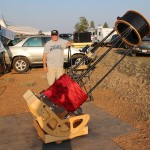
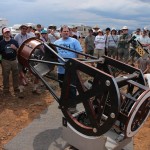
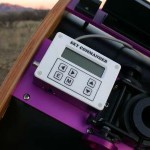
Amateur telescope makers have built upon John’s ideas, creating elegant designs that far surpass those simple telescopes made from scrap. Aircraft grade plywood, machined aluminum frames, carbon fiber and computerized controls are common in modern Dobsonians. The design can be scaled up, Dobsonians are sometimes enormous, with telescopes of 30 or 40 inches aperture seen at many star parties. At OSP last year I setup next to a 40″ built by Chris Fuld, a monster telescope built by hand.
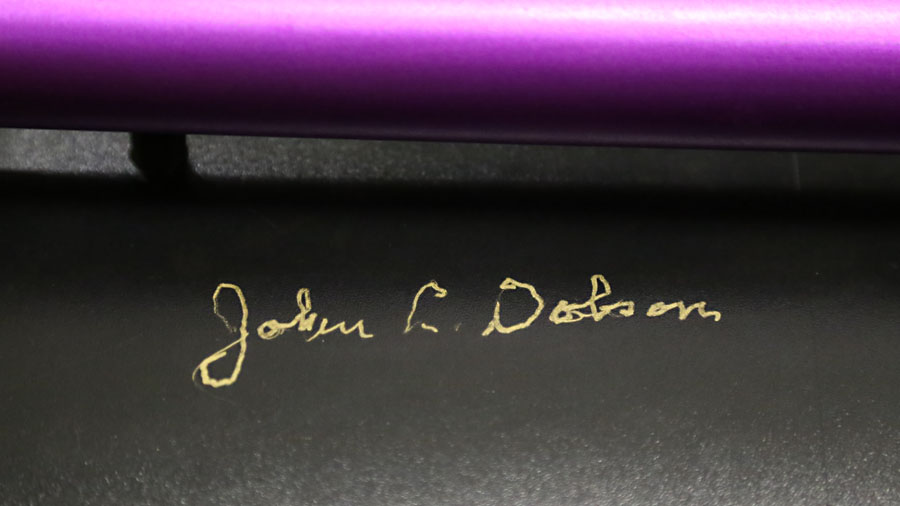
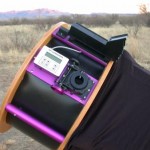
John spent much of his later life touring wherever dark skies, telescopes and people could be found. This often included national parks and regional star parties. I met John a few times across the years, at Grand Canyon Star Party and at an evening observing session at Starizona, an astronomy shop in Tucson. His signature graces the secondary cage of my 18″ f/4.5 Dobsonian, Deep Violet, beside the signature of David Levy.
John was also a proponent of a decidedly non-standard cosmology, believing that the Big-Bang model had fatal flaws. His alternate ideas make… Uh? Interesting reading. He describes a recycling steady state cosmos heavily influenced by the teachings of eastern religions and mystical thought.
John Dobson died today, 15 January 2014 at the age of 98 in Burbank, California. John leaves behind a son, many friends, and a community indebted by his contributions to amateur astronomy. My friend Dean Ketelsen knew John far better than I did, I suggest you read his notes on his passing.
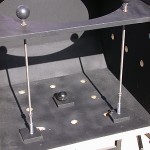
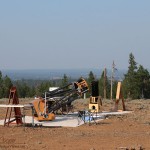
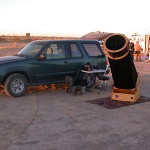
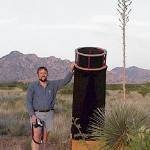
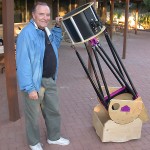
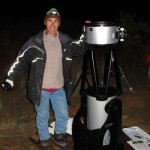
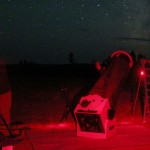
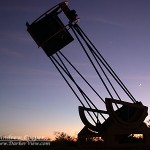
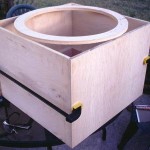
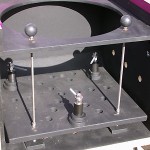
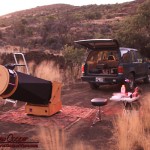
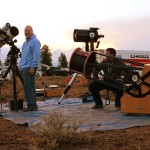
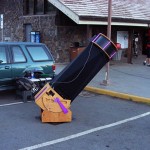
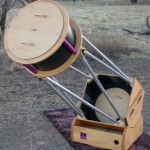
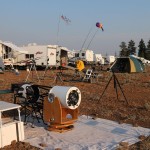
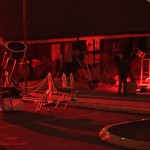
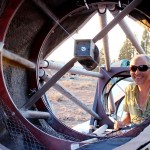
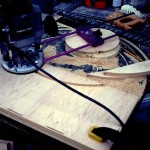
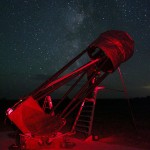
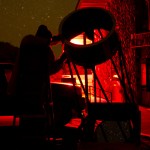
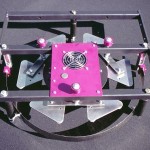
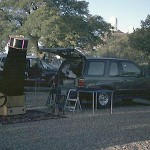
I spent a few moments and put all of the photos of dobsonian telescopes that have appeared here on Darker View into a gallery. The photos are just a little sliver of what John Dobson meant to amateur astronomy…


The Board of Directors of the W. M. Keck Observatory announced today that Taft Armandroff, executive director of the world’s premier ground-based astronomical observatory, will step down on June 1 to become a professor at the University of Texas at Austin, and director of its McDonald Observatory.

Before coming to Keck Observatory, Armandroff worked at the National Optical Astronomy Observatory (NOAO) in Tucson, Arizona, for 19 years, holding positions of associate director and director of the NOAO Gemini Science Center. He is a 1982 graduate in astronomy of Wesleyan University, and he earned his Master’s and Ph.D. degrees in astronomy from Yale University. His scientific research has focused dwarf spheroidal galaxies, stellar populations in the Milky Way galaxy and nearby galaxies, globular clusters, chemical evolution of galaxies, and dark matter.
As executive director of the W. M. Keck Observatory, Armandroff reports to a governing board representing the observatory’s founding partners, the California Institute of Technology (Caltech) and the University of California (UC). The governing board also has liaisons from the NASA, the W. M. Keck Foundation, and the University of Hawaii. In 2013, Keck Observatory managed a budget of $25 million to support the organization’s 120 professional staff, operations, and advanced instrument initiatives.
“Taft did an exceptional job in maintaining the high productivity of Keck Observatory,” said Tom Soifer, Caltech Professor of Physics and a member of the California Association for Astronomical Research (CARA) Board. “During his tenure federal and privately funded cutting edge instruments were built and great advances were made in adaptive optics. We wish him well in his new job.”
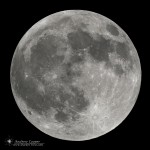
Tonight the Moon and Jupiter will be quite close. The pair will rise at nearly the same time, about 17:08HST. The Moon will be very near full, 98% illuminated and about 5° from the bright planet.

W. M. Keck Observatory press release…
A team of scientists led by astronomers at the University of California, Riverside has used NASA’s Hubble Space Telescope and the W. M. Keck Observatory to uncover the long-suspected underlying population of galaxies that produced the bulk of new stars during the universe’s early years.

Study results appear in the Jan. 10 issue of The Astrophysical Journal, and will be presented today (Jan. 7) at the 223rd meeting of the American Astronomical Society in Washington DC.
The 58 young, diminutive galaxies spied by Hubble were photographed as they appeared more than 10 billion years ago, during the heyday of star birth.
Continue reading “Hubble and Keck Unveil a Deep Sea of Small and Faint Early Galaxies”
Today, at 02:25HST, the planet Venus will pass through inferior conjunction, passing between the Earth and the Sun. Venus will remain hidden from view for another week, emerging in the dawn sky around the 18th. Maximum elongation will be on March 22nd at 46.6°W.
Unlike 2012 there will be no transit, from our point of view the planet will pass over 5° north of the Sun. The next transit will not occur until 2117.
W. M. Keck Observatory press release…
University of Hawaii at Manoa astronomer Regina Jorgenson has obtained the first image that shows the structure of a normal galaxy in the early universe as captured by the W. M. Keck Observatory. The results were presented at the winter American Astronomical Society meeting being held this week near Washington, DC.

These galaxies are known to contain most of the neutral gas that is the fuel for star formation, so they are an important tool for understanding star and galaxy formation and evolution. Discovered and classified over 30 years ago, they have been notoriously difficult to see directly.
Dr. Jorgenson, an NSF Astronomy and Astrophysics Postdoctoral Fellow at the University of Hawaii’s Institute for Astronomy, worked with Dr. Arthur Wolfe of the University of California, San Diego. They used the advanced technologies of the W. M. Keck Observatory on Mauna Kea to obtain the first-ever spatially resolved images of a galaxy of this type.
The galaxy was detected with the 10-meter, Keck I telescope fitted with OSIRIS and the Laser Guide Star Adaptive Optics system.
Continue reading “First Detailed Look at a Normal Galaxy in the Very Early Universe”