
Mercury will exit the evening sky this week. Currently about 10° above the setting Sun, it will quickly orbit back into the Sun’s glare. It will pass through inferior conjunction on November 1st to reappear in the dawn around November 6th.
Category: Astronomy
Exploring the cosmos
Telescopes Large and Small Team Up to Study Triple Asteroid
W. M. Keck Observatory press release…
Combining observations from the world’s largest telescopes with small telescopes used by amateur astronomers, a team of scientists discovered that the large main-belt asteroid (87) Sylvia has a complex interior, thanks to the presence of two moons orbiting the main asteroid, and probably linked to the way the multiple system was formed. The findings are being revealed today, October 7, at the 45th annual Division of Planetary Sciences meeting in Denver, Colorado.

The team, led by Franck Marchis, senior research scientist at the Carl Sagan Center of the SETI Institute, has continued to observe this triple asteroid system by gathering 66 adaptive optics observations from 8-10m class telescopes including those at the W. M. Keck Observatory, the European Southern Observatory, and Gemini North.
“Because (87) Sylvia is a large, bright asteroid located in the main belt, it is a great target for the first generation of adaptive optics systems available on these large telescopes. We have combined data from our team with archival data to get a good understanding of the orbits of these moons,” Marchis said.
Continue reading “Telescopes Large and Small Team Up to Study Triple Asteroid”
Saturn from Above
A spectacular image of Saturn from above. Even better, the image was assembled by an amateur astronomer, Gordan Ugarkovic, working with Cassini imagery taken on October 10th. Click on the image to zoom in, then zoom in some more! You can see exquisite data in the polar cloud-tops and in the rings. Keep an eye out for the shepherd moons at the edges of the various rings…

Watery Asteroid Discovered in Dying Star Points to Habitable Exoplanets
W. M. Keck Observatory press release…
Astronomers have found the shattered remains of an asteroid that contained huge amounts of water orbiting an exhausted star, or white dwarf. This suggests that the star GD 61 and its planetary system – located about 150 light years away and at the end of its life – had the potential to contain Earth-like exoplanets.
The new research findings used data collected from NASA’s Hubble Space Telescope, both of W. M. Keck Observatory’s Keck I and Keck II telescopes, as well NASA’s FUSE telescope, and are reported today in the journal Science.

Earth is essentially a “dry” planet, with only 0.02% of its mass as surface water, meaning oceans came long after it had formed; most likely when water-rich asteroids in the solar system crashed into our planet.
The asteroid analyzed is composed of 26% water mass, very similar to Ceres, the largest asteroid in the main belt of our solar system. Both are vastly more water-rich compared with Earth.
The new discovery shows the same water delivery system could have occurred in this distant, dying star’s solar system – as latest evidence points to it containing a similar type of water-rich asteroid that would have first brought water to Earth.
Astronomers at the Universities of Cambridge and Warwick say this is the first “reliable evidence” for water-rich, rocky planetary material in any extrasolar planetary system.
Continue reading “Watery Asteroid Discovered in Dying Star Points to Habitable Exoplanets”
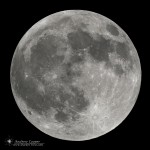
Full Moon
Night Logs
Keck tracks every night with a custom, in-house database. These form a complete log of what occurred every night… The routine, the problems, the small disasters of operating a complex facility on top of a mountain. Reading these logs every morning is a ritual for many of the staff. A synopsis arrives in our e-mail each day, to be read on an iPad over breakfast, or as soon as you sit down at your desk.

Below is a typical night log from a quiet night. Reading through the logs each morning reveals much about the inner workings of the observatory. Who was working the night, the visiting astronomers and their subject of study. The logs also contain a number of statistics that are used to monitor the performance of the observatory.
AO Cabling

The Front Page
An evening stop in the local market to pick up a few groceries. There is always a stack of local newspapers on the checkout counter. But this edition looked a little familiar… That is my photo! I knew Steve, our PIO at Keck, had forwarded the image to the newspaper. I did not expect it to be at the top of the front page!
The image has gotten some traffic. Posted to Facebook the news of snow on Mauna Kea resulted in the highest traffic day I have had in years for this blog. It is not even a great image, just a snapshot taken as we headed for the vehicles to get off the mountain. The light is horrible, the scene seems flat, but it is snow, and that is always big news around here.
Actually, this is my second front page image. A panorama shot from the Keck roof was featured on the front page of the Star-Advertiser earlier this year. It is always a nice surprise to see an image of mine get some press!

Snow on the Mountain
Winter might just be starting in Hawai’i. A fall storm dropped the season’s first snow on the summit of Mauna Kea this afternoon. Not much, just enough to turn the summit white. I had to scrape the frozen snow from the windshield to free the wipers before I could drive down.
We got 1.2″ of rain at the house, quite a bit when you consider we get 10″ a year in the shadow of the mountain. I am headed back to the summit tomorrow morning, wondering what we will find, this storm is just starting.

Postcard from the Summit – Crimping Tools
