
Postcard from the Summit – Wire
When you want to see the stars, find someplace dark

Exploring the cosmos

For viewers here in the Hawaiian islands this will be a deep partial solar eclipse, with well over 40% of the Sun obscured by the Moon. This is enough to produce a noticeable drop in the Sun’s brightness at mid-day.
Please exercise caution when viewing the Sun! Use appropriate eye protection or indirect observing techniques to project an image of the Sun. The link at the start of this paragraph leads to a great discussion on viewing the Sun safely. As always the single best source on the web (or anywhere) for eclipse and transit information is Fred Espenak’s eclipse website at NASA. Stop by whenever you have a question on upcoming events as well as viewing and photography tips.
| Location | Begins | Maximum | Ends | Altitude | Azimuth | Magnitude |
| Honolulu | 14:23 | 15:48 | 17:01 | 43 | 275 | 44 |
| Hilo | 14:31 | 15:56 | 17:05 | 61 | 270 | 47 |
The early hours of dawn on May 5th will see the peak of the ηAquariid meteor shower. This is a reliable shower that produces anywhere from 30-80 meteors each hour near peak. Resulting from debris left behind by Comet 1P/Halley this shower approaches the Earth from the direction of the constellation Aquarius. As this constellation is quite low in the sky during the shower the meteors are entering the atmosphere at a low angle, this often results in meteors with long trains crossing much of the sky. A good shower that produces great fireballs.
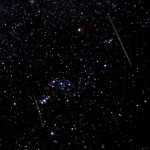
IMO analyses in recent years, based on data collected between 1984–2001, have shown that ZHRs are generally above 30 between about May 3–10, and that the peak rates appear to be variable on a roughly 12-year timescale. Assuming this Jupiter-influenced cycle is borne-out, the next trough is due around 2014–2016, so ZHRs should be relatively modest in 2013, according to this idea – IMO website
The ηAquariid shower has a broad peak with several weeks of activity either side of the peak. The entire meteor shower lasts from around April 19 to May 28. Any morning from May 3rd to May 10th can be worth watching with rates to around 30 meteors per hour. The peak itself is predicted for 01:00UT on May 6th (15:00HST May 5th), but this shower often produces subpeaks as the Earth passes through clouds of debris left on successive orbits of Halley’s Comet.
The radiant for the ηAquariid shower does not rise until the last few hours of dark, about 2:30am, making this an early morning observing exercise. 2013 does offer decent viewing conditions, with only a slim waning Moon on the day of peak activity and new Moon occurring a few days later on the 10th. Remember, meteor watching can be enjoyed without any special equipment, just a dark sky and a safe place to watch from. Perhaps a good reason to get out under a dark sky? But then, should you ever need a reason to go observing, just go.
Astronomy is a science where human timescales become insignificant. It seems like everything we are watching takes millions or even billions of years to occur. To be sure, there are a few things that happen quickly, like supernovae, but those events are the exceptions. Everywhere we look we see the stately dance of stars and galaxies, the formation of worlds. The dance is spread across distances and times so vast that even those who study the universe have difficulty comprehending the sheer immensity involved. Stars and planets take hundreds of thousands of years to form, a galaxy collision may go on for millions of years.
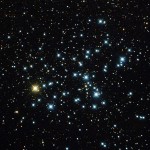
Today the planet Saturn will pass through opposition, directly opposite the Sun in our sky. The planet will be well placed for observation all night long, rising at sunset, transiting at midnight, and setting at sunrise.
During opposition the planet and rings will be slightly brighter than normal, an effect known as the opposition effect. The effect is most notable in the rings where the apparent brightness can increase by 30%. The effect is a combination of two factors, shadow hiding and the retro-reflective properties of the ring particles.
Mercury is sliding into the light of dawn this week. Currently about 10° elevation at sunrise, the planet will disappear into the Sun’s glare over the next few days. It will pass through superior conjunction on May 11th, to reappear for an evening apparition around May 20th.
A nice short video on Keck and the hunt to find and confirm extrasolar planets. It features regular Keck observer Nader Haghighipour from the Institute for Astronomy, University of Hawaii talking about his research into exoplanets.
I had a chance to help out with some of the interior shots. We had to hurry as the film crew was running late and they were up against the schedule, it was time to release the telescopes to the astronomers for the night. It is nice to see the crew got the needed shots and to see the final result a few months later.
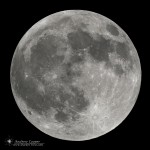
Viewers across Africa, Central Asia and Australia will be able to see a partial lunar eclipse. Pacific and North American observers will not be able to see any of this event. No matter, this is a fairly minor eclipse, with the Moon just brushing the umbra.
Thirty Meter Telescope press release…
Friday marked another important step forward for the future of astronomical discovery and economic opportunity on Hawaii Island. The Hawaiian Board of Land and Natural Resources (BLNR) announced that it has granted a permit to the Thirty Meter Telescope (TMT) project to build and operate the next-generation observatory near the summit of Mauna Kea.
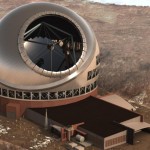
“Over the last several years, the TMT project has welcomed the support it has received from all sectors of the Hawaiian community, from education to cultural to business to labor,” said Sandra Dawson, TMT’s Manager of Hawaii Community Affairs. “We look forward to beginning construction and becoming a neighbor of the outstanding observatories on Mauna Kea.”
Beaches? Tropical gardens? The volcano? Yeah, BTDT, not what I came to Hawaiʻi for. Visiting Mauna Kea is at the top of the list for some folks who visit our island, a priority I can fully understand. Even better? Bring a camera to this spectacular mountain. After six years of working on Mauna Kea I still carry a camera and find new shots. Some of the most fascinating photographic opportunities occur after the Sun has set. For those who pursue shots in the dark, long exposure photography, the summit provides a setting that is worth the effort to shoot.

So what are the real rules for summit access after dark?