Join us this Sunday for a live broadcast from Keck 2 remote observing! Here at Keck we will be participating in a campaign to observe Saturn’s auroras. Join JPL scientist Dr. Kevin Baines and Dr. Tom Stallard of the University of Leicester while they are engaged in using the telescope.
This false-color composite image, constructed from data obtained by NASA’s Cassini spacecraft. Image credit NASA/JPL/University of Arizona/University of LeicesterSunday April 21st
3am-5am Hawai’i Standard Time
6am-8am Pacific Daylight Time
9am-11am Eastern Daylight Time
1pm-3pm UT
At Keck the team of astronomers have five half night’s of observing on Keck 2 using the NIRSPEC spectrograph. They will be making infrared observations to understand more about the auroral features and the interaction of Saturn’s atmosphere with the planet’s magnetic fields.
Another exhibit built for public outreach functions. It was completed and used for the recent W. M. Keck Observatory open house. You will also be able to see it at the upcoming AstroDay fun in Hilo.
Ray-tracing is a standard way to analyze optical designs. The technique allows the optical designer to follow the path of each ray of light through a system of lenses and mirrors. While ray tracing used to be done with pencil and paper, it is now done on a computer screen. What I had never seen was this process done in the physical. But I can figure out how…
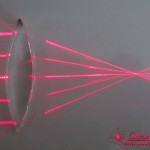
A laser ray trace table used to demonstrate the focal point of a simple lensTake a few laser line modules, a bit of sheet metal and paint, a bit of circuitry and we can do this!
In the photo you can see the idea… Five red laser line modules are aligned across a table. Stick a lens section in the beams and you can observe refraction as it happens. Using a double convex lens, all of the beams converge to a focus. A clear demonstration of the basic principles of optics!
Today Mars will pass through superior conjunction, passing behind the Sun from our vantage point on Earth. During this time the red planet will be lost to view, vanishing from the evening sky, but reappearing in the morning sky during the last days of May.
While the Sun blocks our direct view of Mars the probes we currently have on and around Mars will suffer communications interference. For a few weeks mission planners at NASA place the various orbiters and rovers into a reduced communications routine. No commands will be sent to the spacecraft and only basic status updates sent back. This is nothing new, all Mars missions have had to deal with superior conjunction every two years. Once the red planet is clear of the Sun normal mission activities will resume.
Tonight a bright Jupiter, shining at -2.1 magnitude, will be just under 5° from a pretty crescent Moon. Look for a 20% illuminated Moon with Jupiter just above. The pair will be 50° above the western horizon at sunset.
Tonight the Moon and Jupiter will be close. Look for the pair about 40° above the western horizon at sunset. The Moon will be about 13% illuminated and about 7° below a bight Jupiter. Tomorrow the Moon will have moved to the other side of Jupiter but will be even closer, a little under 5° separation at sunset.
NASA funded observations on the W. M. Keck Observatory with analysis led by the University of Leicester, England tracked the “rain” of charged water particles into the atmosphere of Saturn and found the extent of the ring-rain is far greater, and falls across larger areas of the planet, than previously thought. The work reveals the rain influences the composition and temperature structure of parts of Saturn’s upper atmosphere. The paper appears in this week’s issue of the journal Nature.
“Saturn is the first planet to show significant interaction between its atmosphere and ring system,” said James O’Donoghue, the paper’s lead author and a postgraduate researcher at Leicester. “The main effect of ring rain is that it acts to ‘quench’ the ionosphere of Saturn, severely reducing the electron densities in regions in which it falls.”
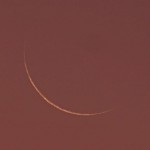
A very young moon over Waikoloa, this is only 26 hours after new, visible to the unaided eye as a sliver in the fading glow of sunsetNew Moon will occur today at 23:35HST.
For the W. M. Keck Observatory 20th anniversary I did a short video. The idea was to create a teaser that could be run at the start of many of the events.
It is surprising how much work can go into a 90 second video. With a very short time span to work with you have to pack a lot of visuals in quickly. The basic material was mostly historical images of the observatory construction, a few bits from local photographer Ethan Tweedie, recycle a couple bits from Keck in Motion add a few science images and pau!
Digging through the library archive with Peggi was a great look into Keck’s past. At one point we had dozens of photo albums scattered across the top of the cabinets and I notes that we were making a mess of her library. She replied in no uncertain terms… “This is great, this is what a librarian should be doing!”
Tomorrow morning, on April 8th, a thin crescent Moon will share the sky with Mercury. The pair will be separated by 8°41′ with the Moon further north. Both will be about rise within minutes of each other about 04:55HST and both will be about 16° above the horizon at sunrise. At magnitude 0.1 Mercury should be easy to spot, making a nice companion to a 3% illuminated Moon.
Observations of Europa from the W. M. Keck Observatory help NASA and California Institute of Technology (Caltech) astronomers go one step further in demonstrating life may be possible in the ocean of one of Jupiter’s moons. In addition to the known existence of water, a paper published today shows hydrogen peroxide is abundant across much of the surface of the smallest of the Galilean Moons. The paper argues that if the peroxide on the surface of Europa mixes into the ocean below, it could be an important energy supply for simple forms of life. The paper was published online in the Astrophysical Journal Letters.
(On March 14, a separate paper was published by the same team in Astronomical Journal, demonstrating the salty ocean of Europa makes its way through the frozen surface, introducing the possibility the ocean is habitable. Click here for that news release.)
“Life as we know it needs liquid water, elements like carbon, nitrogen, phosphorus and sulfur, and it needs some form of chemical or light energy to get the business of life done,” said Kevin Hand, the paper’s lead author, based at NASA’s Jet Propulsion Laboratory, Pasadena, Calif. “Europa has the liquid water and elements, and we think that compounds like peroxide might be an important part of the energy requirement. The availability of oxidants like peroxide on Earth was a critical part of the rise of complex, multicellular life.”
This color composite view combines violet, green, and infrared images of Jupiter’s intriguing moon, Europa, image credit NASA/JPL/University of Arizona
The scientists think hydrogen peroxide is an important factor for the habitability of the global liquid water ocean under Europa’s icy crust because hydrogen peroxide decays to oxygen when mixed into liquid water. “At Europa, abundant compounds like peroxide could help to satisfy the chemical energy requirement needed for life within the ocean, if the peroxide is mixed into the ocean,” said Hand.
Co-author Mike Brown of Caltech in Pasadena, analyzed data collected from the Near-Infrared Echelle Spectrograph (NIRSPEC) and OH Suppressing Infra-Red Imaging Spectrograph (OSIRIS) instruments on the mighty Keck II telescope on Mauna Kea, Hawaii, over four nights in September 2011. The highest concentration of peroxide found was on the side of Europa that always leads in its orbit around Jupiter, with a peroxide abundance of 0.12 percent relative to water. (This is roughly 20 times more diluted than the hydrogen peroxide mixture available at drug stores.) The concentration of peroxide in Europa’s ice then drops off to nearly zero on the hemisphere of Europa that faces backward in its orbit.
Hydrogen peroxide was first detected on Europa by NASA’s Galileo mission, which explored the Jupiter system from 1995 to 2003, but Galileo observations were of a limited region. The data from Keck Observatory shows that peroxide is widespread across much of the surface of Europa, and the highest concentrations are reached in regions where Europa’s ice is nearly pure water with very little sulfur contamination. The peroxide is created by the intense radiation processing of Europa’s surface ice that comes from the moon’s location within Jupiter’s strong magnetic field.
“The Galileo measurements gave us tantalizing hints of what might be happening all over the surface of Europa, and we’ve now been able to quantify that with our Keck telescope observations,” Brown said. “What we still don’t know is how the surface and the ocean mix, which would provide a mechanism for any life to use the peroxide.”