Presenting the wonders of the night sky to the general public can be a rewarding experience. The smile on a child’s eyes they first time the see the rings of Saturn or the craters of The Moon is a truly a wonderful thing.
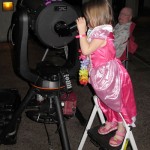
A Halloween princess watching moonrise through the telescopePublic observing can also be a daunting challenge to the inexperienced public presenter. A little preparation and thought can prevent a lot of trouble and make it a better experience for both the presenter and the public.
I am attempting to put down a few of the things I have learned in over a decade of hauling a telescope around. In that time I have used countless schoolyards as observatories, set my gear up at posh resorts, on the tee line of a driving range, outside the front door of Wal-Mart, across the fence from cows at a dude ranch, parking lots, city sidewalks and grassy lawns, under conditions both perfect and absolutely lousy for doing astronomy. Dealt with everything from drunks to two year olds, and I still do this regularly… It is worth every young smile!
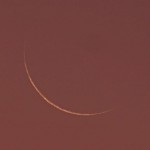
A very young moon over Waikoloa, this is only 26 hours after new, visible to the unaided eye as a sliver in the fading glow of sunsetNew Moon will occur today at 09:51HST.
Today Comet C/2011 L4 (Pan-STARRS) will pass through perihelion, its closest approach to the Sun. Take a good look now, given the 110,000 year orbital period, the comet will not be back anytime soon.
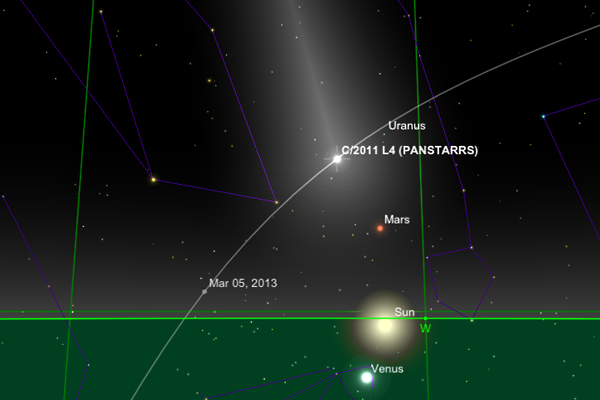
The comet should be visible as a 1st magnitude object 13° above the horizon at sunset and directly above the glow of the setting Sun. It will climb higher each evening after passing through perihelion. It will begin to fade as well, most likely dimming below 4th magnitude by the end of March.
C/2011 L4 ( PanSTARRS ) positions in the sunset as it passes through perihelion, chart for March 10th, 2013
An awful photo of C/2011 Pan-STARRS, SBIG STi and 100mm lensBut it is all I managed to get this evening. A to-do list that is much to long and vehicle trouble caused me to reconsider plans to observe at the VIS. Thus I planned to observe the comet from the driveway. This works well in some respects, using the mounting points in the driveway I can have the ‘scope reasonably well polar aligned in the daytime. This would make finding the comet far easier, I could offset from the Sun and have the ‘scope aimed at the correct coordinates before it was dark.
It had been wonderfully clear all afternoon. It was just as the sky darkened that trouble appeared, a band of high clouds sweeping in from the west. Noooo!
The comet appeared in the STi guide camera right on schedule, my coordinates less than half a degree off! Not bad with a manual telescope mount offsetting from the Sun. The clouds swept over the comet a few minutes later, just as the tail was beginning to appear in the darkening sky.
I did grab a few images from the guide camera and snap a few frames with the DSLR. The monochrome CCD on the guider managed slightly better shots despite a fairly bright sky. I managed a few more frames as an opening appeared a few minutes after that. It is still an awful image. The only reason I could tell it was the comet is that it remained centered as the clouds swept through the image. Take my word for it, the barely there spot at the center of the photo is the comet.
At least my vehicle is fixed, a new alternator in place. Try again tomorrow?
Tomorrow morning, on March 10th, the Moon and Mercury will form a close pair. The Moon will be a very thin crescent, only 1.75% illuminated. Mercury will be only 2° below, shining at 2.7 magnitude. The pair will rise about 05:38HST, and will be 12° above the horizon at sunrise.
Mercury will begin a morning apparition this week. The planet is currently about 10° above the rising Sun, climbing higher each morning. Look for a 2nd magnitude star-like object just above the glow of dawn. Mercury will reach a maximum elongation of 28° on March 31st.
Tomorrow morning, March 10th, the planet will be just 2° below a razor thin Moon. The Moon will be about 1.7% illuminated and will rise at 05:38HST, just 14° and about and hour ahead of the Sun.
The W. M. Keck Observatory has successfully completed a $4 million campaign that will give astronomers the most detailed Adaptive Optics images of the cosmos ever created by mankind. Furthermore, the campaign was funded entirely by private philanthropy.
Today Comet C/2011 L4 (Pan-STARRS) will make its closest approach to Earth. Not that that is saying too much, close approach will be 1.09 AU or about 101,300,000 miles, just over the average distance from the Earth to the Sun. In contrast Comet C/2012 S1 (ISON) will approach us to closer than half that distance, about 0.42 AU or 39,000,000 miles from Earth on December 26th, 2013.
The comet should be visible as a 2nd magnitude object 7° above the horizon and a little south of the Sun at sunset. It will climb higher each evening, passing through perihelion, close approach to the Sun on March 10th.
C/2011 L4 ( PanSTARRS ) positions in the sunset as it passes through perihelion, chart for March 10th, 2013
With data collected from the W. M. Keck Observatory, California Institute of Technology (Caltech) astronomer Mike Brown — known as the Pluto killer for discovering a Kuiper-belt object that led to the demotion of Pluto from planetary status — and Kevin Hand from the Jet Propulsion Laboratory (JPL) have found the strongest evidence yet that salty water from the vast liquid ocean beneath Europa’s frozen exterior actually makes its way to the surface.
The data suggests there is a chemical exchange between the ocean and surface, making the ocean a richer chemical environment, and implies that learning more about the ocean could be as simple as analyzing the moon’s surface. The work is described in a paper that has been accepted for publication in the Astronomical Journal.
The findings were derived from spectroscopy delivered from the Keck Observatory, which operates the largest and most scientifically productive telescopes on Earth.
“We now have the best spectrum of this thing in the world,” Brown says. “Nobody knew there was this little dip in the spectrum because no one had the resolution to zoom in on it before.”
Today the planet Mercury passes through inferior conjunction, passing between the Sun and the Earth. In a week or so the planet will again be visible in the dawn sky, climbing higher each day. Maximum elongation will occur March 31st.