It was not in the forecast. But It came anyway. The night crew abandoned the summit around 3am in the face of ice and snow.
Summit webcams show an increasingly white mountain this morning. Given the numbers in the met data, it is not going to stop anytime soon. Temperatures of well below freezing, -6°C (20°F) and 100% humidity tell the tale of continuing snow.
No sign that our holiday crew has made it to the summit as of yet. I expect them to make an attempt, even if they stay just an hour or two to perform those few tasks that must be done each day. Not much problem for me, a snowy weekend makes for a quiet weekend on-call.
The mountain claimed another vehicle this afternoon.
A rented Nissan Altima parked at the Hoku Kea telescope rolled off the ridge, a steep cinder slope about 400ft high. Fortunately neither passenger was hurt, the woman in the passenger seat exited the vehicle when it began rolling, her companion was already out. Witnesses describe the vehicle rolling several times as it descended the slope.
Now the Mauna Kea Rangers have the unenviable task of removing the vehicle and cleaning up the mess. The rangers report indicates that the vehicle does not appear to be leaking any fluids. Hopefully the vehicle can be removed without further damage to the summit. OMKM’s Natural Resources Manager and an entomologist are being consulted before removal.
Just another reminder to take our mountain seriously…
Wreck of a Nissan Altima that rolled off the summit ridge of Mauna Kea, photo by Shane Fox, used with permissionLocation of a vehicle that rolled off the summit ridge of Mauna Kea, photo by Shane Fox, used with permission
Trying to finish up a new video project for Keck Week. As one would guess, the video features the history of Keck. Looking for material has been a great excuse to dig through the Keck archives. Through the expertise of our staff librarian, Peggi Kamisato, I have pursued hundreds of photos and other material from the history of these great telescopes. Turning page after page of photos albums from the construction of the two telescopes, thumbing through observing log #1 to read the notes from those first nights of science observations. I have a new appreciation for the history of this place.
Not all of this material can make it into the video. Some of the best can, hopefully resulting in a worthwhile result. Just a teaser for today, one of the photos from construction that did not make the cut. What about the video? Come to Keck Week and see the premiere!
Construction of the Keck 1 Telescope circa 1987, photo by Tom Wynne
Today Mercury reaches maximum elongation, the furthest point it will reach from the Sun in the sky and the highest it will be above the sunset for this evening apparition. The planet is easily visible as a bright, starlike object about 18° above the setting Sun as twilight begins. Over the next couple weeks Mercury will slide back into the sunset, heading for inferior conjunction on March 4th.
A good sized meteor has airburst over the city of Chelyabinsk, Russia. There are reports of injuries and damage, but how much is unclear right now. Give it a day and we will probably have a good idea of the scale of this event, and probably fragments of the meteor itself.
A lot of vehicles in Russia carry dashcams, and videos of the event are rapidly showing up on YouTube. It is quite spectacular, the bright fireball saturating the closer cameras.
I have seen meteoric airbursts, but nothing on this scale. It is impressive, and a bit scary to be reminded that this can happen. This even almost certainly has nothing to do with the close approach of asteroid 2012 DA14 tomorrow, but I am sure some people will make a connection. The conspiracy theorists will probably go further, perhaps much further, it should make amusing reading.
Update: A link to a collection of videos and photos of the damage here. Midway down is a vid from a warehouse security camera of a loading bay door blown inwards by the blast wave.
A dashcam video of a meteor airburst over ChelyabinskWarehouse loading bay door blown inwards by meteor blast wave
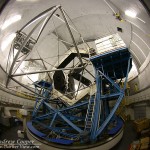
The Keck 1 Telescope awaiting lights out and release for the nightW. M. Keck Observatory has an immediate opening for an Electronics Engineer to design and implement major upgrades to the various telescope control systems, add new capabilities and integrate state of the art instruments.
Responsibilities
Provide electronic engineering expertise to support upgrades and new development projects
Participate in system level specifications, develop hardware specifications, interface control documents, and lifecycle design documents
Write, analyze and document test plans, conduct design tests and evaluate results
Generate and maintain production documentation, including schematics, wire diagrams, assembly drawings, data sheets, manuals, and project notebooks
Support project managers by providing and maintaining accurate cost and labor estimates and Bills of Material. Help to maintain project plans through good communication
Coordinate the electronic interfacing of new instrumentation;
Direct the efforts of associate engineers and technicians, coordinate and schedule engineering activities
Assist in the investigation of chronic performance and reliability problems in existing systems and develop and implement solutions to resolve these problems.
Qualifications
Bachelor of Science in Electrical Engineering or equivalent
Three or more years of applicable work experience, preferably in a team environment
Working knowledge of AC and DC electronics theory
Experience in analog and digital electronics, computer interface electronics, and real-time control systems
Understanding of grounding, shielding, and electrical safety
Experience with schematic capture, PCB design and layout
Experience in the design, debug, simulation and validation of electronic circuits and products
Skilled user of test and analysis equipment including oscilloscopes, logic analyzers, bus analyzers, cable and fiber optic test equipment, power measuring equipment, and signal generators
Experience planning and implementing PLC based solutions including I/O selection, communication and programming (Rockwell/AB ControlLogix and RSLogix); experience with National Instruments RIO and LabVIEW FPGA; use of PADS, E3 Wireworks (Zuken), SolidWorks; and experience with programmable multiple axes motion controllers such as DeltaTau PMAC or Galil would be a plus
The W. M. Keck Observatory operates the largest, most scientifically productive telescopes on Earth. The two, 10-meter optical/infrared telescopes on the summit of Mauna Kea on the Island of Hawaii feature a suite of advanced instruments including imagers, multi-object spectrographs, high-resolution spectrographs, integral-field spectroscopy and a world-leading laser guide star adaptive optics system. The Observatory is a private 501(c) 3 non-profit organization and a scientific partnership of the California Institute of Technology, the University of California and NASA.
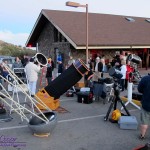
A line of big telescopes greeted the crowd. Mike had his 20″, Cliff his 24″, my 18″ Deep Violet, later in the evening Olivier set up his 18″ Priscilla. All of this large glass was open to the public, we each had long line of folks waiting a turn at the eyepiece. It was a huge Saturday night crowd, several hundred people awaited darkness. Yes, I had made the decision to observe from the VIS, knowing that there would be a crowd, but wow!
A line of big ‘scopes to greet a huge Saturday crowd at the MKVISLots of folks wondered why there were so many telescopes. Over and over we explained that they were lucky, having chosen the right night to visit the mountain. A Saturday night close to the new moon, with local amateurs bringing their own telescopes to share.
Showpiece objects, the Andromeda Galaxy, The Pleiades and Jupiter were available for viewing. I was stuck on the Orion Nebula all evening long. I changed targets once, to meet a chorus of request to move back to the nebula. I have to admit it was a pretty view, even to me, who has seen this sight more times than I remember. I put the 35mm eyepiece in place, creating a bright low power view that had visitors waiting through line a few times for second and third looks.
In addition to the big dobs there were quite a few smaller ‘scopes present. Maureen had her C-11 setup, Larry brought his nice Stellarvue 102mm refractor, Mike had an 8″ SCT beside his 20″ for use by a friend. Dan didn’t bring a ‘scope, but he did bring pizza! We met Woody, an Alaskan Airlines pilot flying the Anchorage to Kona run. Out of a couple carry-on sized bags he produced more telescope than we would have thought fit in airline luggage…. A neat collapsible pier arrangement with an alt-az mount and a very nice WO 110mm APO.
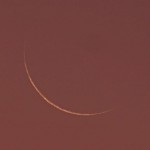
A very young moon over Waikoloa, this is only 26 hours after new, visible to the unaided eye as a sliver in the fading glow of sunsetNew Moon will occur today at 21:20HST.
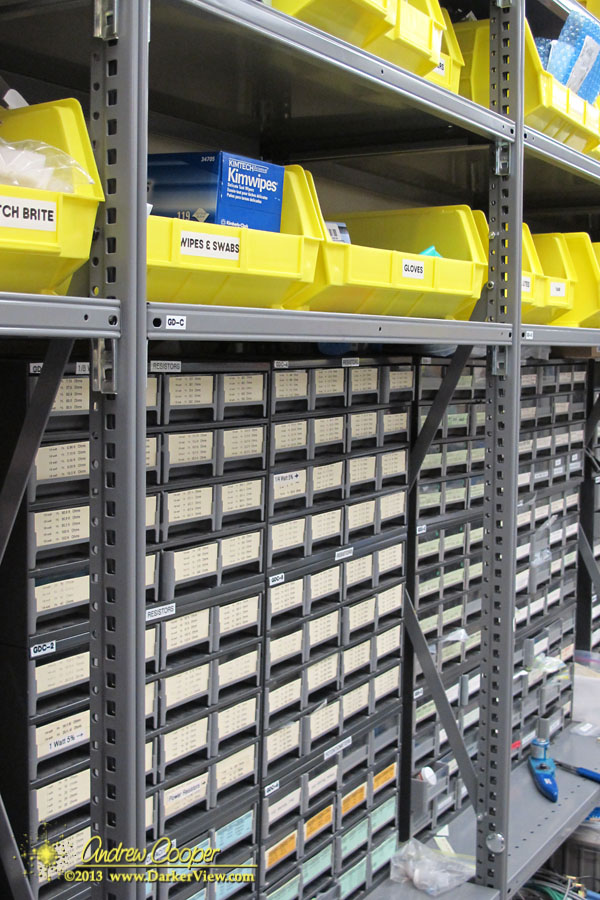
The summit of Mauna Kea is a long way from anywhere on this island. If something breaks we really need to have the parts on-hand to fix it. The result is that just about any unclaimed space in the building is used to store spare parts. We have stuff stashed everywhere!
This goes for the electronics lab too. A little bit of everything we might need is available. Now you just need to spend a few months learning where to find everything…
Racks and bins of supplies in the Keck electronics lab.