You remember haiku? Three lines, the first line with five syllables, a second line with seven syllables, and a last line with five syllables. It may be poetry, but this is easy poetry to write, a short verse with an elegant cadence.
For an AstroDay activity, Keck held an astronomy haiku project. We have a stack of entries we are just now getting a chance to read. Winners are not yet decided, but I have found a few that are wonderful, and worth giving some recognition to.
I should be clear, these are my favorites! Not necessarily the contest winners.
NGC1976 or M42, the Great Orion Nebula
Telescopes are great
They make you see very far
I love telescopes
-Madison Kobayashi (age 9)
Stars shining brightly
I look to them for comfort
In them I find you
-Lacey Siweila
Lacey is over 18 and not eligible for a prize in the contest. She knew this and enters a poem anyway. You have to love that!
The Moon is so bright
The stars help light up the night
Let’s lay out tonight
– Micah Timbresa (age 7)
I have had a problem observing here in Hawai’i. The skies can be gorgeous, there is little to no light pollution, and you have access to much more of the southern sky. What could go wrong? …Dew!
A view of the interior of the handwired dew heater controllerThis is a tropical island, this means tropical humidity and moisture. Dew is a feature of observing that I have not had much problem with in the past. In Arizona it was rarely an issue, but here it can quickly shut down a night’s observing. My last time out on Mauna Kea dew was a problem, it didn’t shut me down, but it was a constant hassle. I had to be quite careful about breathing on the eyepiece. One mis-aimed exhalation and that eyepiece needed to be put in the back of the vehicle to dry out!
I had one dew strap available, given to me by a friend and fellow observer, a small one just right for wrapping around an eyepiece. So I just needed a controller to get started. There are several of these available on the market. But I had some issue with the cost, it seemed a bit high for what was essentially a very simple device. Some of the commercial units offered features like temperature sensing and regulation. Simple overkill for most users actual needs, just warm the optic slightly until the dew goes away. Sounds like an excuse for another evening project to me… Build it!
Tonight’s Keck lecture looks to be an interesting one, discussing the very early ages of the universe in the few million years immediately after the Big Bang. I will be there, I hope you can be there as well.
Dr. Brian Siana
How Stars Destroyed Most of the Atoms in the Universe
Astrophoto gear takes a while to setup. A lot of little bits and pieces are required that make up the mount, the telescopes, and the cameras. This is all connected with cords and cables, a computer, an autoguider, extension cords for power and more. Coming up with a way to minimize the setup is a big advantage. The best solution is to build a personal observatory where the telescope can be setup and remain setup. Since I am not likely to have that solution available any time soon I use the next best thing. I assemble all of the gear and simply roll it out of the garage to use and roll it back when I am done. This reduces the setup time to about 10-15min, in place of almost an hour if done from scratch. The computer and support gear sits on a table small enough to pick up and carry out intact. connect an extension cord for power, connect three cables from the table to the telescope, turn it on and go.
The Losmandy G11 mount setup in the driveway for an evening of astrophotographyThe mount sits on a custom wheeled dolly designed just for moving the telescope. To align and level the scope there are three jackscrews one at each leg to level the mount at setup. Leveling and aligning the scope is one of the longest steps in the process, about 5-7minutes to level and align properly to the Earth’s axis.
The first galaxies had an extraordinary impact on the young universe. Their ultraviolet light destroyed nearly all of the atoms in the cosmos. This process, called reionization, had severe consequences for galaxies trying to form thereafter. Unfortunately, we have no idea how it happened. In galaxies today ultraviolet light cannot escape, so the first galaxies must have been very different from those we see today. Dr. Siana will describe the quest to detect these first galaxies and their impact on the early universe.
There is no charge for admission to any events in the Makana series.
Presented by W.M. Keck Observatory. This event will also be streamed live on the Keck Observatory website.
I have not had a bad cold in quite a while. Wednesday last week I felt the first symptoms, a sore throat beginning. I expected it, Deb had been suffering for a couple days by then. Thursday morning it was inescapable, I called in sick to work. I hoped it would be over by the weekend, I had promised to help out with Astroday and present a lecture on behalf of Keck at the Mauna Kea VIS. This would be the second run across island to Hilo in as many weeks, after almost a year without visiting Hilo, funny how that works.
By Saturday morning things were better, but not great. So off to Hilo I went, a good dose of decongestant improving the situation. I may not have been at 100%, but I had commitments to keep.
David Lynn manning the Keck table at Astroday 2012Astroday is always fun, everyone from the astronomy community setting up tables and educational exhibits throughout the Prince Kuhio Plaza Mall in Hilo. At this point I know so many of the folks there, even the guys from Hilo I only meet a few times each year. The event is really designed for kids, with plenty of activites and a little education mixed in.
I manned the Keck table for a couple hours until David relived me. We did the Astro Haiku contest again. Not bad, but it was a repeat of last year. We really need to get some science experiment bling for our table next year. I have some ideas for that.
This is your last chance this lifetime to witness a Venus transit! On June 5th the Earth, Venus and the Sun will line up correctly so that earthbound observers will see Venus cross the disk of the Sun.
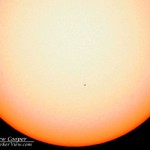
Mercury transiting the face of the Sun, 6 Nov 2006Venus transits are relatively rare events, that occur in pairs1, with the paired events separated by eight years. Each pair is separated from the next pair in a predictable pattern, alternating 105.5 or 120.5 year gaps. The first transit of the current pair was in June 2004, with the 2012 event completing the pair. The next pair of events will begin in December 2117. Given the century long separation between events Venus transits have only occurred seven times since the invention of the telescope (1631, 1639, 1761, 1769, 1874, 1882 and 2004)2.
For Hawai’i the event will begin at about 12:10pm with the Sun high in the sky, mid-point will be about 3:26pm and will end about 6:44pm, just before sunset. These times are only approximate, exact times will depend on the observer’s location and can vary by several minutes across the islands.
Keck Observatory will be making an extra effort for this transit as Mauna Kea is perfectly positioned to observe the event. We will be webcasting the transit from a small telescope located at the summit. The webcast can be seen on your computer, or come over to our headquaters in Waimea to see the webcast and a live view in a solar telescope if the weather cooperates. there will be extra staff on hand to answer your questions.
Stay tuned to DarkerView for further details as the transit draws near.
Testing the Keck 1 laser under the light of a nearly full MoonThe W. M. Keck Observatory operates two of the world’s largest optical/infrared telescopes located on the summit of Mauna Kea on the Big Island of Hawaii. Each telescope is equipped with a full suite of instruments designed to perform exciting, cutting edge astronomical research.
The Observatory seeks a Software Engineer responsible for a variety of duties related to developing, deploying and optimizing software for control solutions used at the observatory and integration of partner developed science instruments. The successful candidate will enjoy a comprehensive benefits package while residing in one of the world’s most uniquely beautiful and diverse locations.
The candidate is expected to have a minimum of 5 years’ proven experience developing and integrating distributed control software solutions for engineering or scientific applications with involvement in all aspects of the software life cycle from specification through deployment.
The candidate is expected to have sound knowledge of modern software engineering practices. Practical experience in the following is required: strong C/C++ with significant O-O design and development; UNIX platform development environment using the gnu tool chain under Linux or Solaris; working with communication middleware such as RPC, RMI, ICE or messaging systems; working with real-time OS like VxWorks or RT Linux; User Interface development with Tcl/Tk, Java, Qt, Python or other toolkits.
The ideal candidate should be a motivated, self-starter who can collaborate effectively across disciplines in a fast paced environment. Experience working with EPICS at an astronomical observatory or high energy physics experiment facility and experience with driver development and motion control are highly desirable.
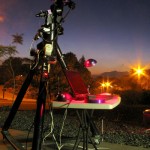
Two telescopes set up on the side of Mauna Kea. Olivier’s 12″ and my 18″ Deep Violet. A full night of deep sky observing under very nice conditions.
The photo was taken with a red LED light swept over the area during the 20 seconds of exposure. The camera had other ideas, set for automatic white balance it attempted to correct the color, fairly successfully. Surprising given the monochromatic nature of the light source.
As usual, click on the image for a larger version…