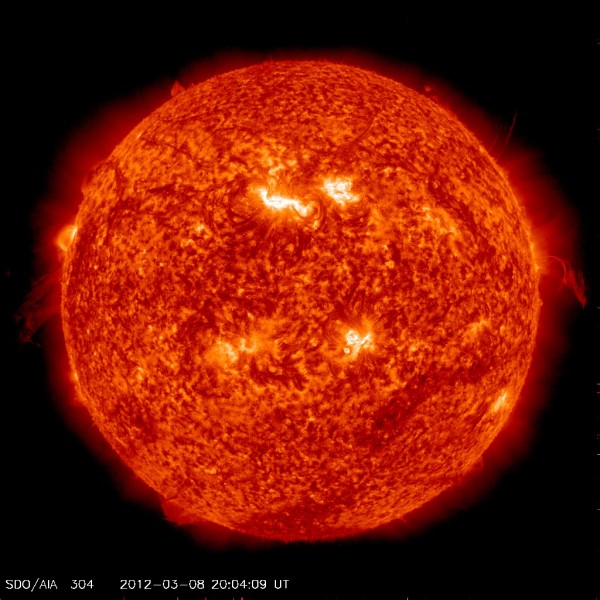
Today the planet Mercury passes through inferior conjunction, passing between the Sun and the Earth. In a week or so the planet will again be visible in the dawn sky, climbing higher each day. Maximum elongation will occur April 18th.
Category: Astronomy
Exploring the cosmos
Spring Equinox
Spring equinox occurs today at 19:14HST. Today there will be little difference between the length of the night compared to number of daylight hours. This is the first day of spring as marked by many cultures in the northern hemisphere.
Some calendars may mark the first day of spring on the 20th. And it is, for much of the world. For Hawai’i the equinox occurs on the 19th when you consider the time zone difference.
| 2012 Solstices and Equinoxes | ||||
|---|---|---|---|---|
| UT | HST | |||
| Perihelion | Jan 5 | 03:59UT | Jan 4 | 17:59HST |
| Spring Equinox | Mar 20 | 05:14UT | Mar 19 | 19:14HST |
| Summer Solstice | Jun 20 | 23:09UT | Jun 20 | 13:09HST |
| Apehelion | Jul 4 | 23:59UT | Jul 4 | 13:59HST |
| Fall Equinox | Sep 22 | 14:49UT | Sep 22 | 04:49HST |
| Winter Solstice | Dec 21 | 11:12UT | Dec 21 | 01:12HST |
| Source: USNO Data Services Website and the NASA Sky Calendar | ||||
Venus Transit on Mauna Kea
A Venus Transit is a truly rare event. Transits occur in pairs eight years apart, with the next pair not occurring for another 120 years. The first event of the current pair occurred in 2004. Thus the next event will happen in June 2012. Considering the century long period between events, this is the last chance to witness a Venus transit during our lifetimes.
The 2012 event will be visible from the west coast of North America to Japan, China, Australia and Central Asia. For those wanting to observe the entire event from start to finish the choices narrow quite a bit. You have the choice of the Central Pacific, Japan, as well as Eastern China and Eastern Australia. This, of course, includes here in the Hawaiian Islands.
Many sky-watchers from North America will see only one choice if they wish to observe the event… the Big Island. The only place easily accessible by air, featuring excellent visitor accommodation, and an observing site that sits above the clouds that could so easily interfere with carefully laid plans. For the serious observer there is one obvious choice… Mauna Kea.
We saw the first signs of this well over a year ago. The tour companies that specialize in astronomy related travel, the folks that feature solar eclipse tours and similar events, began scouting Mauna Kea as a destination. Then the ads appeared, in Sky & Telescope magazine, Astronomy magazine, etc., “See the transit from Mauna Kea!” We had fair warning that this event was not going to pass peacefully.
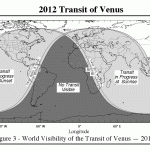
Visibility chart for the 2012 Venus transit, image credit: Fred Espenak/NASA
Some folks seem to think the crowd will be huge, a thousand people or more. I am not so certain, this does not have the general appeal of a total solar eclipse. The transit is something that will be of interest to amateur astronomers and some interested segments of the public. I personally expect hundreds of people coming to Mauna Kea to view the transit, not thousands.
However many folks do ascend the mountain for this event, we have begun putting plans in place to handle it. Various groups have met to do a bit of planning. Most significantly, those in charge of managing the mountain, The Office of Mauna Kea Management, are putting a few measures in place. As usual, expect to stop at the Mauna Kea Visitor Information Station on the day of the transit. But this day there will be a few differences…
- All available MKSS staff will be on duty. All of the Mauna Kea rangers and visitor station staff will be helping make sure assistance is available to visitors when traveling to the high altitude environment of the summit.
- Access to the mountain will be controlled for the day, a gate at the VIS allowing access for official vehicles only.
- A free shuttle will run from the VIS to the summit. The Mauna Kea tour companies providing the vehicles and drivers.
- Solar telescopes and video monitors will be set up at the VIS to allow safe viewing. Staff will be available to answer questions and assists with the equipment.
- Several other locations on the island will be setup for viewing the transit with solar telescopes and staff. Expect these to include ‘Imiloa, Keck HQ in Waimea, and some possible other locations.
All of these plans are somewhat preliminary, details may change as the date approaches and final arrangements are made. I will attempt to post what I know here on Darker View.
Myself? I plan to observe the event from the summit. Set up behind Keck with a solar telescope to photograph the transit. We plan to set up a live feed of the transit for use by other sites, and available to viewers across the internet.
iPhone Moon
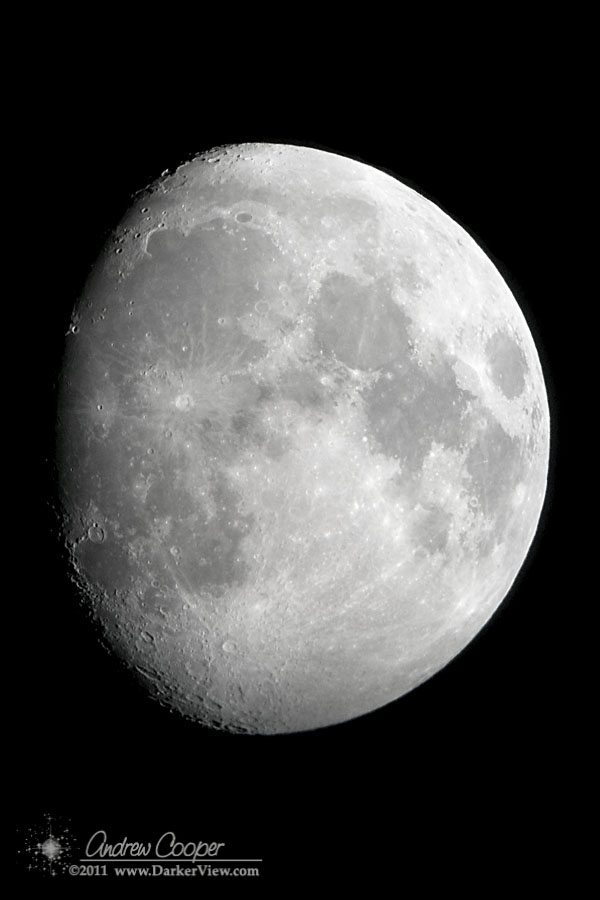
Despite numerous attempts, I had never managed a decent shot of the Moon using an iPhone. When showing people how to do afocal photography, I have leaned how to make just about any compact camera perform nicely, but routinely seen nothing but trouble with cell phone cameras.
Lunar photography is incredibly popular with folks using the telescope, a great activity for a night with a bright moon. Long ago I found that an inexpensive 20-25mm Plössl is a good match for the lens of most compact cameras. On a 1-2m focal length telescope this combination can produce very nice lunar photos. The setup does not work with cell phone cameras. Though people do try, the results have been routinely disappointing.
Working a resort star party recently, I discovered a combination of telescope and eyepieces that works very well. A C11 telescope, an f/6.3 focal reducer, and a 20mm Nagler type 2 eyepiece produced very nice photographs with several different cell phone cameras. The result was a very happy audience and a lot of great lunar photos. As people walked away from the telescope they were rapidly replaced by a crowd holding glowing screens, all wanting to get a nice lunar shot for themselves. I will have to explore other telescope/eyepiece combinations to find another solution that does not involve a $500 eyepiece.
Mercury Exits the Evening Sky
Mercury is ending it’s first evening apparition of 2012. Over the next few days the planet will slide into the sunset heading for inferior conjunction on March 21st and a morning apparition beginning at the end of March.
Venus and Jupiter
A reminder that tonight will see the two brightest planets in our sky just 3° apart. The two have been close for several days now, the closest approach will be this evening. The bright pairing will be visible as soon as the sky begins to darken, setting around 21:46HST. Venus will be the brighter of the pair at -4.3 magnitude, compared to Jupiter at -2.1 magnitude.
The Moon and Saturn
There will be a bright triangle in the sky tonight made up of the Moon, Saturn and Spica. All three will be within 10° of each other. The Moon will dominate the trio at over 87% illumination as it waxes towards full. Saturn will be shining at 0.4 magnitude while Spica is very close to 1.0 magnitude.
Martian Devil
A desolate rocky plain, red, cold, dry, a scene from an alien world. In the distance there is movement, a swirling dust devil slowly works its way across the plain.
To truly appreciate such an image takes you to another world, so similar, yet so different from our own. The world is Mars, the scene is real, captured by the HiRISE camera orbiting aboard the Mars Reconnaissance Orbiter. I never get tired of these sort of pictures…

Employment Opportunity at Keck – Temporary Electrical Engineer
W. M. Keck Observatory Position Announcement…
Temporary Electrical Engineer
This temporary position provides electronics and electrical engineering support to develop new observatory capabilities and for upgrades to our existing observatory infrastructure. This is a challenging fast-paced technical environment where teamwork and good interpersonal communication skills are essential.

Desired competencies include, but are not limited to: understanding of analog and digital electronics, data communications and computer interface electronics, industrial control systems experience including specific PLC competencies. The ideal candidate should be a motivated self-starter who can manage multiple projects and priorities within a fast paced environment.
Qualifications for this position include a Bachelor of Science in Electrical Engineering or equivalent; two years of work experience performing design and documentation, analysis, fabrication, test, and troubleshooting of electronics and electromechanical systems; engineering process and configuration management experience.
This position requires you to submit your resume on-line at: http://keckobservatory.iapplicants.com/ViewJob-282805.html with your cover letter that states why you are uniquely qualified for the position.
Additional information about WMKO and this position may be found on our website at www.keckobservatory.org EEO Employer
Geomagnetic Update
The CME from yesterday’s solar flare struck at about 01:00HST, not as strongly as predicted. Right now there is a geomagnetic storm going on, but only at a moderate intensity, Kp=5. It takes something with a Kp>10 before aurora become a likelihood at low latitudes. Expect some nice photos from the folks up north as they get to enjoy the show.
The sunspot responsible for the flare, AR1429, is still there, pointed directly at our Earth. It harbors the energy for more X class flares, stay tuned!