Category: Astronomy
Exploring the cosmos
Improved Rocker Box Pads
A small design detail in a dobsonian telescope is a method to restrain the mirror box in the center of the rocker box, to keep it from sliding side-to-side in the elevation bearings.
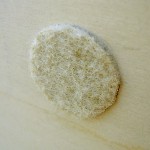
I have had trouble with these pads in Deep Violet. They do not stay put! Sometimes when inserting the heavy mirror box into the rocker I would catch a pad and simply shear it away from the wood. I ended up using a larger pad and using small wood screws to secure it instead of the adhesive.
Neptune at Superior Conjunction
Today will see Neptune pass through superior conjunction with the Sun at 09:53HST. The planet will reappear in the dawn during the first weeks of March.
A Line of Bright Planets in the Evening
A nice lineup of three bright planets will be forming in the sunset over the next couple weeks. There will be three bright planets, Mercury, Venus and Jupiter, and a faint planet in the lineup, Uranus. Together they will nicely outline the ecliptic in the evening sky.
Tonight you can see this lineup taking shape, looking low, just above the glare of the setting Sun you might pick out Mercury. It is only 10° from the sun this evening, but getting higher each day. High above, Venus and Jupiter can not be missed, Venus at about 40° elevation at sunset, with Jupiter even higher at 60° elevation. Venus shines much brighter than Jupiter at about -4.2 magnitude while Jupter is only -2.3 magnitude. Uranus is hiding about halfway between Mercury and Venus at a mere 5.9 magnitude.
Over the next two weeks Mercury will climb higher, reaching maximum elongation on March 5th. At the same time Jupiter and Venus will draw closer, having a separation of about 9° on the 5th. The pair will be closest on March 13th, at about 3° separation. As March slips by, Mercury will drop back into the Sun’s glare and Jupiter and Venus will separate once again. Still, the bright pair dominating the evening sky through much of the month.
While the lineup is still prominent, the Moon will swing through the alignment from February 22nd to the 27th. On February 22nd a 1.8% illuminated Moon will pair up with Mercury, just 6° away. On the 24th and 25th the Moon will sidle up to Venus, under 5° away on the 25th. On the 26th the Moon will be near Jupiter, with under 4° away and 25% illuminated.
One last dance of the alignment will occur on March 25th when a crescent Moon will join Jupiter and Venus. The planets will be about 10° apart with a 11% illuminated Moon in between them. A very nice trio indeed.
Late February and much of March will be a nice show for sky watchers. Make a point to get out and look!
Mercury in the Sunset
Mercury is beginning an evening apparition this week. Look directly above the sunset for a starlike object shining at -1.2 magnitude. The planet will be over 10° from the Sun today, rising a little further each day until maximum elongation on March 5th.
Keck in Motion Hits the Web
I expected the video to be popular, maybe not this popular. So far several major websites have picked up the video. First is was ScienceBlogs.de and Universe Today, then Phil at Bad Astronomy was nice enough to post the vid. Now it is Wired Magazine that has posted the video along with an article. I expect the video will pass 10k views sometime in the next hour.
For those readers that might be stopping by Darker View for the first time… Welcome!
A video like this takes a surprising amount of work to assemble. It is rewarding to see that the results of that effort are not in vain. Sharing my experience on the mountain, celebrating the efforts of the great guys of our summit daycrew, it is very satisfying to see that so many folks are interested in what we do.
If you like what you see, why not stick around, we have more to share!
Keck Lecture: Dr. Tom Soifer on The Invisible Universe
For those who were unable to attend the last Keck lecture or view the live webcast, you missed a pretty good discussion. Never fear! We have the recording, now ready for viewing.
Primero
Every astronomer has a first telescope, mine is a 6″ f/5.1 Newtonian I first built as a teenager. As life progressed I was forced to dismantle the telescope and it dwelt for a time as a pile of parts in a box. Eventually I had an opportunity to rebuild the telescope, but as both my technical capability and my financial means had increased I was able to do a substantially better job.
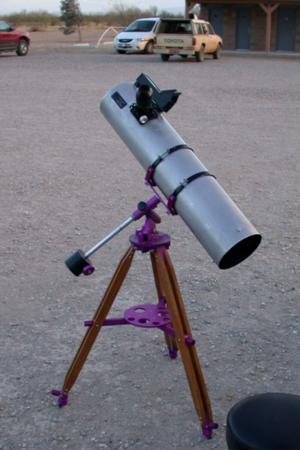
The optical design of the telescope is standard Newtonian with a f/5.1 primary mirror of 6.0 inches giving a focal length of 777mm. The mirror was hand ground when I was a teenager and thanks to expert help during figuring is an excellent mirror.
The RFT design is deliberate and has proven to be a good choice, particularly with modern eyepieces that perform so well in short focal length scopes. With a 35mm Tele-Vue Panoptic eyepiece the scope provides a 22x image with just over a three degree field.
Afocal Photography
When doing any sort of public astronomy, showing folks the beautiful sights available to a telescope, I often hear the question “Can I take a photo of that?” The person asking the question is usually holding the ubiquitous compact digital camera. They are often surprised when my answer is “Yes”.
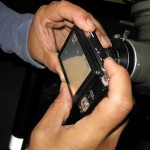
It is indeed possible to manage hand held shots of bright astronomical objects by simply holding the camera up to the eyepiece. There are a few tricks to making it work, but nothing that can not be demonstrated in a minute or two. The resulting photographs can be quite pleasing, definitely worth showing to friends and family along with the rest of the Hawai’i vacation shots.
The method of positioning a camera with a lens in front of an eyepiece is called afocal photography, or sometimes digiscoping. Afocal has been around for a while, but was not considered a practical photographic method by most. The advent of common digital cameras without removable lenses has changed this.
Continue reading “Afocal Photography”Postcard from the Summit – Daytime Shutters
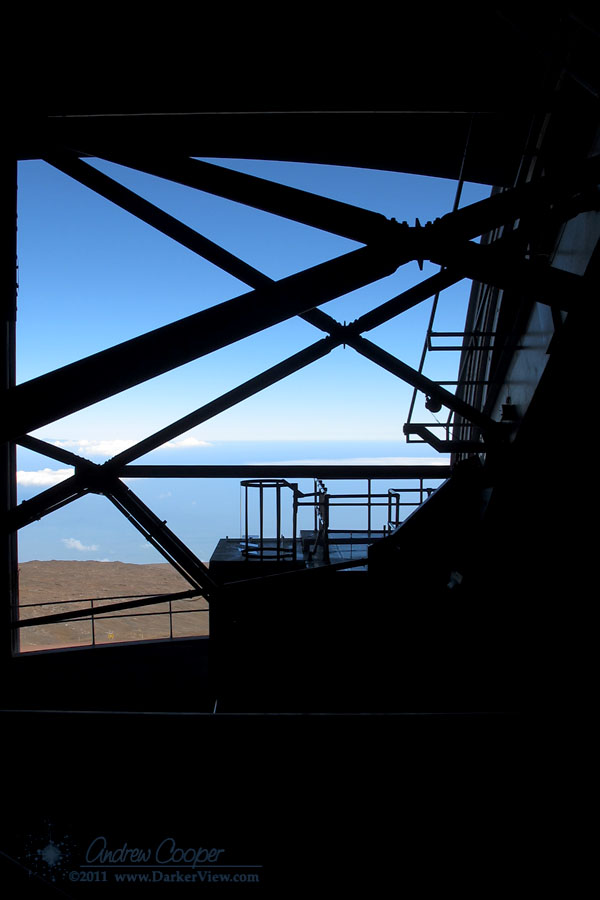
Normally we do not open the shutters during the day. As any kid who has used a magnifying glass in the sun knows, direct sunlight and optics are a powerful combination. The amount of sunlight a 10 meter mirror could gather would result in something a bit more powerful than a child’s toy.
Occasionally it is necessary to do maintenance on the shutters, in the process opening the shutters during the day. It is a careful operation, turning the dome away from the Sun and positioning the telescope away from the opening. Still, it is an odd situation, daylight streaming into the dome, a place normally only lit by starlight or the dome florescents. Then there is the view…