Postcard from the Universe – The Tarantula from Hawaiʻi

OK… It is a crappy astrophoto.

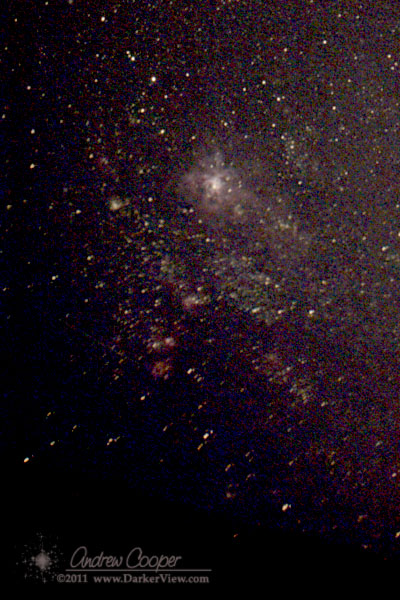
But it does prove one thing, you can see the Large Magellanic Cloud from Mauna Kea… Barely.

The photo was taken from the Mauna Kea VIS parking lot as the LMC rose above the slopes of Mauna Loa. As the object skirted the distant ridge line I shot a dozen frames with the 60D and the TV-76mm scope. The resulting photo is nothing to be proud of, I expected it to be pretty bad when I shot it. It was taken simply to prove the point.

Tarantula NGC2070

The Tarantula Nebula, NGC2070, rising above the slopes of Mauna Loa

Lasers and Aircraft

Those of us who use green lasers for astronomy outreach are always worried about law enforcement cracking down on these devices. As the lasers get cheaper and more available they inevitably get into the hands of those who do not use them responsibly. Worse, the lasers are easily available at power levels that are truly dangerous.

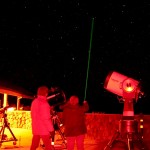
Laser and Stars
Deb pointing out the star βPhoenicis to VIS volunteer Joe McDonough
The problem has continued to escalate, each year there are more reported incidents of aircraft being illuminated by the laser of some idiot (yes, the correct term) who thinks it might be cool to tempt fate and the law. In 2010 there were 2836 incidents reported to the FAA, up from only a few hundred a few years before. With this sort of trend it seems inevitable there will be some sort of official reaction.

Illuminating an aircraft with a laser can be prosecuted under federal law. Not because there is any specific statute addressing lasers, but as it is deemed “Interference with a Crewmember” using an interpretation of a pre-existing 1961 federal law, specifically 14 CFR 91.11.

The FAA has put together a new webpage on lasers and aircraft safety. The page organizes and links some informative resources. This includes a couple reports on the possible effects of laser illumination on aircraft crew, as well as the legal and regulatory recommendations of the FAA. I urge anyone who uses these devices to follow the link and do a little reading.

Used responsibly these lasers are extraordinarily useful in astronomy education. Nothing grabs the crowd’s attention so quickly as that brilliant green beam. Everyone can follow along without confusion as objects are pointed to across the sky. From the constellations to the Milky Way, satellites, planets and zodiacal light, on to star clusters and galaxies, everyone knows right where to look. I do prefer lasers in the 20-30mW range, bright enough to be seen by a crowd, even under moonlight. Not powerful enough to easily injure in the case of a brief exposure to the beam.

Postcard from the Summit – Laser Panorama

Assembling panoramas properly is not a trivial exercise. I have been attempting to master a program called Hugin and may have achieved some modest level of competency with it. It is surprising complex, and extraordinary powerful. Even more impressive as it is free software. Properly mastered it allows correction of tip, tilt and yaw in the camera, lens distortion, even translation of the camera’s position in x,y, and z. The task is made even more complex if the scene changes during the sequence, which is inevitable during the fifteen minutes it takes to sweep a moonlit scene on the observatory roof with one minute exposures. The stars move, the telescopes move, while I try not to shiver uncontrollably in the bitter wind.

Laser Panorama
A moonlit panorama from the roof of Keck during a night of laser engineering

Keck and a Nobel Prize

We are celebrating a bit at Keck today. It is somewhat unusual for an astronomer to be awarded the Nobel Prize in Physics. Today it was announced that three astronomers will share the award for their work in cosmology. Saul Perlmutter, Brian Schmidt, and Adam Riess led a pair of teams that were investigating the expansion of the universe through observing type Ia supernovae. Saul Perlmutter led the Supernova Cosmology Project, while Brian Schmidt and Adam Riess led a separate group, the High-Z Supernova Search, performing nearly identical work.

Both teams discovered something disturbing in the data. The expansion of our universe appeared not to be slowing as astronomers expected, but actually accelerating. The result, had both teams scrambling to understand the data, checking and triple checking everything in an attempt to see where they had gone wrong in their analysis. When each team finally published they were glad to see that they were not alone, that another group had independently confirmed this unexpected discovery.

A couple decades later we have come to accept this result as further data has accumulated. We now understand that there is another element of the universe that had not been appreciated before. What the astronomers had found was the effects of something that had been hinted at in a number of physicists theories (including Einstein), something we now call Dark Energy.

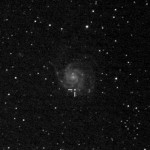
SN2011fe in M101
Type Ia supernova, SN2011fe, in the galaxy M101
The teams used a number of different telescopes in a coordinated effort to both discover and then obtian the spectral data on the supernovae. Smaller telescopes would be used to discover the supernovae, searching wide swaths of sky looking for these rare events. Then the team would use large telescopes, like Keck, to gather the spectral data of the supernovae. The spectra would confirm the event as a type Ia supernova and give the redshift.

The most critical data, the spectra of the furthest and faintest supernovae, were made possible by the Keck telescopes, then the largest in the world. It is these most distant objects where the effect of our universe’s accelerated expansion is most noticeable. Looking through the tables of data in the original scientific papers, the Keck Observatory is often credited.

It is somewhat unfortunate that only a few individuals are named with a Nobel Prize. The discovery of dark energy and the acceleration of the expansion was an effort made by teams of individuals. Both supernovae search teams and all the members deserve real recognition for this. In turn their efforts depended on the staffs of the observatories that made the observations possible. Big discoveries are rarely made by individual scientists, but by the cooperative effort of many. There are only three names on the Nobel Prize, but a lot of folks are celebrating today.

Shaken and Back On-Sky

I understand it was quite the scramble, but both telescopes are back on-sky tonight.

The earthquakes started just after two this afternoon with the magnitude 4.5 event that got our attention so quickly. This gave day crew three hours to have everything inspected, checked out and ready for the night. Physical inspections, instrument checkouts, and more, an extensive checklist to follow and insure that no real damage was done by the temblors. Just after 5pm we got word that everything was good-to-go and both telescopes would be released for the night’s observing.

As of writing this, about ten hours after the first quake, there have been 32 separate events under Mauna Kea detected by the seismographs. A half dozen of those were near magnitude three. I have felt thirteen separate aftershocks, this plus the original quake makes fourteen, the most I have ever felt in a single day by a wide margin.

The USGS has released a statement noting that this was probably a “structural adjustment” a result of the enormous weight of Mauna Kea stressing the underlying rock…

Magnitude 4.5 earthquake on the north flank of Mauna Kea

By USGS/HVO

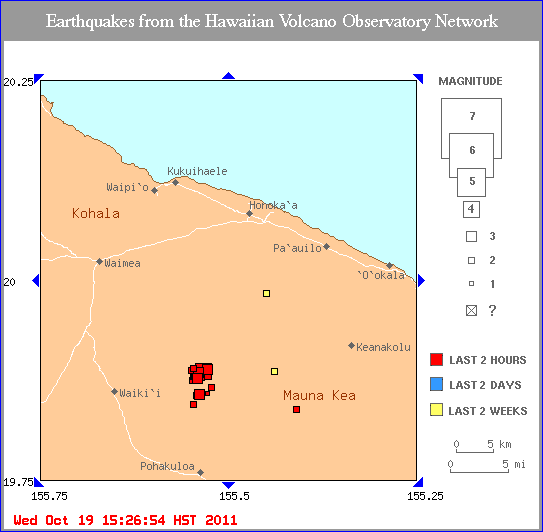
Hawai‘i Island, HAWAII—The U.S. Geological Survey’s Hawaiian Volcano Observatory (HVO) recorded a magnitude-4.5 earthquake located beneath the Island of Hawai‘i on Wednesday, October 19, at 2:10 p.m. HST. This earthquake was centered about 9 km (6 mi) northwest of Mauna Kea’s summit and 49 km (31 mi) west-northwest of Hilo, at a depth of 18.7 km (11.6 mi).

The earthquake was widely felt on the Island of Hawai’i. The USGS “Did you feel it?” Web site (http://earthquake.usgs.gov/eqcenter/dyfi/) received more than 500 felt reports within an hour of the earthquake.

The earthquake was the largest in a cluster of about 20 earthquakes on the north flank of Mauna Kea on Wednesday afternoon. Most of these aftershocks were too small to be felt, but, as of 3:30 p.m., two earthquakes with magnitudes greater than 3.0 had occurred in addition to the magnitude-4.5 event.

Over the past 25 years, the north flank of Mauna Kea has experienced 10 earthquakes greater than magnitude 4.0, including today’s event, at depths of 10–40 km (6–25 mi). Deep earthquakes in this region are most likely caused by structural adjustments within the Earth’s crust due to the heavy load of Mauna Kea.

Adjustments beneath Mauna Kea during past similar events, such as in March 2010, have produced a flurry of earthquakes, with many small aftershocks occurring for days after the main quake. Given this history, it is possible that additional small earthquakes may be recorded in the coming days.

Today’s earthquakes caused no detectable changes on the continuing eruption of Kilauea Volcano.

For eruption updates and information on recent earthquakes in Hawai’i, visit the Hawaiian Volcano Observatory website at http://hvo.wr.usgs.gov

More Shaking

This is starting to look ominous! Nineteen events so far and counting, it seems the building rattles every 10-20min with another aftershock. Will it please settle down?

Word is that Keck1 is fine, we are scheduled to do some engineering with the AO laser. The laser itself is still on and operational, a minor miracle. There may be some issues with Keck 2 after the initial quake. We are waiting for a more detailed report from the summit crew.

Earthquake Swarm
An ongoing earthquake swarm underneath Mauna Kea, 19Oct 2011

Titan before Rings

A world shrouded in hydrocarbon smog, where there are rivers and lakes collecting methane rain. Despite numerous flybys of the Cassini spacecraft and landing of Huygens probe on the surface, Titan remains a very mysterious world. A thick atmosphere and exotic chemistries create conditions that might even harbor some form of life.

Taken from this angle, the view looks toward the side of Titan that always faces away from Saturn. Keep in mind that Titan is 5,150 kilometers (3,200 miles across), much smaller than the Earth, but quite a bit larger than our Moon. The image was taken with the Cassini spacecraft narrow-angle camera on Aug. 9, 2011 using a spectral filter sensitive to wavelengths of near-infrared light centered at 938 nanometers. The view was acquired at a distance of approximately 1.4 million kilometers (870,000 miles) from Titan and at a Sun-Titan-spacecraft, or phase, angle of 35 degrees. Image scale is 8 kilometers (5 miles) per pixel.

Titan before Rings
Saturn’s large moon, Titan, with edge-on rings seen behind, image taken 9Aug2011, acquired by the Cassini narrow angle camera and a 938nm infrared filter, credit NASA/JPL-Caltech/Space Science Institute