Mercury Transit

About a dozen times a century Mercury passes in front of the Sun as seen from Earth. The event is observable with a modest telescope and a solar filter, Mercury can be seen as a small black dot crossing the surface of the Sun. If half of those happen when the sun is below your horizon the average person will have the chance to observe five or six in a lifetime. Since the next opportunity will not occur until May 9th, 2016 I didn’t want to miss this one!

Photographing a Mercury Transit
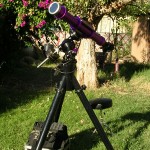
90mm refractor Violet Haze photographing the transit
I took the day off.

Considering that Mercury never gets very far from the Sun means that most of the time you can observe Mercury it is low on the horizon and is typically seen through a great deal of atmospheric distortion. A transit is one exception to this, during a transit mercury is a sharp disk, very different from the multicolor jello ball that is usually seen.

The 2006 Transit was well timed for observation across western North America, starting just after noontime and ending at 5:09pm MST. This put the Sun high in the sky for all but the last part of the event. Our weather cooperated as well, delivering a cloudless blue sky the entire day in place of the clouds that had been forecast. The air was reasonably steady as well allowing good photographic and observing conditions.

I took advantage of the weather and photographed almost the entire transit, all but the very end when the sun sank below the trees in my neighborhood. I used the Canon 20Da and setup a timer to shoot every 5min. The only issue was the inability to do a polar alignment on the mount when setting up in the middle of the day. The result was I had to manually guide the scope every 10-15 min to keep the sun centered.

I got plenty of good photographic material, enough for a few single photos as well as an animation of the transit. A transit is an impressive demonstration of the scale and arrangement of our solar system. Not hard to visualize the reality of those textbook drawings of planetary orbits after you have had such an opportunity to see the real thing.

No complaints on my second Mercury transit.

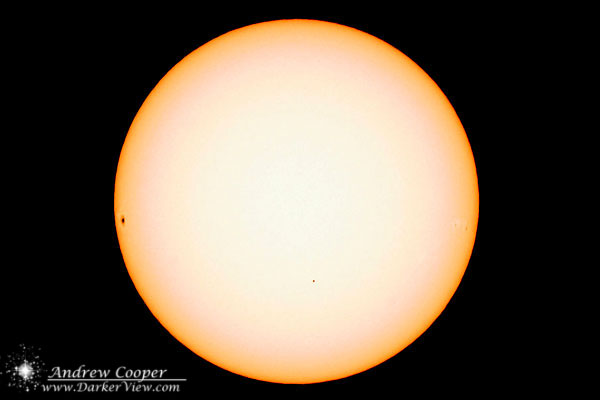
Mercury Transit 8Nov2006
The Mercury transit of 8 Nov 2006 in progress. Mercury is about halfway between the center to the bottom, a large sunspot complex is visible on the left edge. Photo with a 90mm APO refractor, a Thousand Oaks full aperture filter and a Canon 20Da camera.

DSLR Astrophotography

Digital SLR cameras make surprisingly good astrophotography cameras on bright objects. Good sensitivity, low noise and a convenient form factor make these camera a good choice for shooting the night sky.

One useful modification to the camera is removing the standard IR cutoff filter present in cameras and replacing it with a filter that is tuned to let in more of the red. The new filter should allow light at 656nm, what astronomers call hydrogen alpha, or Hα, the light emitted by neutral hydrogen atoms, the most common element in our universe. This is the red glow that makes the emission nebulae so colorful. An astrophotographer can do the filter change themselves, send it to a specialist who can do the work, or buy an already “modded” camera. Canon has produced two special models specifically for the astrophotography market, the EOS 20Da and 60Da, with this special filter.

Below, one can see the results of using modified, and unmodified cameras and relatively small telescopes…

2005 Sentinel-Schwaar Star Gaze

With the first cold weather of the year I planned a trip to Sentinel, one of our favorite winter observing sites. The site features dark skies and good company. The forecast was for clear skies, so Saturday afternoon I packed up my big dob and headed down the freeway.

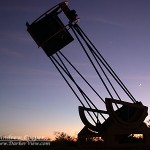
Dob Silhouette
Steve Dillinger’s 20″ Dob awaiting full dark at Sentinel, AZ with Venus and the Moon shining behind
The sky started a little rough, with high cirrus and contrails scarring the blue lit by the the glow of sunset. The thin crescent Moon and Venus were gorgeous among the bright gold wisps. Shortly after dark these annoyances quickly cleared leaving a clean sky. Seeing was soft all night, transparency was decent, but poor at low altitude as views into Fornax or lower demonstrated.

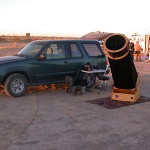
Violet Awaiting
The author’s setup awaiting a dark December sky with Deep Violet
I counted over 20 vehicles a little before sunset, but a least 10 more rolled in at sunset or just after. After a few hours there was a steady rate of departure as the cold night took its toll on Arizona observers.

I spent the first half of the night touring old friends and a couple new objects, but was basically killing time waiting for H400 objects to rise. After midnight the objects I had been waiting for had risen high enough to appreciate properly and I started to work, cleaning out Pyx, Lyn and Pup of a few remaining H400 objects as well as chewing on western UMa a little. It looks like I have 28 objects left, almost all in UMa, the end is in sight!

Around 0300 the breeze had become a steady cold biting wind and I finally packed it up and pulled out. I had already had around nine hours of good observing so I can call it a success. I wasn’t the last, there were at least two observers still going when I pulled out.

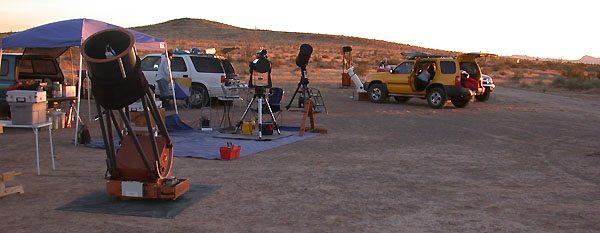
Telescope Line
The telescope line at Sentinel for the 2005 Sentinel-Schwaar Star Gaze

2005 All Arizona Messier Marathon

A Messier Marathon, one of the crazier ways we celebrate our love of the night sky. Try to find all 110 objects on Charles Messier’s catalog in a single night. It is possible, barely, to do this. It is a challenge of skill and perseverance, and a lot of fun. In 2005 I joined a group of friends at Arizona City at the 2005 All Arizona Messier Marathon. This site has hosted the most successful marathons anywhere, a great site and a large group of very skilled observers makes the competition tough.

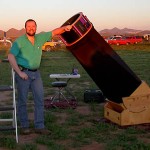
Ready to Marathon
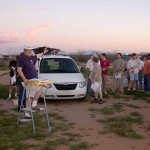
The author waiting for dark
My immediate competition was my young friend Carter Smith. Carter and I marathoned together, often racing on objects and comparing scores through the night. I had meant to quietly work on H400 galaxies in Virgo, but Carter sucked me into marathoning with him. Great night with good transparency and for once this winter and spring, NO clouds. Seeing was great at sunset with wonderful views of Saturn while we waited for full dark. The seeing deteriorated badly after dark with cool and warm breezes warring over the site. But transparency is what you want for a perfect marathon which is what we got.

Marathon Briefing
Briefing the attendees on the rules of our messier marathon
I managed to stay ahead of Carter most of the night using my 18″ while he was using a 10″. Actually parts of the marathon are much harder with a big scope, particularly the Virgo cluster where a big scope sees all of the dimmer galaxies and not just the M’s you want. I used the setting circles only to confirm objects a few times, so both of us ran this one manually. We ran on purist rules, Telrad and charts the only tools allowed to find the object! The All Arizona Messier Marathon allows setting circles and GOTO scopes, but we are free to make our own rules a little tougher.

Late in the night Carter found my weakness, the 18″ will not depress below 5 degrees elevation, so he could get objects coming over the horizon before I did, after that he was ahead most of the time. Except a few occasions when guile won out against youthful enthusiasm and young, sharp eyesight. In the end we both scored a 109, the best that was possible with M30 being impossible. We had to work on M74, M73 and M72 together to be sure, but the spottings were confirmed by both of us. All in all a great marathon!!!

Messier Marathon Mosiac
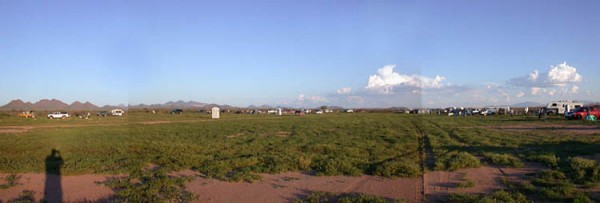
The observing field at the Farnsworth Ranch, with the Silverbell Mountains in the background and Kitt Peak just visible at far right. The field is unusually green after heavy spring rains. The clouds are rapidly departing to the east.