
On the evening of the 31st, a pretty crescent Moon will join this dance in the sunset, forming a triangle about 5° across. A 16% illuminated crescent moon with make a lovely trio with the bright planets.
When you want to see the stars, find someplace dark

Exploring the cosmos
On the evening of the 31st, a pretty crescent Moon will join this dance in the sunset, forming a triangle about 5° across. A 16% illuminated crescent moon with make a lovely trio with the bright planets.




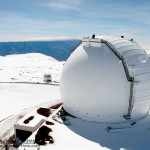





Over the years I have hand wired so many microcontroller PCB’s. Along with my own projects for myself there are more than a dozen of my little microcontroller devices at work about the observatory. The OSIRIS IR calibration source, the Keck 2 dome inclinometers, a precipitation sensor interface, the Keck 1 AO electronic vault temperature sensors, the weather mast fan and shelter controller, the list goes on. Anyplace a bit of electronic intelligence is needed for the task.
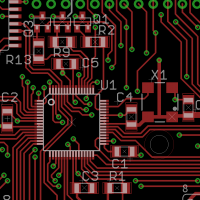
While a couple of my microcontroller designs have been laid out on proper circuit cards, like the SciMeasure camera exposure controllers, I have never laid out a general purpose microcontroller PCB. This is not for lack of thinking about it, so many times I have considered this could be so much easier if I could only invest a little time in a layout.
Today Mercury will be at maximum western elongation, as high in the morning sky as it will appear for this current apparition. After today the planet will slide back into the dawn, passing through superior conjunction on March 6th to reappear in the evening around the end of March.
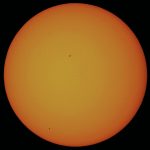
There are no transits of Mercury in 2017, the next will be Nov 11, 2019.


This February will feature a very close approach of Comet 45P/Honda–Mrkos–Pajdušáková. The comet will pass about 0.08AU (11.9 million km or 7.4 million miles) from Earth on February 11th, making it an easy telescopic object, and a marginal naked eye comet at around 6th magnitude.

The comet itself is rather interesting. Discovered in 1948 the comet has been a the frequent target of scientific observation as it may pass quite close to Earth. In 2011 it passed about 0.06AU from Earth and was the target of radar observations.
Currently in the evening sky the comet is sinking into the sunset rather rapidly. It will pass by the Sun around the end of January to appear in the morning sky. It will rise rapidly above the dawn, by February 5th it will be rising at 3:22am, about four hours before the Sun. On the day of close approach, February 11th, the comet will rise well before midnight in the northern sky.

Of course any comet getting this close to us will catch the attention of the doomsday preachers and assorted apocalyptic predictions. Comet 45P is already a bit of a YouTube celebrity with quite a few videos filled with dire predictions.
I predict that we will have a pretty comet in the new year’s sky to provide a nice target for telescopic observations and astrophotographers. I would suggest making a point to get out and observe this comet as it passes by.
Today Venus is at maximum elongation, as high in the sunset sky as it will get for this evening apparition, about 47.1°. After today the planet will begin its slide back into the glare of sunset. It will disappear from view around mid-March and reach inferior conjunction on March 25th, 2017.
As Earth and Venus race about the Sun, Venus will complete about one cycle of appearances each year. We can expect one evening apparition and one morning apparition to occur in 2017.