Observing at Kaʻohe

A dark night under the stars! It has been too long… Why not?

Obsession at Kaʻohe
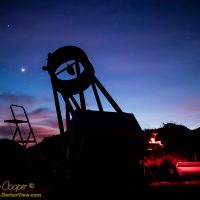
The 20″ Obsession telescope awaiting full dark at Kaʻohe, on the side of Mauna Kea

After all the work restoring the 20″ Obsession it was time to get it out under the stars for a decent observing run. During the many hours of work I had looked forward to simply using this telescope for a bit. While it would eventually be stored at the observatory and used for outreach, it seemed a shame not to spend a night or two under the stars with this instrument. Not like I need a 20″ telescope, my 18″ is just fine, but I loaded it up just the same, leaving Deep Violet in the garage.

Obsession at Kaʻohe
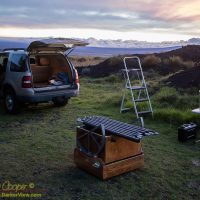
The 20″ Obsession telescope being set up at Kaʻohe, on the side of Mauna Kea

My favorite close by site is KaʻOhe, taking only a twenty minute drive from home to reach. At 5,700 feet on the side of Mauna Kea nearby home does not mean second rate. I really like this spot, the view is spectacular with the coastline below and the Mauna Loa and Hualālai volcanoes dominating the horizon. The entire southern horizon is unobstructed, allowing observations of southern objects right down to the horizon.

Better yet, recent rains meant green grass and a spot near the road maintenance gravel pile was hard packed rock, no dust! The area had even been mown recently! I sometimes have a few uncharitable words to describe DLNR, but not this evening.

Continue reading “Observing at Kaʻohe”

‘Heartbeat Stars’ Unlocked in New Study

NASA press release

Heartbeat Star
The overlaid curve in depicts the inferred cyclic change in velocities in one such system, called KIC 9965691, looking something like the graph of an electrocardiogram. Credits: NASA/JPL-Caltech
Matters of the heart can be puzzling and mysterious — so too with unusual astronomical objects called heartbeat stars.

Heartbeat stars, discovered in large numbers by NASA’s Kepler space telescope, are binary stars (systems of two stars orbiting each other) that got their name because if you were to map out their brightness over time, the result would look like an electrocardiogram, a graph of the electrical activity of the heart. Scientists are interested in them because they are binary systems in elongated elliptical orbits. This makes them natural laboratories for studying the gravitational effects of stars on each other.

In a heartbeat star system, the distance between the two stars varies drastically as they orbit each other. Heartbeat stars can get as close as a few stellar radii to each other, and as far as 10 times that distance during the course of one orbit.

Continue reading “‘Heartbeat Stars’ Unlocked in New Study”

Long-term, hi-res tracking of eruptions on Jupiter’s moon Io

UC Berkeley press release

NIRC2 image of Io
A NIRC2 image of Jupiter’s Moon Io
Jupiter’s moon Io continues to be the most volcanically active body in the solar system, as documented by the longest series of frequent, high-resolution observations of the moon’s thermal emission ever obtained.

Using near-infrared adaptive optics on two of the world’s largest telescopes — the 10-meter Keck II and the 8-meter Gemini North, both located near the summit of the dormant volcano Maunakea in Hawaii — UC Berkeley astronomers tracked 48 volcanic hot spots on the surface over a period of 29 months from August 2013 through the end of 2015.

“On a given night, we may see half a dozen or more different hot spots,” said Katherine de Kleer, a UC Berkeley graduate student who led the observations. “Of Io’s hundreds of active volcanoes, we have been able to track the 50 that were the most powerful over the past few years.”

Continue reading “Long-term, hi-res tracking of eruptions on Jupiter’s moon Io”

Broken, Now Fixed

It is always a good day when I drive up the mountain to a broken telescope, then drive down leaving a working telescope. Easy to say, not always easy to accomplish, the simple statement obscuring a day of struggle to solve the problem and fix it.

Smoked Relay
A relay with a blown out coil from the Keck 2 telescope drive
Such a day was Monday.

The Keck 2 telescope drive is a complex beast of dozens of relays, miles of cabling, servo amplifiers and power supplies, plus several circuit boards designed and built in the 1980’s holding a bewildering array of arcane logic.

Continue reading “Broken, Now Fixed”

A Dusting of Snow

While most states have yet to see any snow this winter, Hawaiʻi is not one of them. A light dusting of snow graced the summit of Mauna Kea this morning.

Interestingly recent forecasts have revisited the possibility of a La Niña event forming in the central Pacific this fall. If this does come to pass Hawaiʻi may be looking at a wetter than usual winter with the potential of significant snowfall on Mauna Kea. While this can wreak havoc with observatory operations, it can also be quite pretty.

Mauna Kea Summit Snow
A light dusting of snow on the summit of Mauna Kea on the morning of October 18, 2016
Subaru in the Snow
A light dusting of snow on the summit of Mauna Kea on the morning of October 18, 2016

Restoring an Obsession

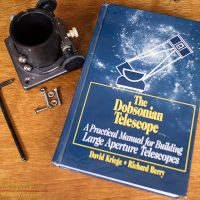
Obsession Telescopes are something of a standard in the astronomy community. David Kriege was one of the first to start building truss tube dobsonian telescopes commercially, bringing portable large aperture telescopes to the astronomy community. These telescopes were a bit of a revolution in the pursuit, with sizes unreachable only a decade before, when a 10″ or 12″ telescope was considered big. When I built my 18″ it is David Kriege’s book I used for much of the design, following in the footsteps of so many amateur astronomers.

20" f/4 Obsession Telescope
The restored 20″ Obsession telescope set up at hale Pohaku on the side of Mauna Kea

A 20″ f/4 Obsession donated to the observatory has presented a challenge and an opportunity. The telescope was the prized possession of Bob Michael having been ordered new directly from Obsession. The telescope is serial number 004 with a manufacturing date of June 1st, 1990. As David started Obsession Telescope in 1989, this is a very early example of his work. For many years Bob and his wife used this telescope to observe, completing the Herschel 400 and other observing projects. Unfortunately he was forced to give up astronomy due to age and glaucoma, donating his equipment to the observatory.

Continue reading “Restoring an Obsession”