Summer Solstice

Summer solstice occurs today at 12:34HST. Today the Sun will occupy the most northerly position in the sky of the year. The term solstice comes from the latin terms Sol (the Sun) and sistere (to stand still). On this day the Sun seems to stand still as it stops moving northwards each day and begins move to the south. This is the first day of summer as marked by many cultures in the northern hemisphere. Alternately this is the first day of winter for those living south of the equator.

2016 Solstices and Equinoxes
  UT HST
Perihelion Jan 2 22:49UT Jan 2 12:49HST
Vernal Equinox Mar 20 04:30UT Mar 19 18:30HST
Summer Solstice Jun 20 22:34UT Jun 20 12:34HST
Apehelion Jul 4 16:24UT Jul 4 06:24HST
Autumnal Equinox Sep 22 14:21UT Sep 22 04:21HST
Winter Solstice Dec 21 10:44UT Dec 21 00:44HST
 
Source: USNO data Services


Warp3

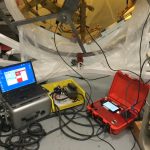
I have previously covered the importance of warping, tuning the Keck primary mirror segments for optimum optical performance. Warping has been my responsibility for some years now. Reading out the settings of the thirty strain gauges on the back of each segment is performed by a test fixture, a computer and a sensitive data acquisition system. Over the last year I have designed, built, and programmed a new test fixture.

Keck mirror segment warping fixtures
The old and new warping fixtures being tested side-by-side on a spare segment
The old warping fixture was showing its age. Built in 2000 it has been in use for 16 years. It is the computer that I was most worried about, it has begun to crash randomly, usually at the worst possible time. Replacing the computer has some issues as well, the A/D system uses a parallel interface, something not found on any modern computer. The operating system is Windows XP, while unsupported, at least you can still install and use this old operating system. The software is in an ancient version of LabView. I have no love for LabView, too many bad experiences with it, it crashes too often and the licensing issues are horrible.

As this is the third generation warping test fixture the name of the software is obvious… Warp3

Continue reading “Warp3”

Faintest Early-Universe Galaxy Ever, Detected and Confirmed

W. M. Keck Observatory press release

An international team of scientists has detected and confirmed the faintest early-Universe galaxy ever using the W. M. Keck Observatory on the summit on Maunakea, Hawaii. In addition to using the world’s most powerful telescope, the team relied on gravitational lensing to see the incredibly faint object born just after the Big Bang. The results are being published in The Astrophysical Journal Letters today.

MACS2129.4-0741
Color image of the cluster taken with Hubble Space Telescope (images in three different filters were combined to make an RGB image). Credit: Bradac/HST/W. M. Keck Observatory
The team detected the galaxy as it was 13 billion years ago, or when the Universe was a toddler on a cosmic time scale.

The detection was made using the DEIMOS instrument fitted on the ten-meter Keck II telescope, and was made possible through a phenomenon predicted by Einstein in which an object is magnified by the gravity of another object that is between it and the viewer. In this case, the detected galaxy was behind the galaxy cluster MACS2129.4-0741, which is massive enough to create three different images of the object.

“Keck Observatory’s telescopes are simply the best in the world for this work,” said Marusa Bradac, a proefssor at University of California, Davis who led the team. “Their power, paired with the gravitational force of a massive cluster of galaxies, allows us to truly see where no human has seen before.”

Continue reading “Faintest Early-Universe Galaxy Ever, Detected and Confirmed”