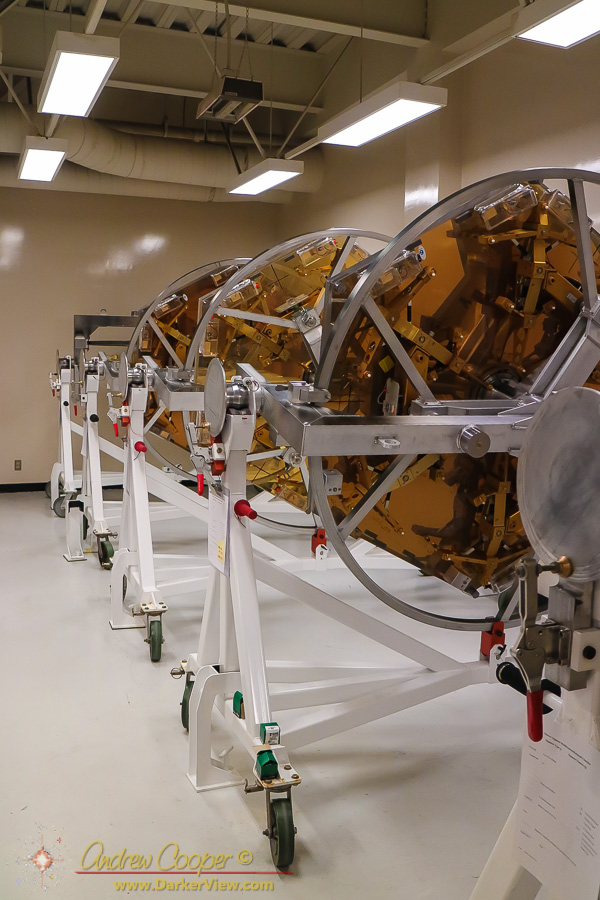
Segment Storage
When you want to see the stars, find someplace dark

Exploring the cosmos
Today marks the beginning of winter. While snow and ice can appear on the summit of Mauna Kea any time during the year, the most severe weather usually occurs during winter storms. We all look forward to the beautiful sight of Mauna Kea with her white coat. Of course this comes at a price, days of difficult access to the summit facilities, or no access at all. The loss of observing nights due to ice and clouds is most common from January to March.

Winter solstice occurs today at 18:48HST. Today the Sun will occupy the most southerly position in the sky of the year. The term solstice comes from the Latin terms Sol (the Sun) and sistere (to stand still). On this day the Sun seems to stand still as it stops moving southwards each day and begins move to the north. This is the first day of winter as marked by many cultures in the northern hemisphere. Alternately, this is the first day of summer for those folks in the southern hemisphere.
| 2015 Solstices and Equinoxes | ||||
|---|---|---|---|---|
| UT | HST | |||
| Perihelion | Jan 4 | 08:59UT | Jan 3 | 22:59HST |
| Vernal Equinox | Mar 20 | 22:45UT | Mar 20 | 12:45HST |
| Summer Solstice | Jun 21 | 16:38UT | Jun 21 | 06:38HST |
| Apehelion | Jul 6 | 12:59UT | Jul 6 | 02:59HST |
| Autumnal Equinox | Sep 23 | 08:20UT | Sep 22 | 22:20HST |
| Winter Solstice | Dec 22 | 04:48UT | Dec 21 | 18:48HST |
| Source: NASA Sky Calendar | ||||
Looks like freezing fog and snow left a bit of ice on the summit last night…


When your Celestron GPS telescope will not get GPS fix for a long time, or the GPS will not work at all, it is time to replace the battery on the GPS receiver board. Another symtom is when the telescope may get a fix, but it is incorrect, the time or location no where close.
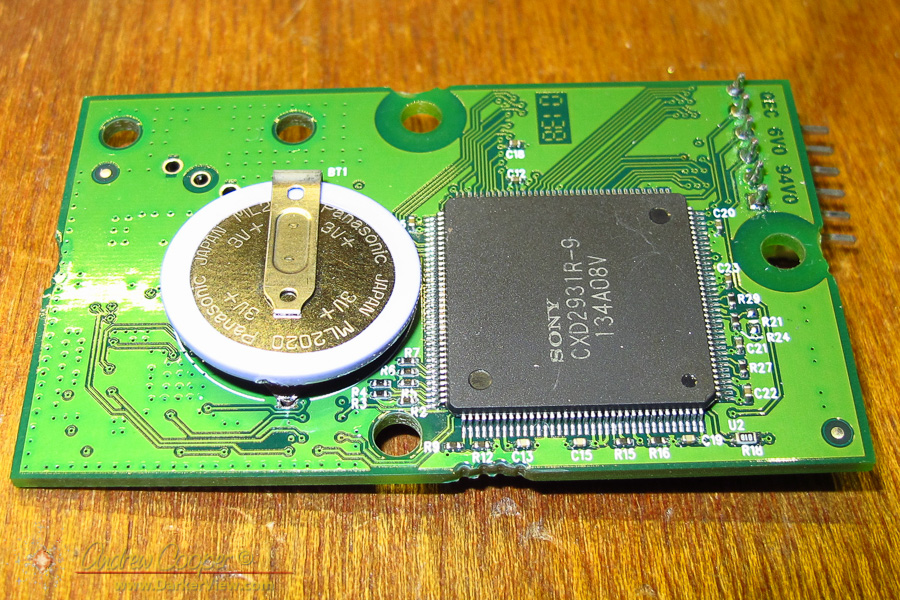
The GPS board is found in the main section on the oldest telescopes, but located in the arm in later ‘scopes. Our is located in the arm, a small circuit card just under the inside plastic panel connected to an antenna by a cable. Simply remove the four screws holding the plastic panel and you have access. The antenna cable can be disconnected with some gentle tugging, two screws for the board, one more connector and the board comes out. The battery is found hidden on the underside of the PCB.
Continue reading “Replacing the Celestron NextStar GPS Battery”
In Arizona, during the heat of summer we would head for the mountains. We knew dozens of fire roads and meadows where a telescope could be set up under the stars among the cool forest pines. When the weather chilled, we headed to the low desert, our favorite site was Sentinel, Arizona. A desolate volcanic field just off Interstate 8 between Gila Bend and Yuma. It was still cool at night, a beautiful place to enjoy the desert skies…

W. M. Keck Observatory press release…
A team of Australian researchers used two Maunakea-based observatories – Gemini North and W. M. Keck Observatory – to discover why some galaxies are clumpy rather than spiral in shape and it appears that low spin is to blame. The finding challenges an earlier theory that high levels of gas cause clumpy galaxies, and sheds light on the conditions that brought about the birth of most of the stars in the Universe. The finding was published today in The Astrophysical Journal.

A combination of integral field spectroscopy data from Keck Observatory and Gemini Observatory was the key to obtaining measurements for a galaxy’s spin. Keck Observatory’s OSIRIS instrument collected data high spatial resolution in the galaxy centers, and the Gemini Multi-Object Spectrograph (GMOS) collected data for high surface brightness sensitivity out to large radii.
Lead author Dr. Danail Obreschkow, from The University of Western Australia (UWA) node of the International Centre for Radio Astronomy Research (ICRAR), said that ten billion years ago the Universe was full of clumpy galaxies, but these developed into more regular objects as they evolved; the majority of stars in the sky today, including our five billion-year-old Sun, were probably born inside these clumpy galaxies.
Continue reading “Mauna Kea Observatories Put New Spin on Galaxy Formation”
A reminder that tonight is the peak of the Geminid meteor shower. Meteors will begin to appear around 8pm when the constellation Gemini and the radiant rises. The peak occurs at 8am on the 14th, favoring the early morning hours. As the Geminid meteors have a broad peak activity can be expected to be good all night long.
Ceres reveals some of its well-kept secrets in two new studies in the journal Nature, thanks to data from NASA’s Dawn spacecraft. They include highly anticipated insights about mysterious bright features found all over the dwarf planet’s surface.

Credit: NASA/JPL
Ceres has more than 130 bright areas, and most of them are associated with impact craters. Study authors, led by Andreas Nathues at Max Planck Institute for Solar System Research, Göttingen, Germany, write that the bright material is consistent with a type of magnesium sulfate called hexahydrite. A different type of magnesium sulfate is familiar on Earth as Epsom salt.
Nathues and colleagues, using images from Dawn’s framing camera, suggest that these salt-rich areas were left behind when water-ice sublimated in the past. Impacts from asteroids would have unearthed the mixture of ice and salt, they say.
“The global nature of Ceres’ bright spots suggests that this world has a subsurface layer that contains briny water-ice,” Nathues said.
The surface of Ceres, whose average diameter is 584 miles (940 kilometers), is generally dark — similar in brightness to fresh asphalt — study authors wrote. The bright patches that pepper the surface represent a large range of brightness, with the brightest areas reflecting about 50 percent of sunlight shining on the area. But there has not been unambiguous detection of water ice on Ceres; higher-resolution data are needed to settle this question.
Continue reading “New Clues to Ceres’ Bright Spots and Origins”